Eureka Self-Guiding Tour
The Eureka, Nevada Historical Society designated a number of sites in the town and surrounding area to be included in a self guiding tour. Please scroll down this page to see photos and descriptions of these sites. Numbers have changed a few times over the years and some of the structures are no longer in existence.
Eureka is not a ghost town. These sites are privately owned and most are still in use. Please do not trespass on or in any land or building that is not open for business. Please treat all sites with respect. This tour is undertaken at your own risk. Some old buildings are unsafe. No attempt has been made to change Eureka. It is absolutely authentic as it stands. To change this town would be to destroy a very rare and wonderful piece of Nevada's heritage. We would like to keep Eureka just as it is, and with your help, we can. Note the numbers on the buildings and sites correspond to the following historical descriptions. Current ownership and occupancy changes without notice, so inquire locally for details.
Mining is still a strong industry in Eureka. The Ruby Hill Mine is in operation adjacent to the town on the west.
Eureka is not a ghost town. These sites are privately owned and most are still in use. Please do not trespass on or in any land or building that is not open for business. Please treat all sites with respect. This tour is undertaken at your own risk. Some old buildings are unsafe. No attempt has been made to change Eureka. It is absolutely authentic as it stands. To change this town would be to destroy a very rare and wonderful piece of Nevada's heritage. We would like to keep Eureka just as it is, and with your help, we can. Note the numbers on the buildings and sites correspond to the following historical descriptions. Current ownership and occupancy changes without notice, so inquire locally for details.
Mining is still a strong industry in Eureka. The Ruby Hill Mine is in operation adjacent to the town on the west.
|

|
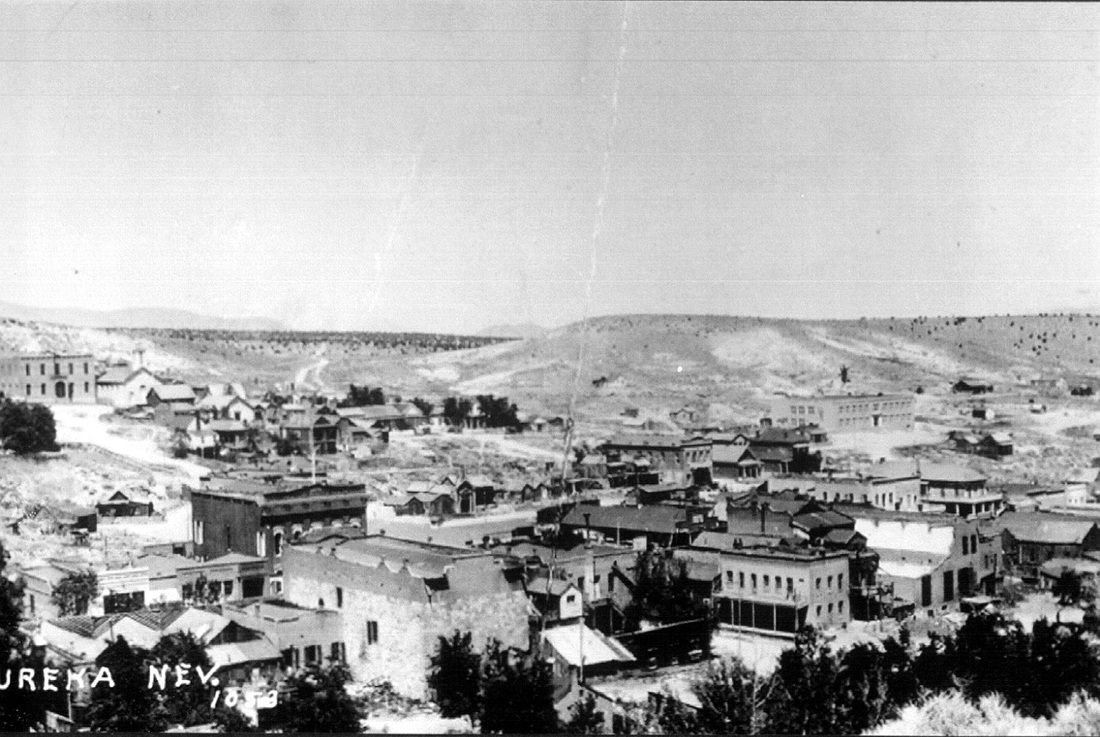
Vintage photos of Eureka - click for larger views.
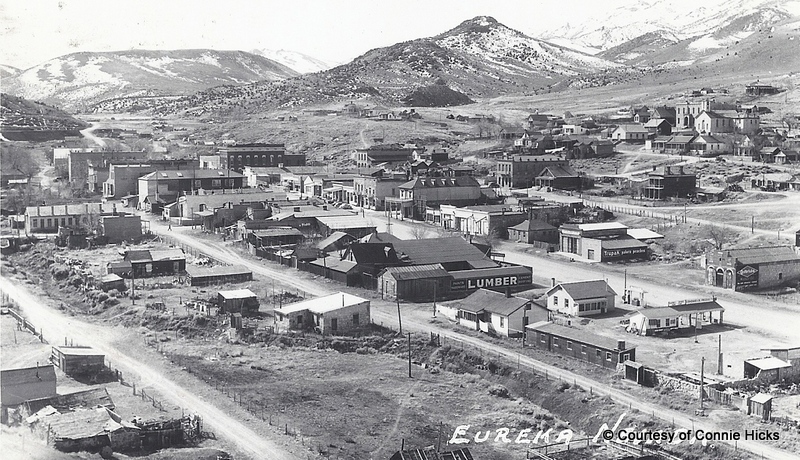
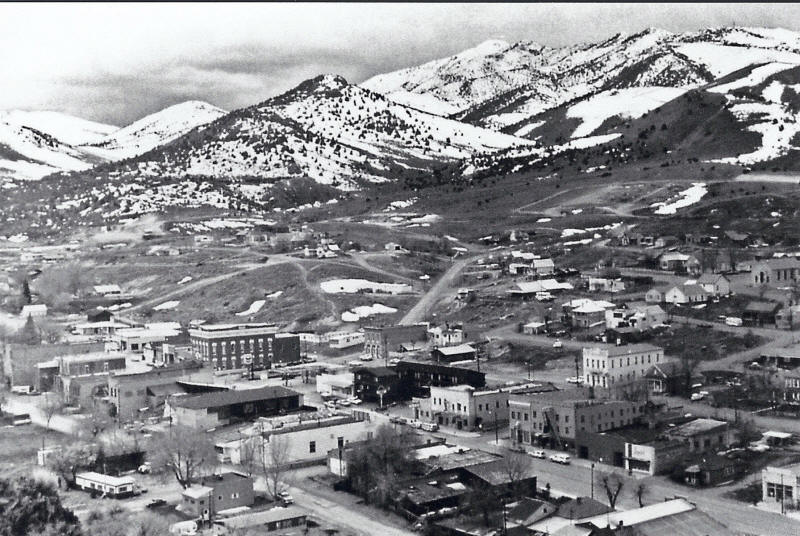
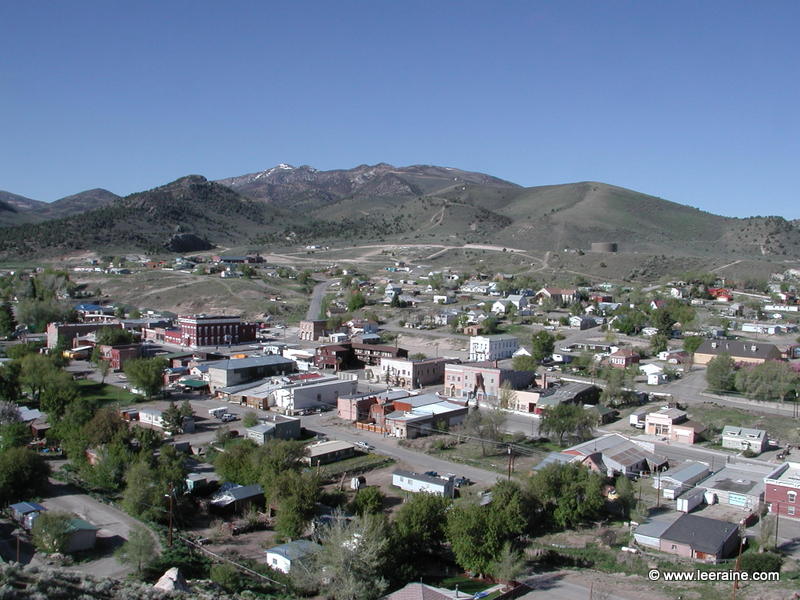
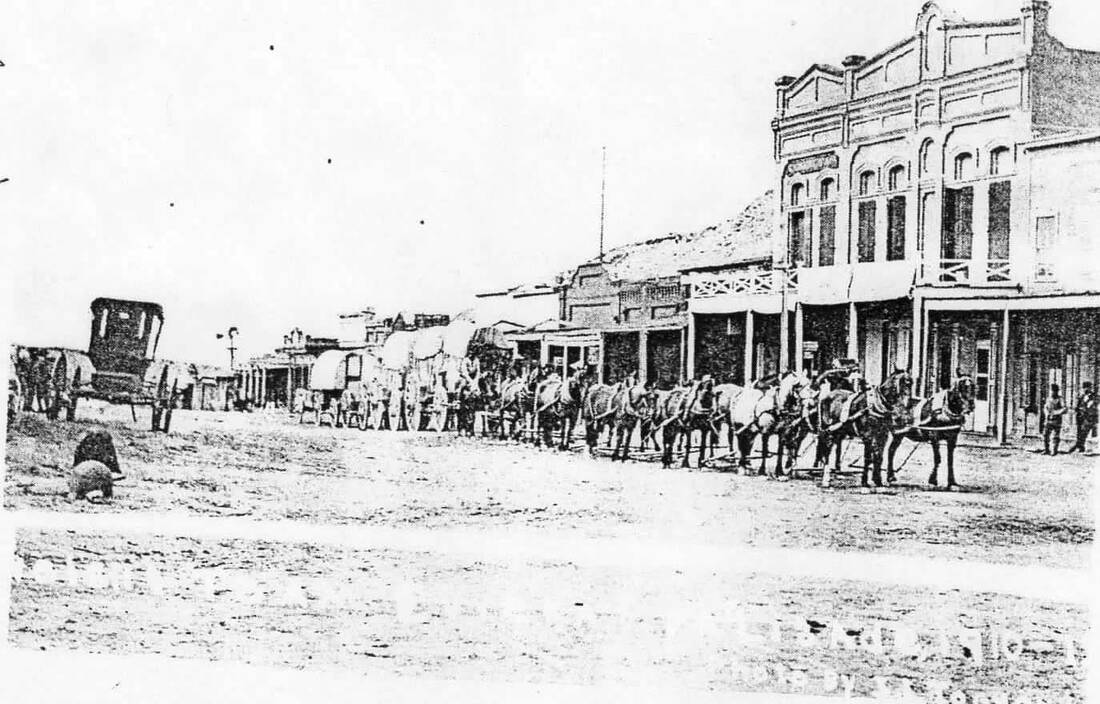
Downtown Eureka in 1870s
|
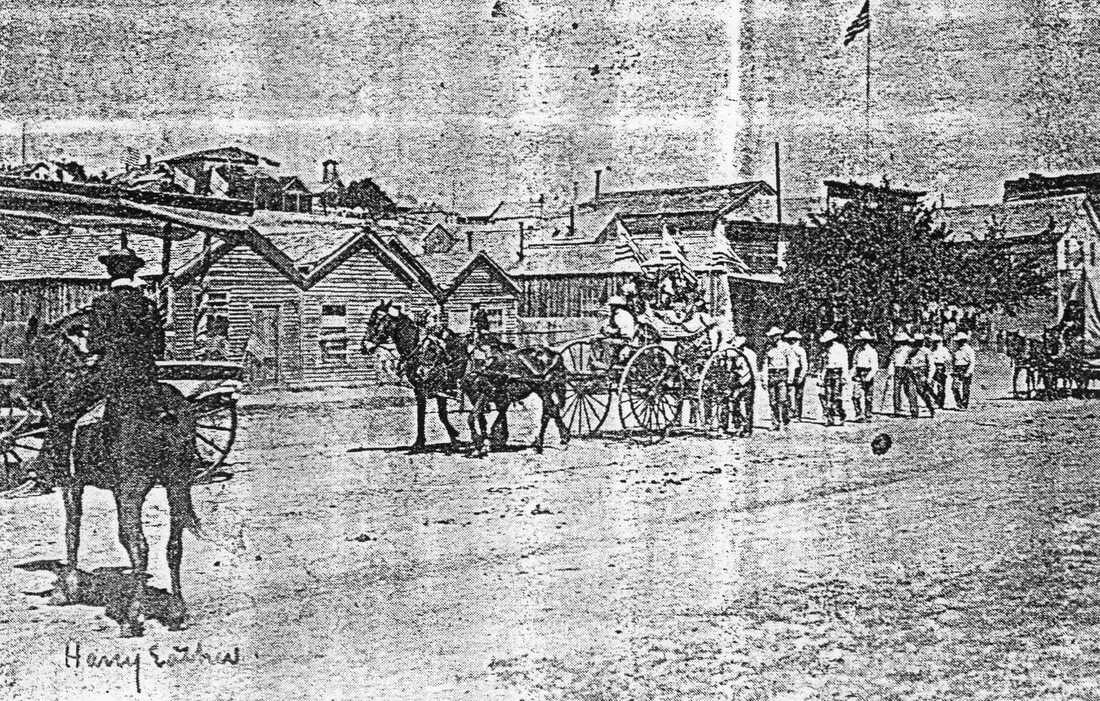
Downtown Eureka in 1870s
|
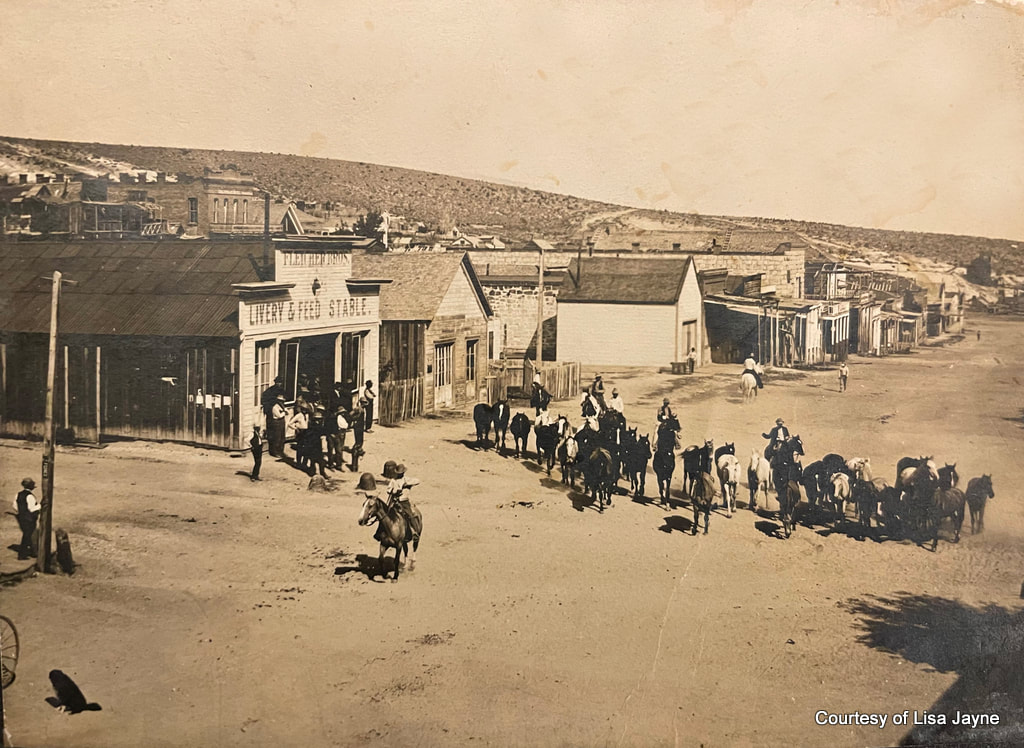
Downtown Eureka 1890s-
Note that the Fletcher Bros Livery is where today's Standard Station is.
|
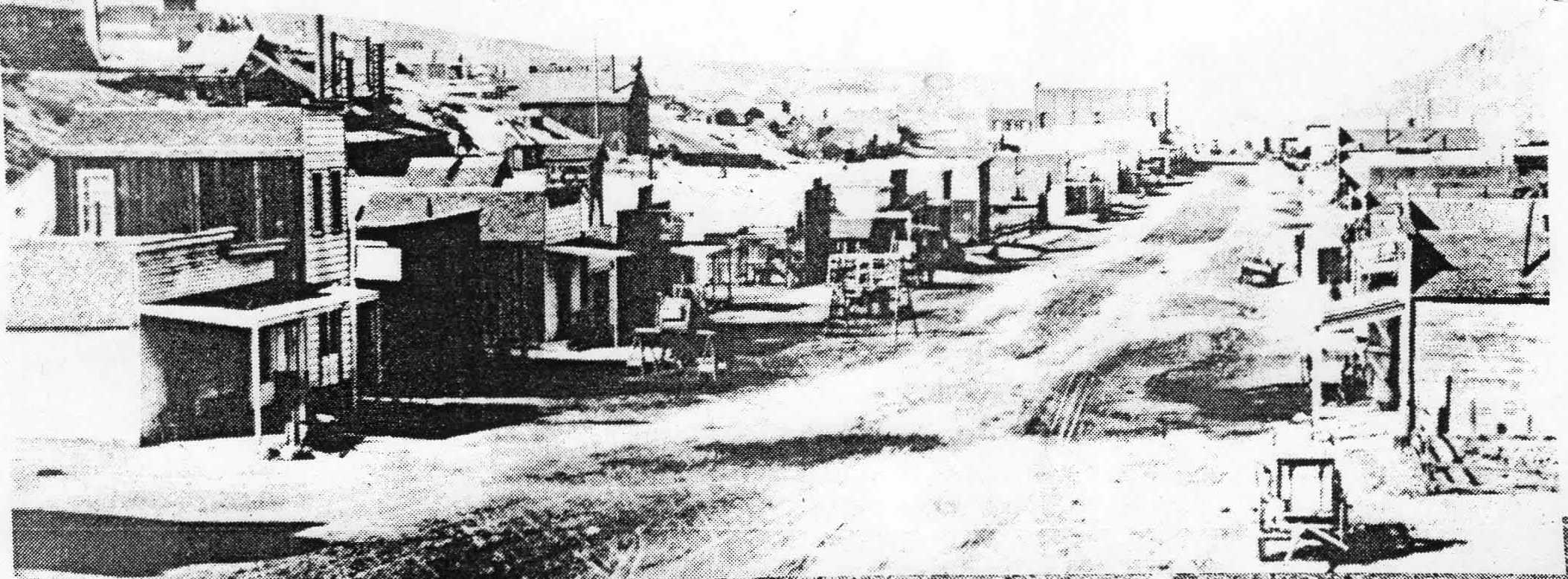
Downtown Eureka in 1870s
|
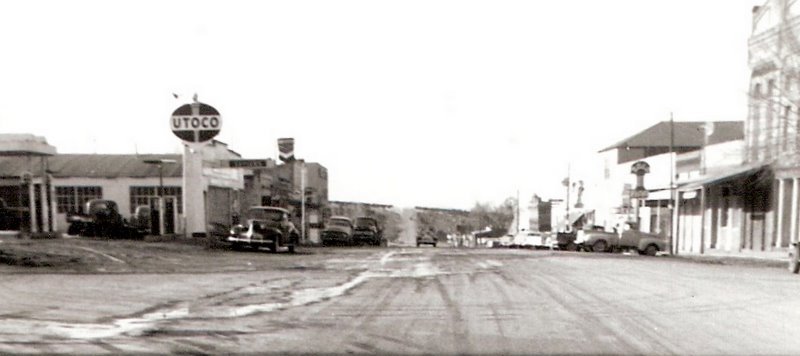
Eureka Main Street, facing north, in the 1950s.
|
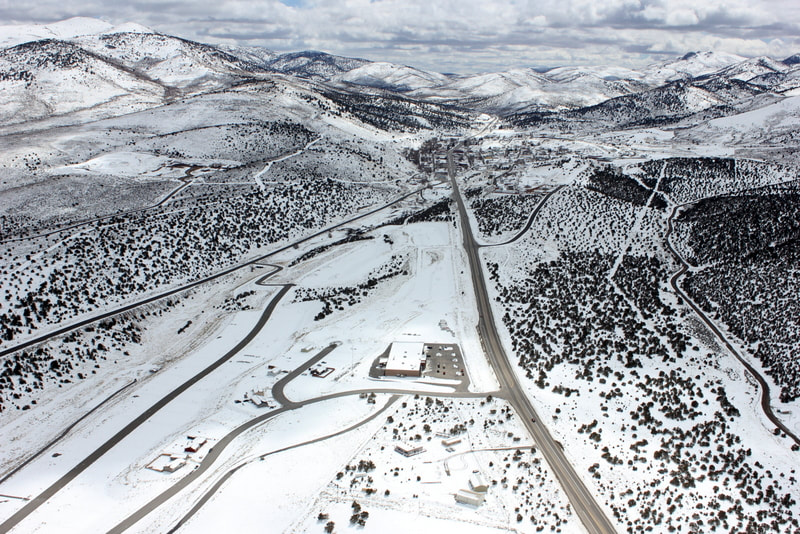
Aerial view of Eureka facing south 2018
|
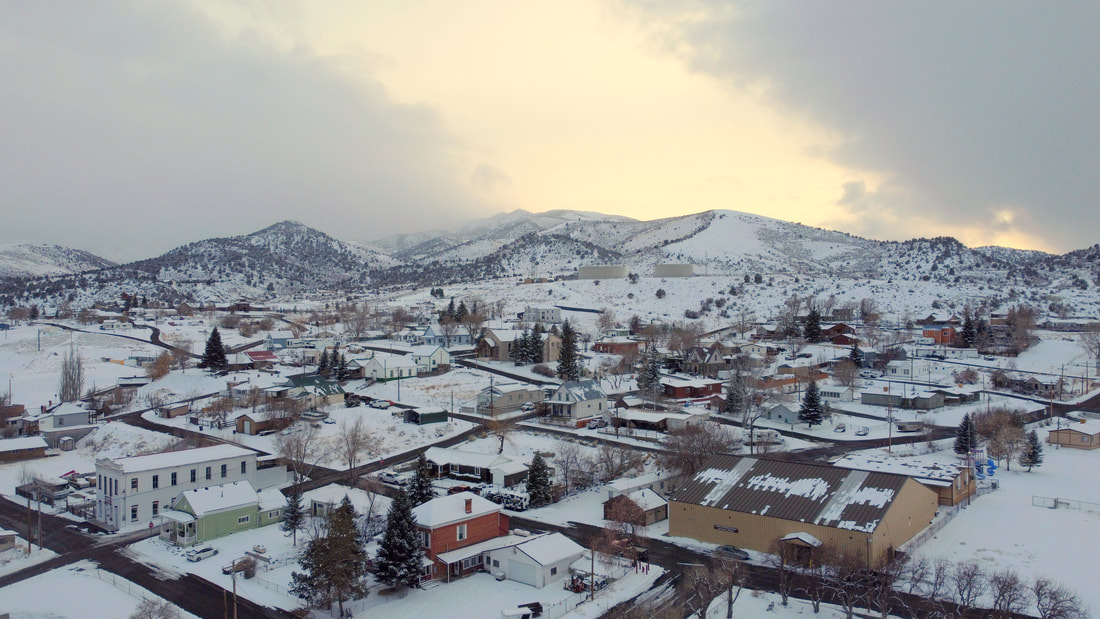
Winter 2021
|
Eureka Overflight Video
|
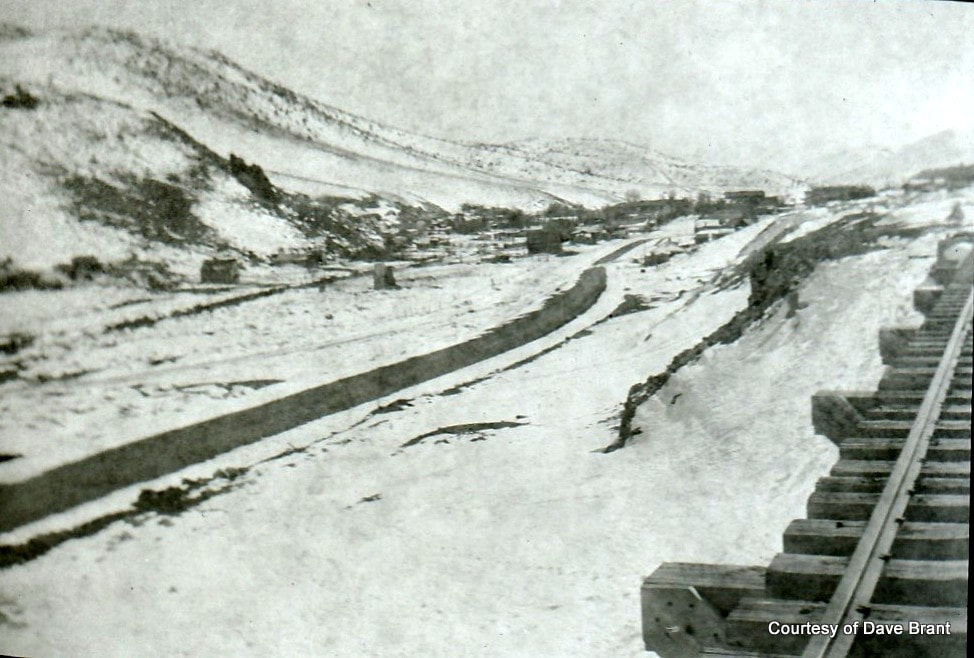
Eureka Historic District (Eureka, Nevada), a historic district in Eureka, Nevada, United States, that is listed on the National Register of Historic Places. (The district essentially consists of the entire community of Eureka.)
Link to the National Registry nomination form with an erudite summary of Eureka history by Marsha Elliot.
Link to the National Registry nomination form with an erudite summary of Eureka history by Marsha Elliot.
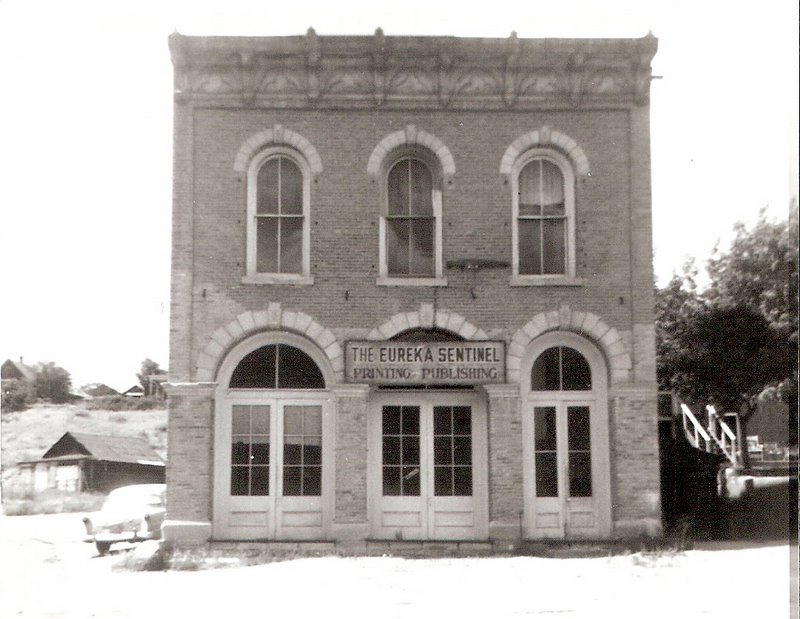
Eureka Sentinel Newspaper office in the 1950s.
|
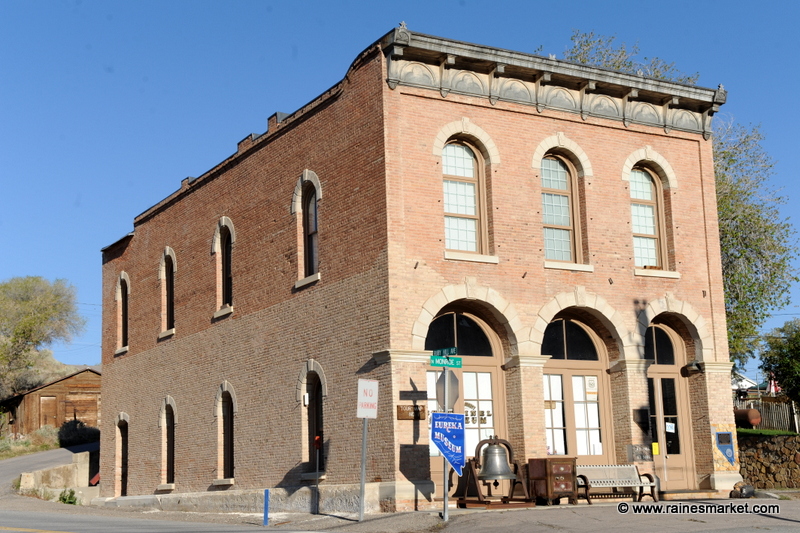
#1 Sentinel Museum
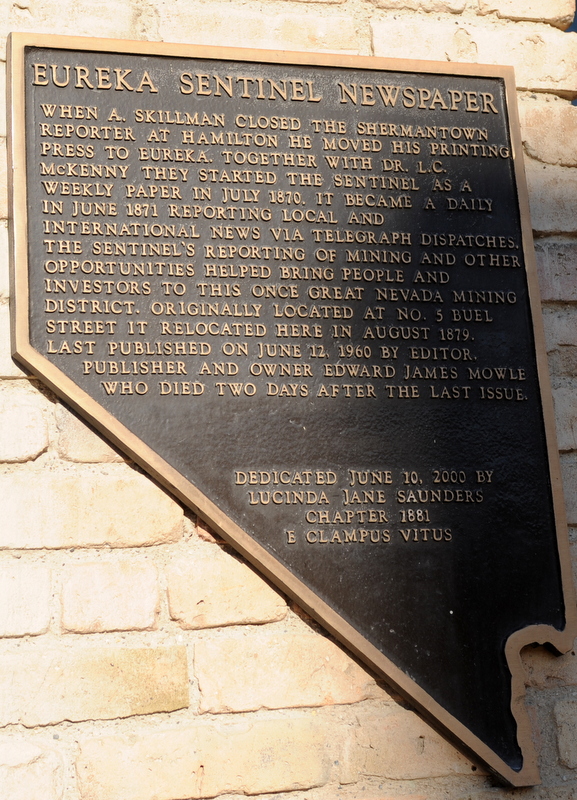
The Eureka Sentinel Newspaper published its first newspaper in 1870 in an office at 5 Buel Street. The current building was built in 1879 to replace the newspaper office after one of the town fires destroyed all but its fireproof portion. After the fire, the building remained so intensely hot that wet blankets were thrown over the backs of the printers so that they could get the next edition of the newspaper out on schedule. This building was constructed at a cost of $10,000 and designed by architect C. M. Bennett. The Eureka Sentinel continued publication here until 1960. The museum houses the original equipment and presses of the Eureka Sentinel Newspaper which are located in the back room. Many of the posters on the walls date back to the 1880s. The museum also displays original mining equipment and ledgers, military uniforms, a reconstructed 1880s barbershop, and exhibits depicting life in the early days of Eureka. View on the left is from the 1950s when it was still the newspaper office. |

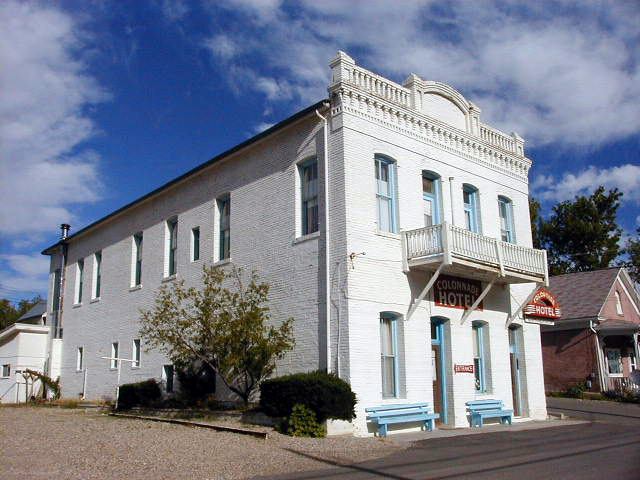
#2 Colonnade Hotel
This building was erected in 1880 by the Italian Benevolent Society who held meetings here. By 1890 and into the 1930s the building was vacant. In the 1940s the Colonnade was again open for business as a boarding house and continued as a hotel until the turn of the century. Today it is being restored. |
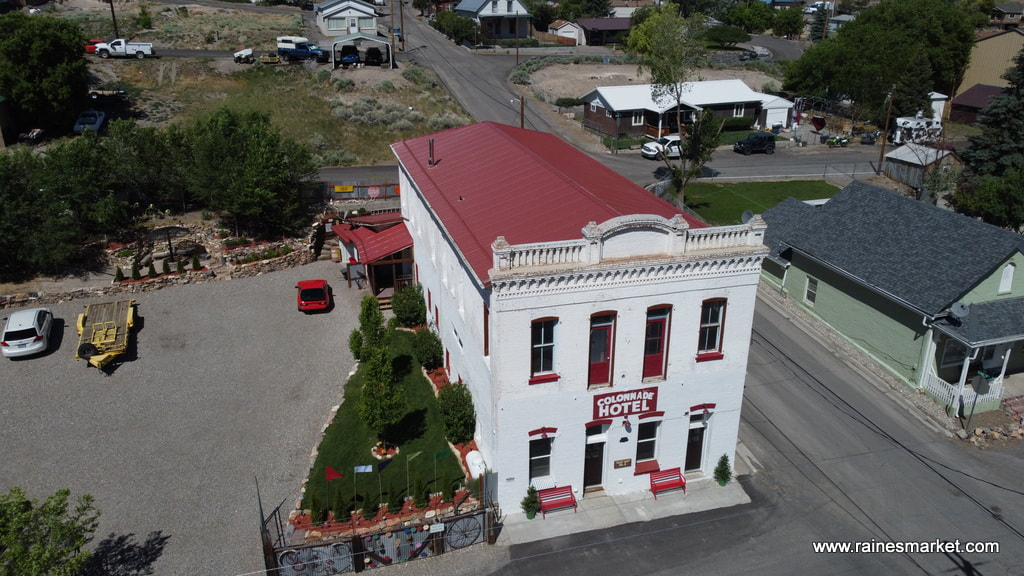
2021
|
#3 Sadler House
(private residence)
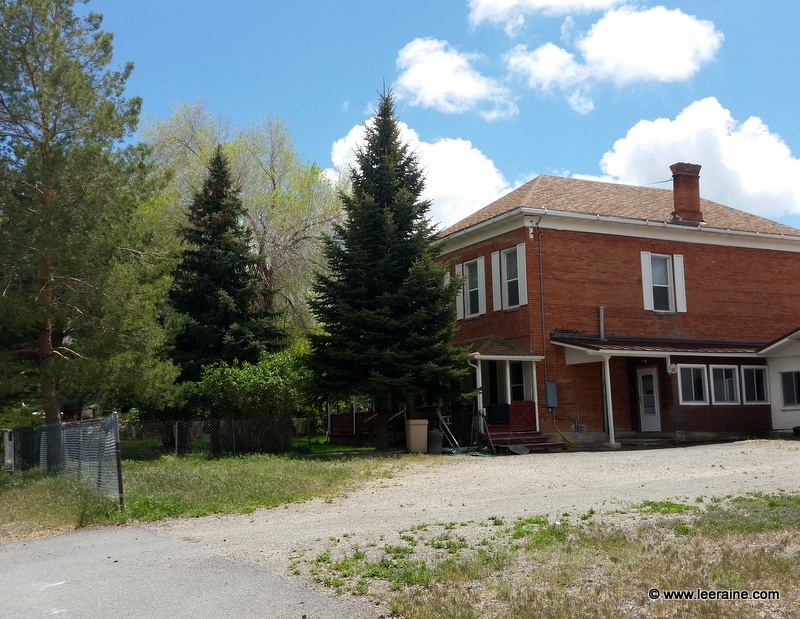
This house was built by Reinhold Sadler, a well-known businessman, contract teamster and rancher who was Nevada Governor from 1896-1902. Mr. Sadler owned and operated a general merchandise store on main street next to the present day Louie's Lounge. It is said Mr. Sadler had a tunnel built from the basement of his home to his place of business so that he didn't have to go out into the weather while going to work. Now a private residence
(private residence)
This house was built by Reinhold Sadler, a well-known businessman, contract teamster and rancher who was Nevada Governor from 1896-1902. Mr. Sadler owned and operated a general merchandise store on main street next to the present day Louie's Lounge. It is said Mr. Sadler had a tunnel built from the basement of his home to his place of business so that he didn't have to go out into the weather while going to work. Now a private residence
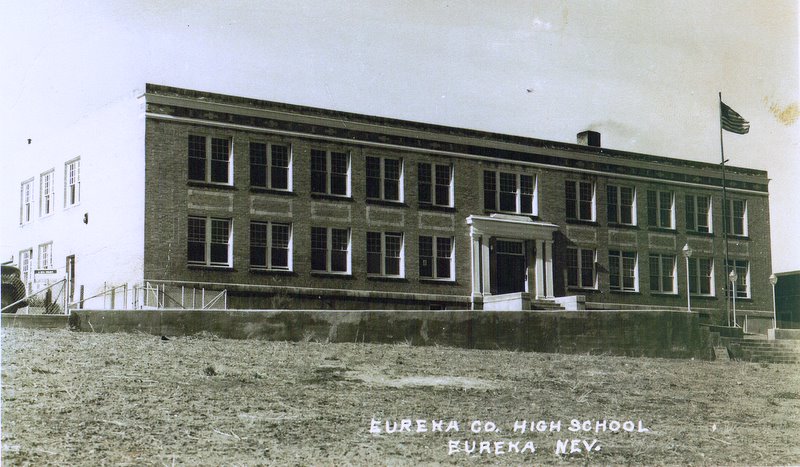
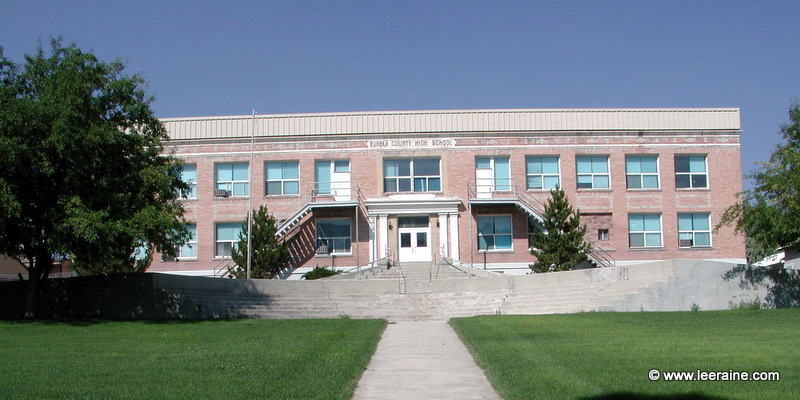
#4 Eureka High School
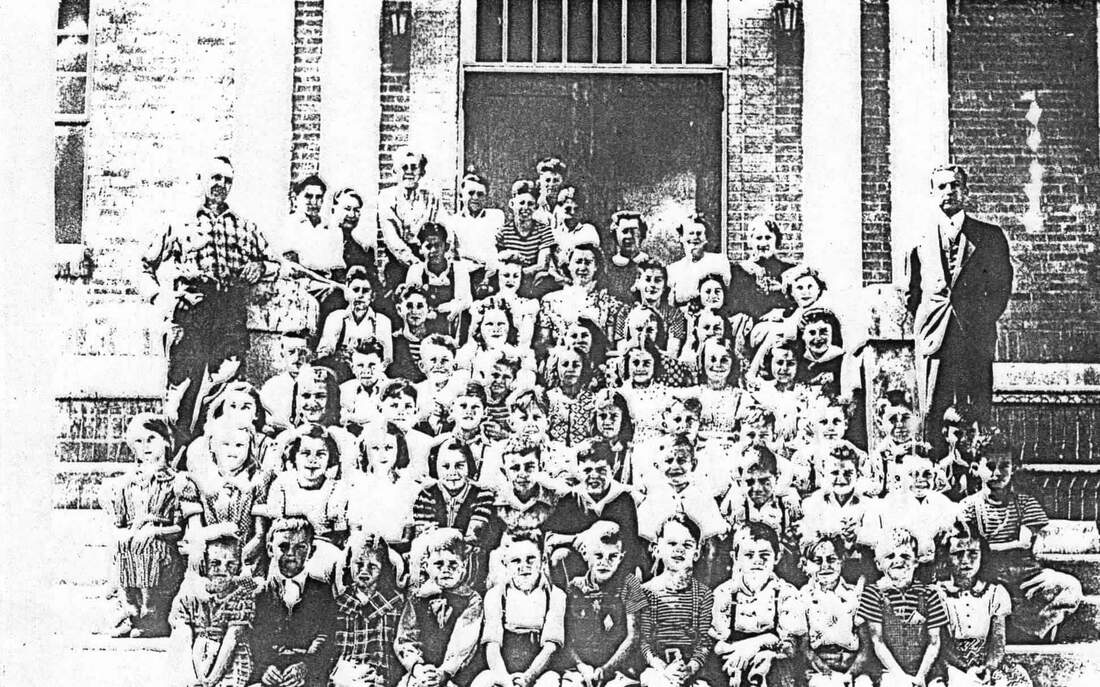
This building was completed in March, 1924 and financed by a school tax raising $3000. The building housed the 1st-12th grade students until a new high school was built on Vandal Way in 1969. Elementary students continued to attend school here until 1995 when a new grade school was built. View on the left is the school when it was new. It was demolished in 2012 by order of the Eureka Co. School Board.
This building was completed in March, 1924 and financed by a school tax raising $3000. The building housed the 1st-12th grade students until a new high school was built on Vandal Way in 1969. Elementary students continued to attend school here until 1995 when a new grade school was built. View on the left is the school when it was new. It was demolished in 2012 by order of the Eureka Co. School Board.
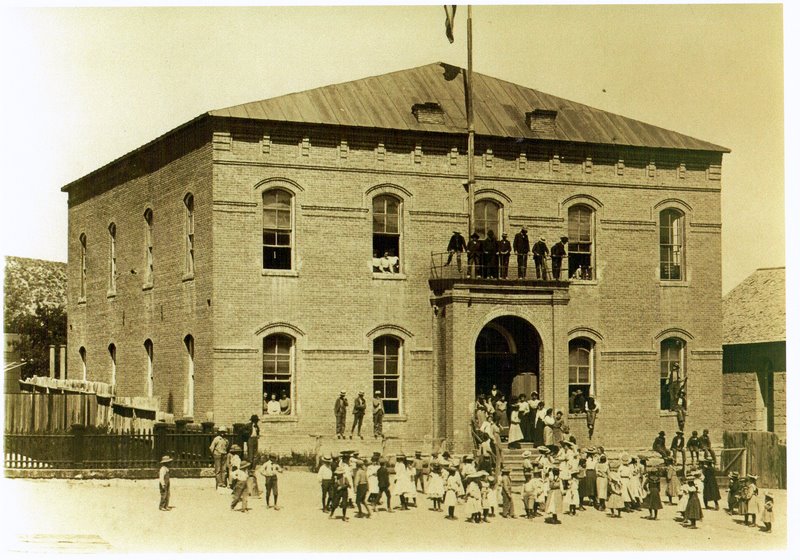
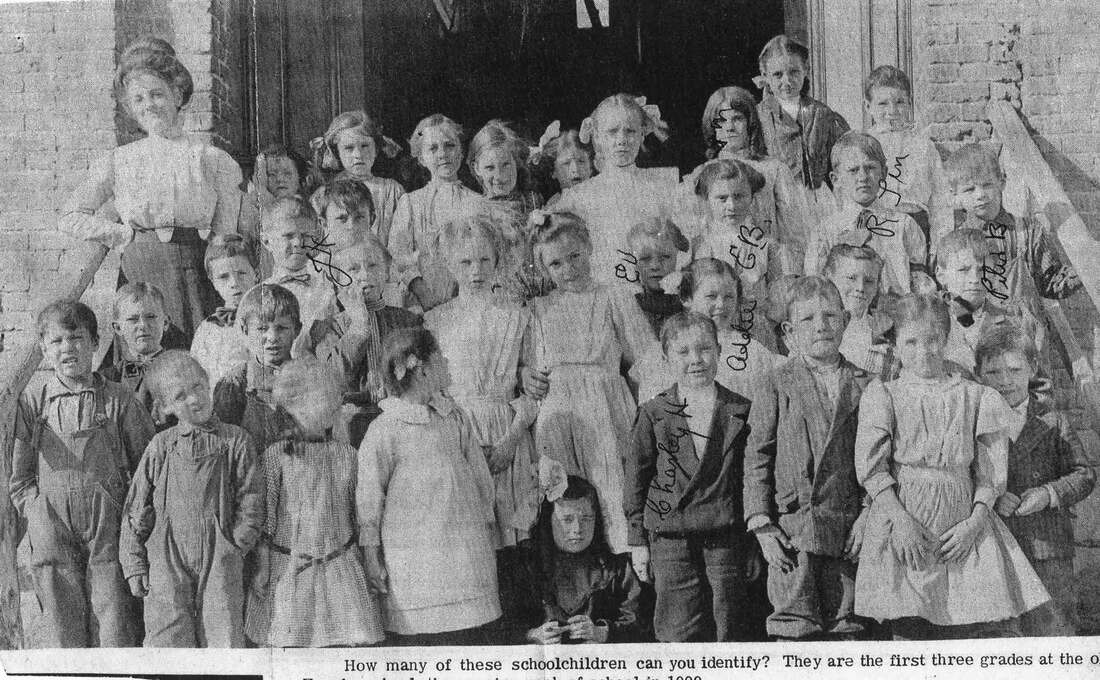
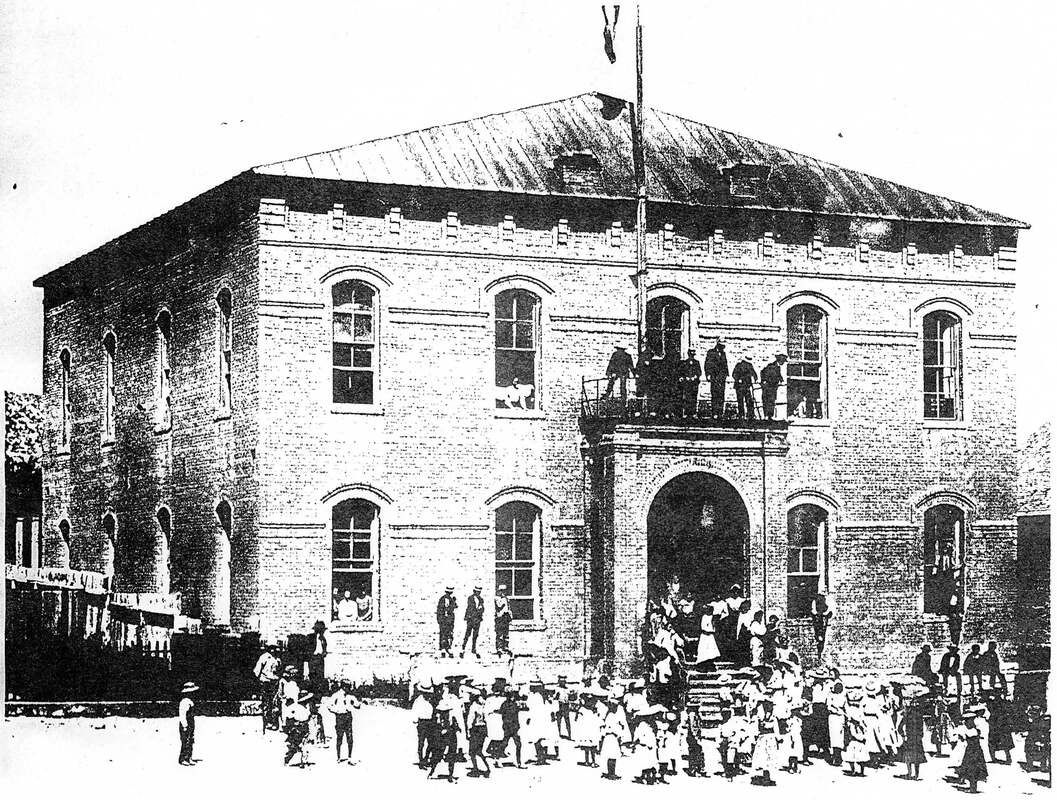
Nob Hill School, Eureka, 1800s - (building on right in photo is St. Brendan's Church) Eureka's first two-story brick school was built in 1879, but was torn down in the late 1930s. It had to be vacated in the early 1920s due to structural damage caused by an earthquake.
|

First high school graduating class in Eureka, 1887.
|
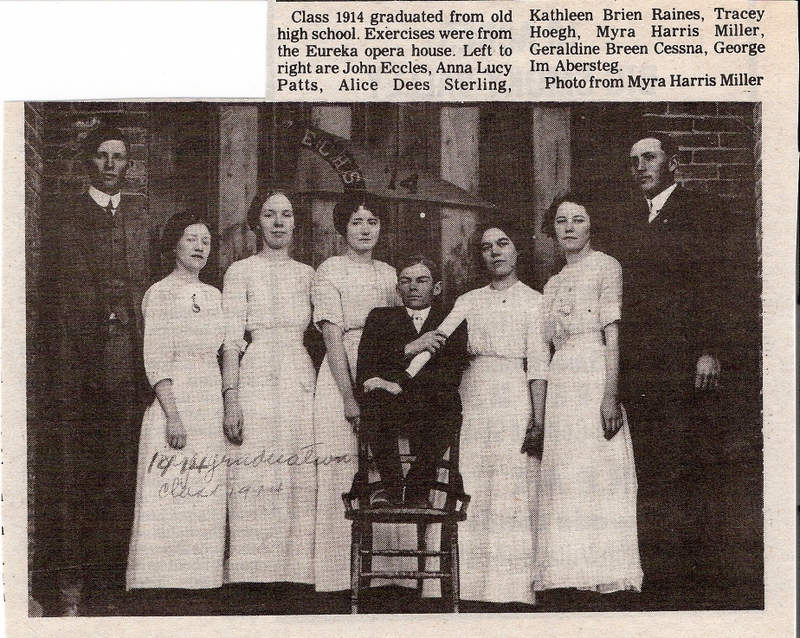
Eureka High School Graduating class of 1914. John Eccles, Anna Lucey, Alice Dees, Ketty Breen, Myna Harris, George Im Abersteg, Tracey Hoegh. This version of names is from a Tognoni album. Spelling may be incorrect in some cases as it differs from the printed page. Newpaper also gives the ladies' married surnames.
|
The History of Eureka Schools
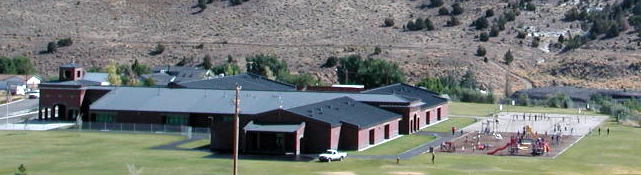 1994 Grade School
The first school classes in Eureka were held in a tent and later moved to a framed building.
In 1879-80, a two-story brick building was built on Nob Hill next to the Catholic Church. It cost $13,000.00 and was considered one of the finest schools in Nevada at the time. A 1920 earthquake hit the area and moved the building on its foundation enough to cause structural problems. It was later closed and demolished. Classes were held in various buildings around Eureka, including the Presbyterian Church and the Remington Laird Building.
The first graduation from Eureka High School was in 1887. The ceremonies were held in the Eureka Opera House, as the school had no auditorium. The Eureka County High School came into being January 1, 1910, through an vote of the taxpayers. Until then, it had been the Eureka District High school.
The lack of proper school facilities, World War 1, the flu epidemic, the shortage of teachers, and illness of many were serious hardships faced by the people of Eureka County. The economy was poor, and the cost of a new school was such that the citizens were divided on the issue of financing one. On November 7,1922, an election was held to decide if bonds of $90,000 should be issued for the construction of a new school. The bill passed with a majority of 70 votes. T.J. Ress of Fallon was awarded a contract for $75,335.20. For an additional $400, Rees agreed to install maple flooring in the gymnasium. The balance of the $90,000 went for supplies and furnishings.
The building’s upstairs served the high school class rooms, chemistry lab, home economics, study hall, and commercial department. The downstairs served the grade school, rest rooms, gymnasium, band room, stage, and offices. The basement served the girls’ and boys’ shower and locker rooms,as well as the furnace room and storage. A separate manual-training shop was to the north of the school. Playground area and well equipped play ground was to the west. It served the community year-round. Parking was in front, and later the tennis court and amphitheater were added in the front by the WPA. This was the first Eureka school to have indoor plumbing and central heating. The building was dedicated on May 16, 1924. The celebration was a very special one, and attended many state dignitaries. This school was well loved by the community it served in many ways. The gymnasium served the community for many purposes. It was the site of the first polio clinics when the Salk Polio Vaccine was administered on sugar cubes in the 1960s.
The first class to graduate from the 1924 school was made up of five students, including Charles Damele who had completed his training at Damele‘s Tonkin Ranch where a certified teacher was provided by the district. Mabel Moore, Rae Rogantini, Annie Pratt, Tom Pastorino, and Charles Damele were honored with a commencement in the new school, even though they had not attended there. It was quite a celebration with food and dancing.
The Class of 1969 was the last high school class to graduate from the 1924 school. The school continued to serve and the stage was turned into offices. A gym was built nearly, but had no showers.
The 1924 school served as the elementary school until 1994 and in 2012 It was demolished by order of the Eureka Co. School Board for no apparent reason. Before the wrecking machinery hit, it was as sound as the day it was built. The playground, amphitheater area and tennis court are still well enjoyed. The 1924 tennis court remains the only one in town.
The new high school was built on the hill above the 1924 school. It was dedicated on October 27, 1968 in a Masonic Cornerstone Ceremony. The school was opened and first classes held in the fall of 1969. It continues to serve the Eureka area students, and has been enlarged and improved with a major renovation in 2008.
The 1968-69 school has served the community in many ways. A satellite program from Northern Nevada Community College, now Great Basin College, has long been housed in the school. This makes it possible for students and others to continue college studies in Eureka.
The new grade school was completed in 1994. The building also served as the District Office location. It is a spacious building with large windows. The students are bussed to the school which is on the Ruby Hill Highway.
Eureka High School Alumni Association was formed in June of 1904. It remains very active and meets annually for dinner, dancing, and mostly for “coming home to Eureka.”
Rural Schools
Antelope Valley school:
Ethel Eccles, a very young lady from Ruby Hill, accepted a teaching position in Antelope Valley where she was to board and room at the ranch where the school was located. In her memoirs she told of her loneliness for her family. She also showed some humor in telling of her taking the reins to drive the horse pulling the wagon on her first trip to her new teaching position. A school trustee had come to take her to the ranch. He bought a jug in town and had enjoyed the contents along the way. Ethel later married Edgar Sadler of the Sadler Ranch in Diamond Valley.
The Diamond Valley Country School was located in various locations, but provided dedicated teachers and a good basic education for many county students in their grade school years.
In 1879-80, a two-story brick building was built on Nob Hill next to the Catholic Church. It cost $13,000.00 and was considered one of the finest schools in Nevada at the time. A 1920 earthquake hit the area and moved the building on its foundation enough to cause structural problems. It was later closed and demolished. Classes were held in various buildings around Eureka, including the Presbyterian Church and the Remington Laird Building.
The first graduation from Eureka High School was in 1887. The ceremonies were held in the Eureka Opera House, as the school had no auditorium. The Eureka County High School came into being January 1, 1910, through an vote of the taxpayers. Until then, it had been the Eureka District High school.
The lack of proper school facilities, World War 1, the flu epidemic, the shortage of teachers, and illness of many were serious hardships faced by the people of Eureka County. The economy was poor, and the cost of a new school was such that the citizens were divided on the issue of financing one. On November 7,1922, an election was held to decide if bonds of $90,000 should be issued for the construction of a new school. The bill passed with a majority of 70 votes. T.J. Ress of Fallon was awarded a contract for $75,335.20. For an additional $400, Rees agreed to install maple flooring in the gymnasium. The balance of the $90,000 went for supplies and furnishings.
The building’s upstairs served the high school class rooms, chemistry lab, home economics, study hall, and commercial department. The downstairs served the grade school, rest rooms, gymnasium, band room, stage, and offices. The basement served the girls’ and boys’ shower and locker rooms,as well as the furnace room and storage. A separate manual-training shop was to the north of the school. Playground area and well equipped play ground was to the west. It served the community year-round. Parking was in front, and later the tennis court and amphitheater were added in the front by the WPA. This was the first Eureka school to have indoor plumbing and central heating. The building was dedicated on May 16, 1924. The celebration was a very special one, and attended many state dignitaries. This school was well loved by the community it served in many ways. The gymnasium served the community for many purposes. It was the site of the first polio clinics when the Salk Polio Vaccine was administered on sugar cubes in the 1960s.
The first class to graduate from the 1924 school was made up of five students, including Charles Damele who had completed his training at Damele‘s Tonkin Ranch where a certified teacher was provided by the district. Mabel Moore, Rae Rogantini, Annie Pratt, Tom Pastorino, and Charles Damele were honored with a commencement in the new school, even though they had not attended there. It was quite a celebration with food and dancing.
The Class of 1969 was the last high school class to graduate from the 1924 school. The school continued to serve and the stage was turned into offices. A gym was built nearly, but had no showers.
The 1924 school served as the elementary school until 1994 and in 2012 It was demolished by order of the Eureka Co. School Board for no apparent reason. Before the wrecking machinery hit, it was as sound as the day it was built. The playground, amphitheater area and tennis court are still well enjoyed. The 1924 tennis court remains the only one in town.
The new high school was built on the hill above the 1924 school. It was dedicated on October 27, 1968 in a Masonic Cornerstone Ceremony. The school was opened and first classes held in the fall of 1969. It continues to serve the Eureka area students, and has been enlarged and improved with a major renovation in 2008.
The 1968-69 school has served the community in many ways. A satellite program from Northern Nevada Community College, now Great Basin College, has long been housed in the school. This makes it possible for students and others to continue college studies in Eureka.
The new grade school was completed in 1994. The building also served as the District Office location. It is a spacious building with large windows. The students are bussed to the school which is on the Ruby Hill Highway.
Eureka High School Alumni Association was formed in June of 1904. It remains very active and meets annually for dinner, dancing, and mostly for “coming home to Eureka.”
Rural Schools
Antelope Valley school:
Ethel Eccles, a very young lady from Ruby Hill, accepted a teaching position in Antelope Valley where she was to board and room at the ranch where the school was located. In her memoirs she told of her loneliness for her family. She also showed some humor in telling of her taking the reins to drive the horse pulling the wagon on her first trip to her new teaching position. A school trustee had come to take her to the ranch. He bought a jug in town and had enjoyed the contents along the way. Ethel later married Edgar Sadler of the Sadler Ranch in Diamond Valley.
The Diamond Valley Country School was located in various locations, but provided dedicated teachers and a good basic education for many county students in their grade school years.
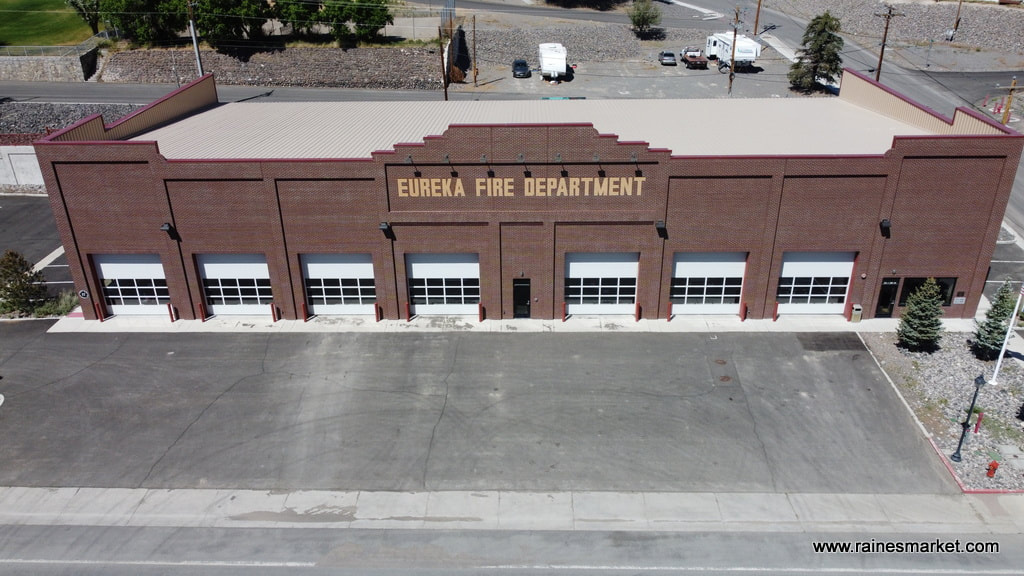
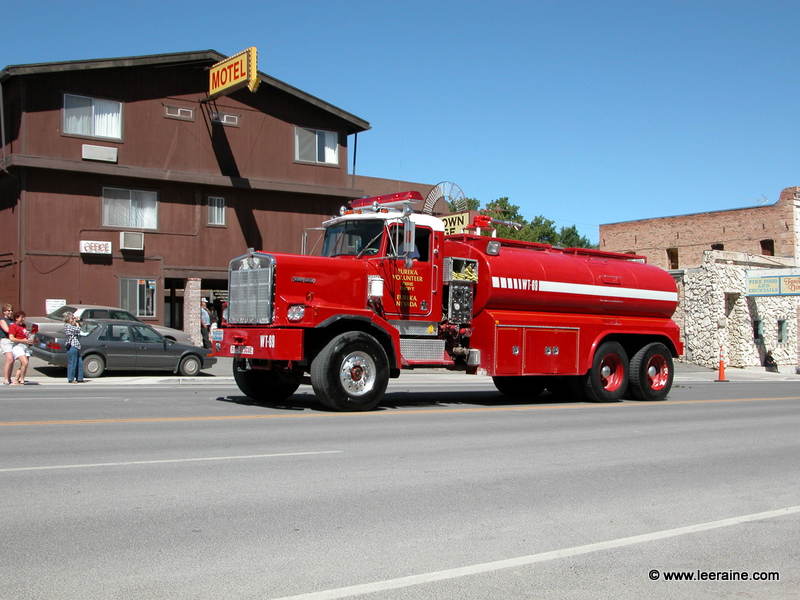
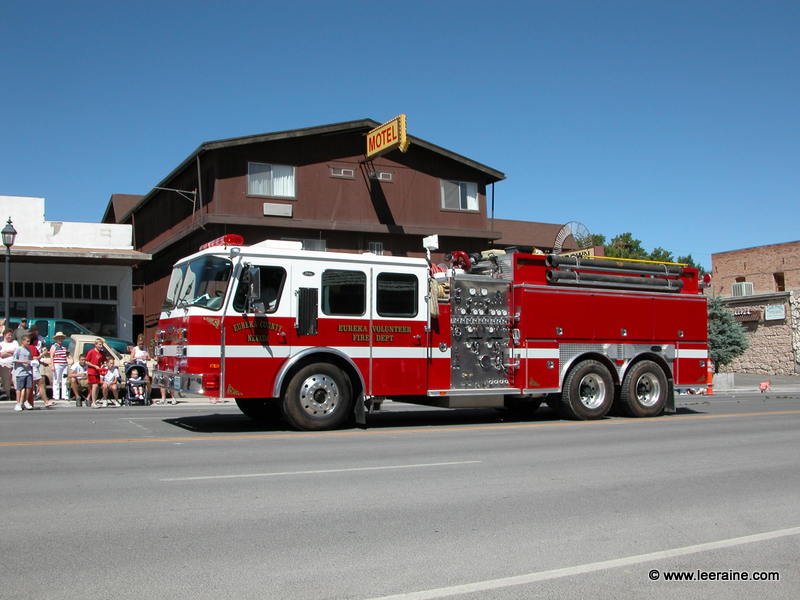
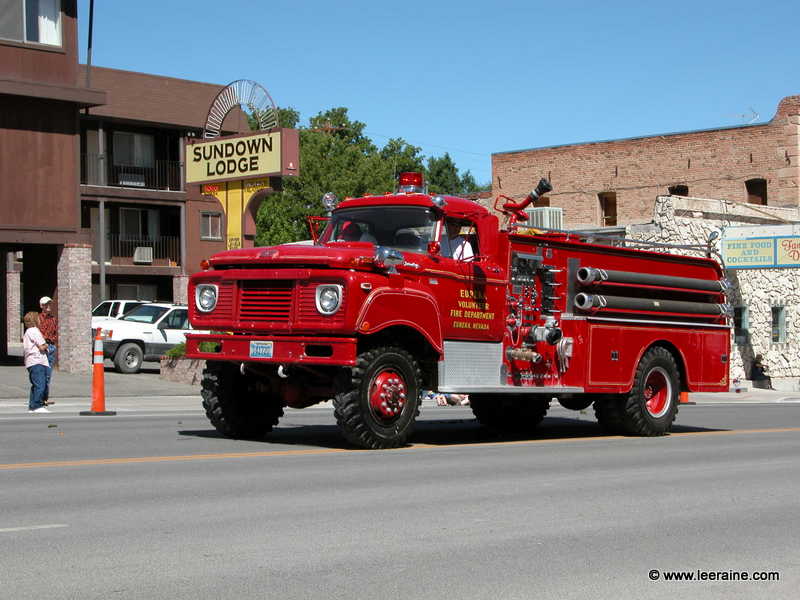
Eureka Fire Department and Fire Museum
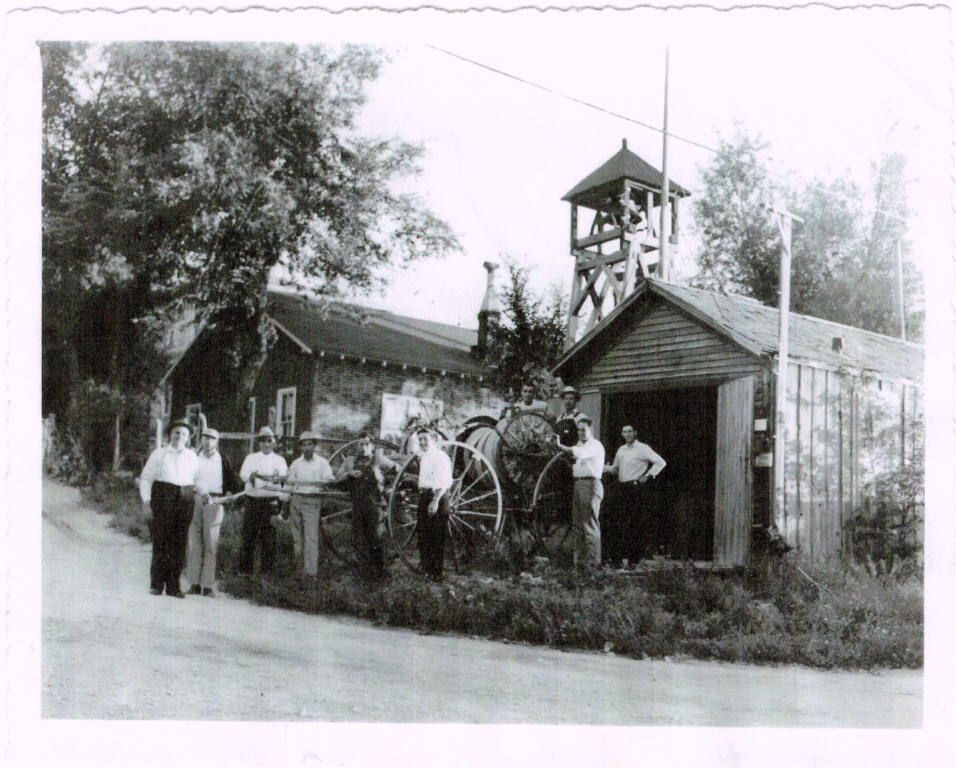
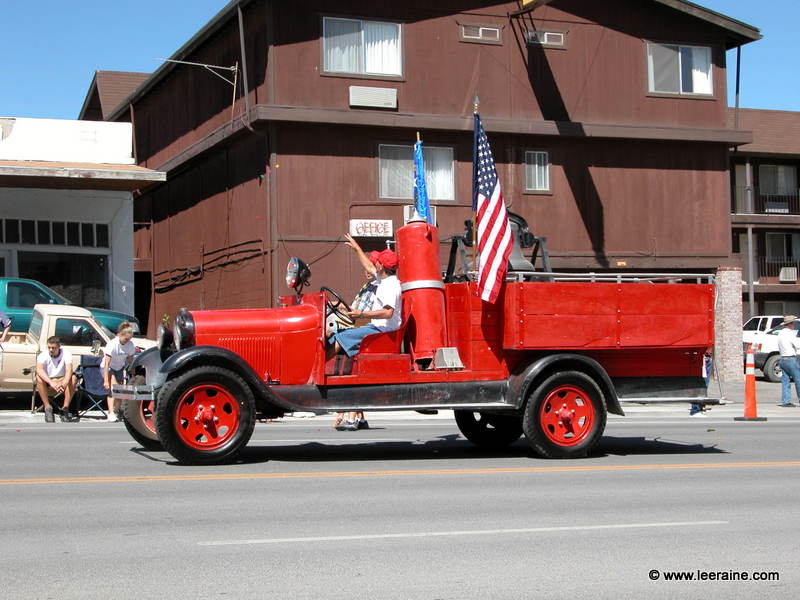
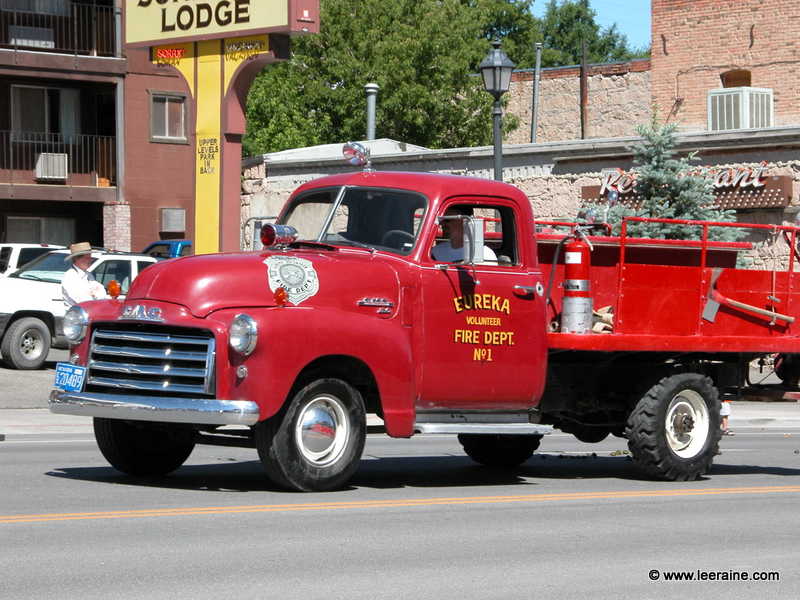
This was the site of the Eureka County Shop building for over 40 years, the same old shop building then housed The Eureka Volunteer Fire Department for more than a decade. The modern fire building was constructed in 2009 and holds fire and rescue apparatus that provided the local fire department with facilities to house expanded structure, wild-land, and crash/rescue capabilities. The fire building design features large glass panels in all doors to provide taxpayers 'transparency in government' by displaying fire / rescue equipment they have purchased. A Fire Department Museum was incorporated into the structure where many of the original fire apparatus used since the founding of Eureka can be found in excellent condition. The fire museum includes several original man-pulled hose carts still in working condition, Eureka's first motorized fire truck - a Model A Ford that still runs and is driven in the Independence Day parade every year, as well as other historic Eureka fire engines and tools. Large 'store front' windows provide a good view of the museum to all, the display is lighted for viewing after dark and tours inside can be had by contacting any of Eureka's Volunteer Firemen.
This was the site of the Eureka County Shop building for over 40 years, the same old shop building then housed The Eureka Volunteer Fire Department for more than a decade. The modern fire building was constructed in 2009 and holds fire and rescue apparatus that provided the local fire department with facilities to house expanded structure, wild-land, and crash/rescue capabilities. The fire building design features large glass panels in all doors to provide taxpayers 'transparency in government' by displaying fire / rescue equipment they have purchased. A Fire Department Museum was incorporated into the structure where many of the original fire apparatus used since the founding of Eureka can be found in excellent condition. The fire museum includes several original man-pulled hose carts still in working condition, Eureka's first motorized fire truck - a Model A Ford that still runs and is driven in the Independence Day parade every year, as well as other historic Eureka fire engines and tools. Large 'store front' windows provide a good view of the museum to all, the display is lighted for viewing after dark and tours inside can be had by contacting any of Eureka's Volunteer Firemen.
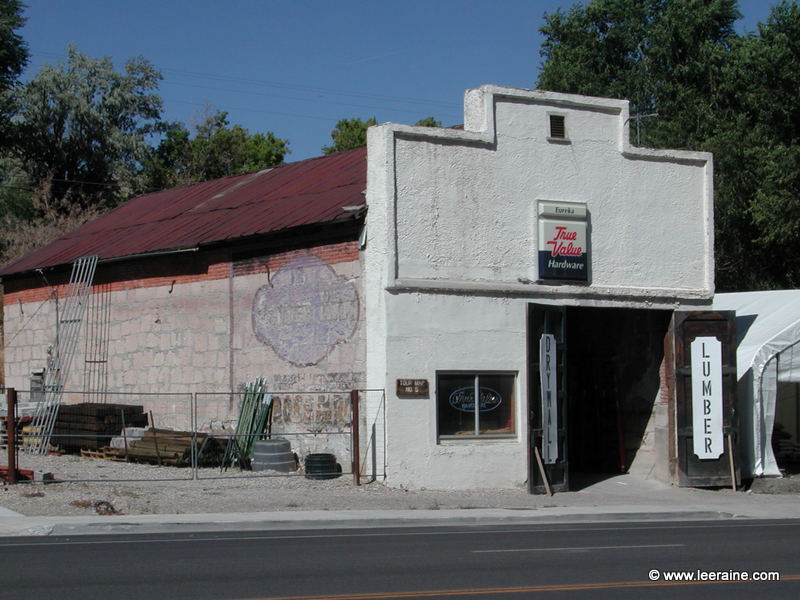
#5 Stone and Brick Building 200 N. Main Street Celso Tolli's Salloon (1879)
This building has a "Castorlube Motor Oil" sign painted on the north side. This building was originally a two story structure that was built in 1879 by an Italian company under the management of Celso Tolli. It served as a saloon. It was in Tolli's saloon that approximately 500 Italian carbonari (charcoal burners) formed the Eureka Coalburners Protective Association in July, 1879. Because many of the Italian charcoal burners did not speak English, they were often cheated in the sale of charcoal to the refineries. After forming their association, the desperate burners stopped the supply of charcoal, asking for a two cent increase to a total of 30 cents a bushel. Several teamsters were threatened, the refineries threatened to shut down and burners were arrested, but little charcoal was loaded. An ugly confrontation occurred on August 19, 1879, at Fish Creek when striking charcoal burners and a local posse exchanged words, then gun shots. Six burners were killed and ten more were wounded. The coroner's inquest excused the posse as acting "in the line of duty." The charcoal burners realized that the companies had won and they had no choice but to go back to work. The companies then lowered the price of charcoal to 26 cents a bushel.
See The Fish Creek War.
This building has a "Castorlube Motor Oil" sign painted on the north side. This building was originally a two story structure that was built in 1879 by an Italian company under the management of Celso Tolli. It served as a saloon. It was in Tolli's saloon that approximately 500 Italian carbonari (charcoal burners) formed the Eureka Coalburners Protective Association in July, 1879. Because many of the Italian charcoal burners did not speak English, they were often cheated in the sale of charcoal to the refineries. After forming their association, the desperate burners stopped the supply of charcoal, asking for a two cent increase to a total of 30 cents a bushel. Several teamsters were threatened, the refineries threatened to shut down and burners were arrested, but little charcoal was loaded. An ugly confrontation occurred on August 19, 1879, at Fish Creek when striking charcoal burners and a local posse exchanged words, then gun shots. Six burners were killed and ten more were wounded. The coroner's inquest excused the posse as acting "in the line of duty." The charcoal burners realized that the companies had won and they had no choice but to go back to work. The companies then lowered the price of charcoal to 26 cents a bushel.
See The Fish Creek War.
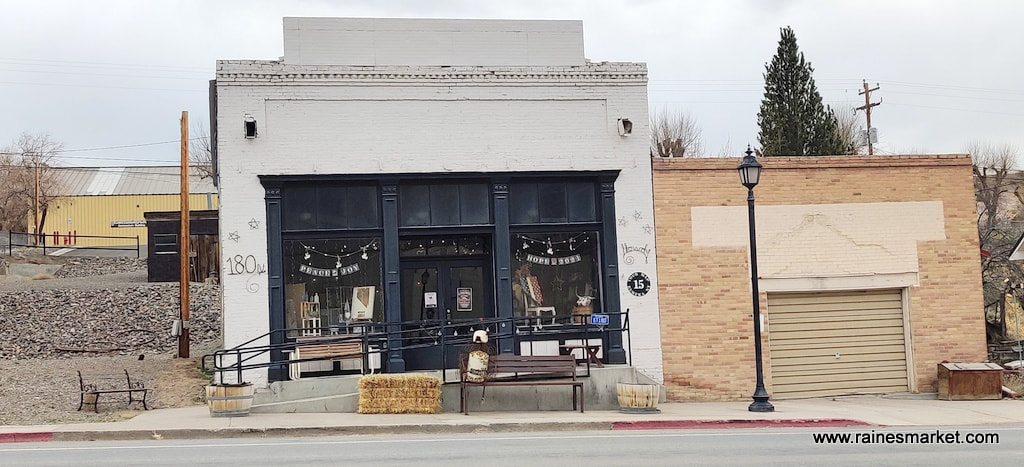
2021
|
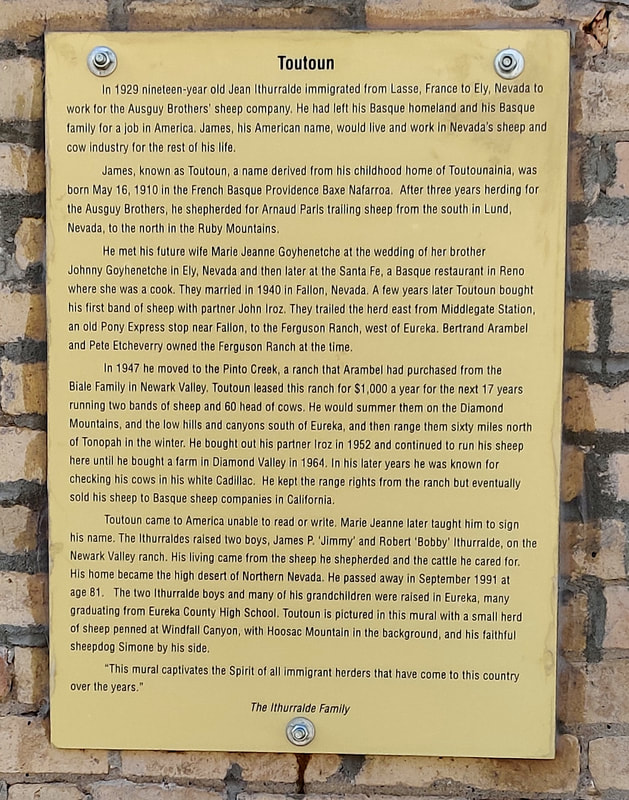
Toutoun
|
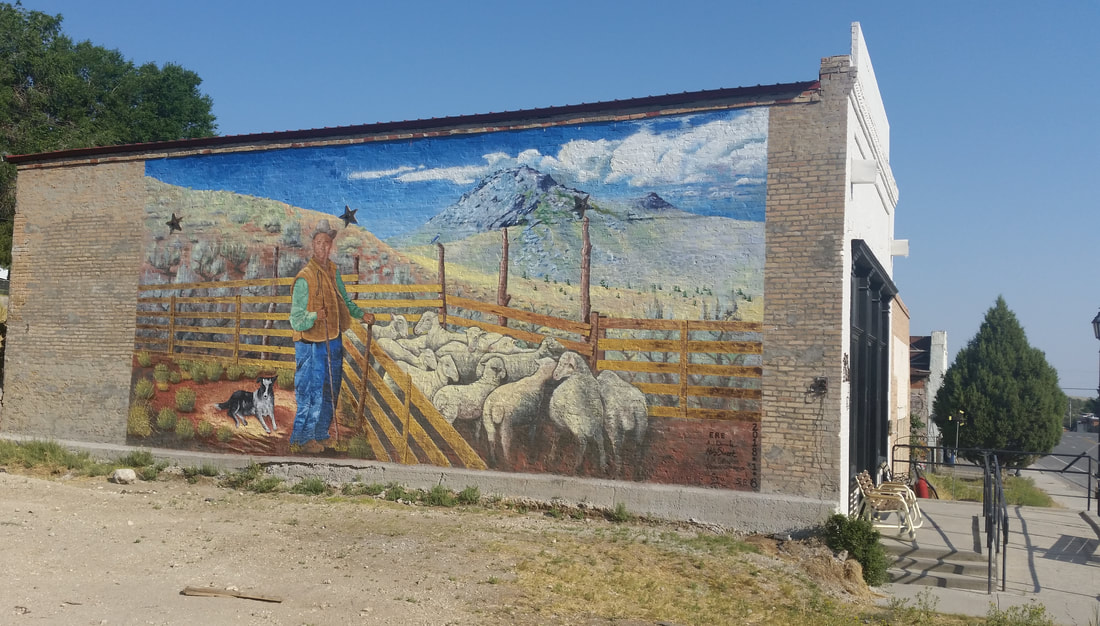
|
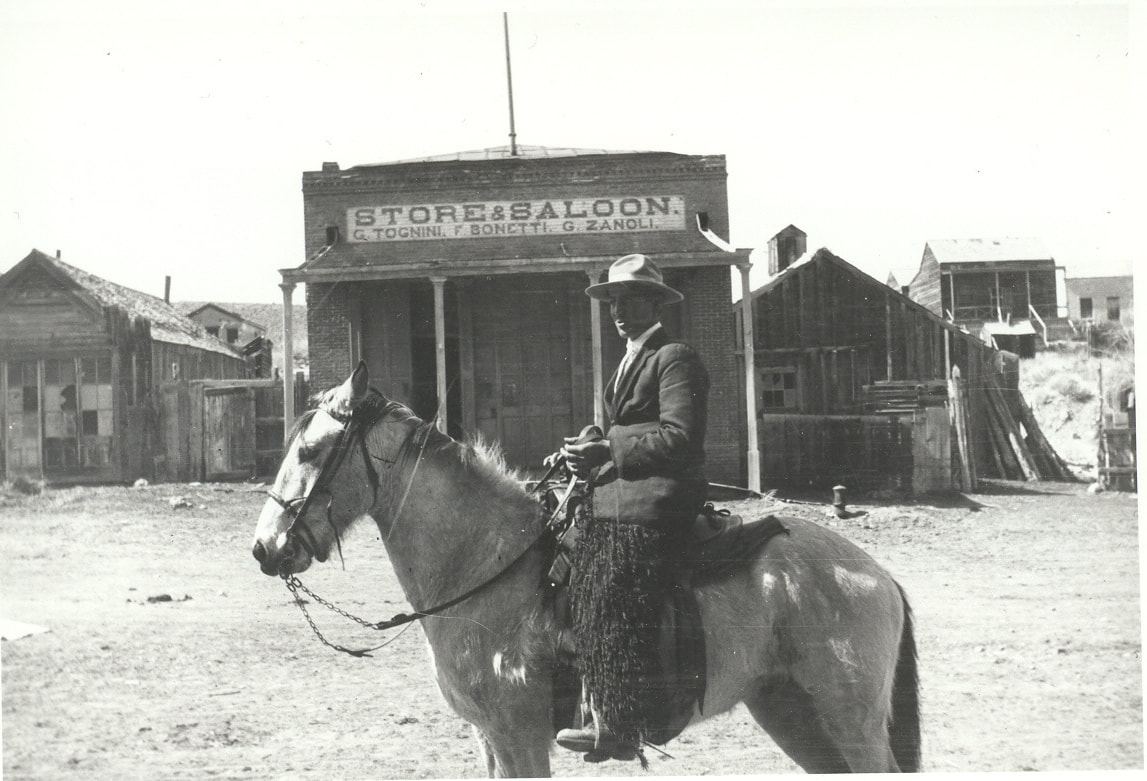
Courtesy NE NV Museum
circa 1877
|
#6 Tognini and Company Building
This building was built in 1877 by Tognini and Company. The Swiss-Italian Company consisted of Joseph Tognini, Ferdinando Bonetti, and Gabiriel Zanoli. The copartnership between Tognoni and Co. in the grocery and saloon business in the town of Eureka was dissolved on June 25, 1877. Subsequent business was conducted by J. Tognoni and Gabriol Zanoli.
The Eureka Billiard Hall Saloon was operated here. Like many other companies in Eureka at the time, Tognini and Company was one of the largest companies involved in charcoal production. The building attached to the north was built in 1924 by John Biale. The front bricks are the same as those used in the construction of the school. Other portions contain bricks salvaged from the Pinto Mill that was located several miles southeast of town. This building is also the site of the first business establishment in Eureka known as the Pioneer Restaurant which consisted only of a canvas tent. The star plates and rods on the sides of the building hold the walls together. The sign "Trupak Palora Peaches, a distinct new variety," was painted on the wall around 1930.
Now designated as 180 North Main, it is headquarters for Eureka Restoration Enterprises who have restored it and are using it for an arts and crafts gallery.
In 2018 a mural was completed on the south side of the building. The mural was created by Antone Damele, who based it off of an old photograph of local pioneer Basque sheepherder and rancher James “Toutoun” Ithurralde. Local artists Abby Sweet and Adeline Callaghan helped complete the mural.
This building was built in 1877 by Tognini and Company. The Swiss-Italian Company consisted of Joseph Tognini, Ferdinando Bonetti, and Gabiriel Zanoli. The copartnership between Tognoni and Co. in the grocery and saloon business in the town of Eureka was dissolved on June 25, 1877. Subsequent business was conducted by J. Tognoni and Gabriol Zanoli.
The Eureka Billiard Hall Saloon was operated here. Like many other companies in Eureka at the time, Tognini and Company was one of the largest companies involved in charcoal production. The building attached to the north was built in 1924 by John Biale. The front bricks are the same as those used in the construction of the school. Other portions contain bricks salvaged from the Pinto Mill that was located several miles southeast of town. This building is also the site of the first business establishment in Eureka known as the Pioneer Restaurant which consisted only of a canvas tent. The star plates and rods on the sides of the building hold the walls together. The sign "Trupak Palora Peaches, a distinct new variety," was painted on the wall around 1930.
Now designated as 180 North Main, it is headquarters for Eureka Restoration Enterprises who have restored it and are using it for an arts and crafts gallery.
In 2018 a mural was completed on the south side of the building. The mural was created by Antone Damele, who based it off of an old photograph of local pioneer Basque sheepherder and rancher James “Toutoun” Ithurralde. Local artists Abby Sweet and Adeline Callaghan helped complete the mural.
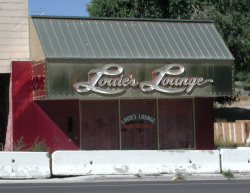
#7 Louie's Lounge
Two Jewish dry goods merchants erected this stone building in 1874. Cesare Rossetti acquired the building in 1874 and still owned it in 1886 when books were sold in the main floor and lodgings could be had upstairs. If you look at the back of the building, you can still see the original blocks formed from local volcanic rock. For many years it was operated as a bar with a dance hall in the back.
Two Jewish dry goods merchants erected this stone building in 1874. Cesare Rossetti acquired the building in 1874 and still owned it in 1886 when books were sold in the main floor and lodgings could be had upstairs. If you look at the back of the building, you can still see the original blocks formed from local volcanic rock. For many years it was operated as a bar with a dance hall in the back.
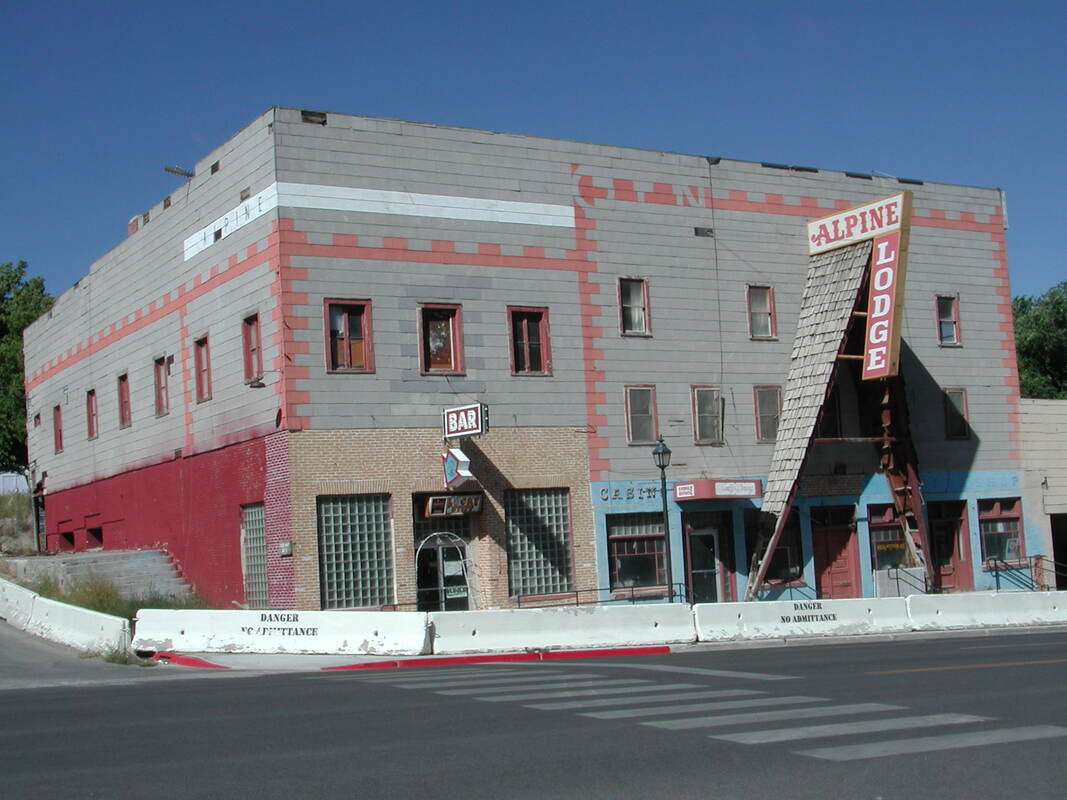
#8 Lincoln Hotel / Alpine Lodge
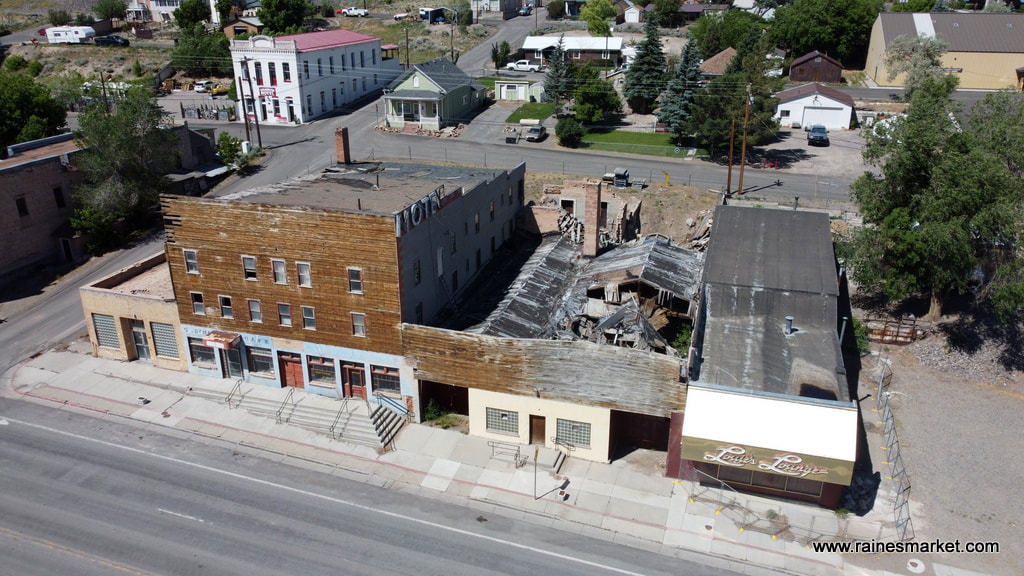
A two story frame building stood here in the 1880s. The original building housed a dry goods or clothing store downstairs with the San Francisco Lodging House upstairs. Around 1880 William Zadow moved his butcher shop from a building next to the Eureka Opera House to this location. He operated the butcher shop for over twenty years. A brick building was erected on the left housing a bar and a jaialai fronton (jaialai court) was in the structure on the right.
In 1941 all three of them were combined as the Lincoln Hotel with more than 50 small rooms. It was acquired by Lee and Blanche Olinger in 1946. Lee died in 1966 and in April 1968 the hotel was the site of the unsolved murder of Blanche Olinger. After that it was sold and became the Alpine Lodge and the Lucky Stiff Bar. It was condemned in 1996 and for many years stood empty.
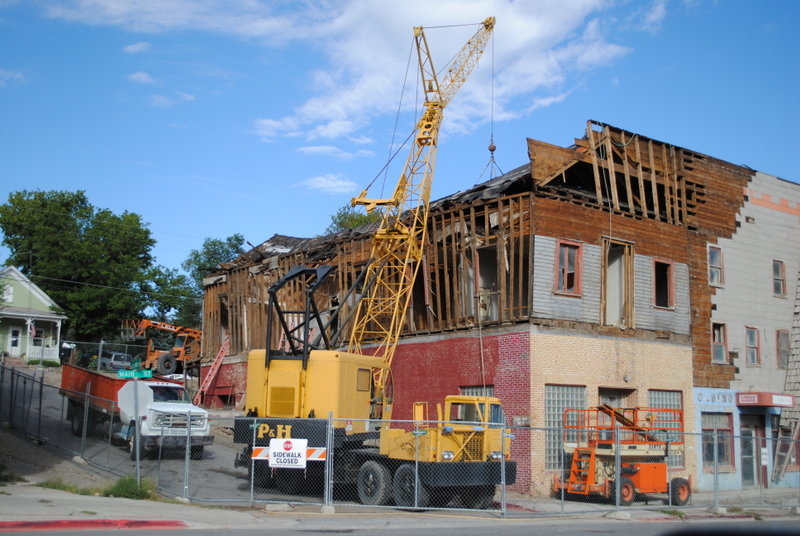
New owners acquired the building and are attempting to remove the unsound portions of the structure. Progress was stopped by a new state law requiring commercial property to be demolished by licensed contractors. Interestingly enough, the private property was being demolished by the owners, it has not been open as a commercial structure for 18 or so years, and there is no zoning in Eureka county to designate it as commercial...
A two story frame building stood here in the 1880s. The original building housed a dry goods or clothing store downstairs with the San Francisco Lodging House upstairs. Around 1880 William Zadow moved his butcher shop from a building next to the Eureka Opera House to this location. He operated the butcher shop for over twenty years. A brick building was erected on the left housing a bar and a jaialai fronton (jaialai court) was in the structure on the right.
In 1941 all three of them were combined as the Lincoln Hotel with more than 50 small rooms. It was acquired by Lee and Blanche Olinger in 1946. Lee died in 1966 and in April 1968 the hotel was the site of the unsolved murder of Blanche Olinger. After that it was sold and became the Alpine Lodge and the Lucky Stiff Bar. It was condemned in 1996 and for many years stood empty.
New owners acquired the building and are attempting to remove the unsound portions of the structure. Progress was stopped by a new state law requiring commercial property to be demolished by licensed contractors. Interestingly enough, the private property was being demolished by the owners, it has not been open as a commercial structure for 18 or so years, and there is no zoning in Eureka county to designate it as commercial...
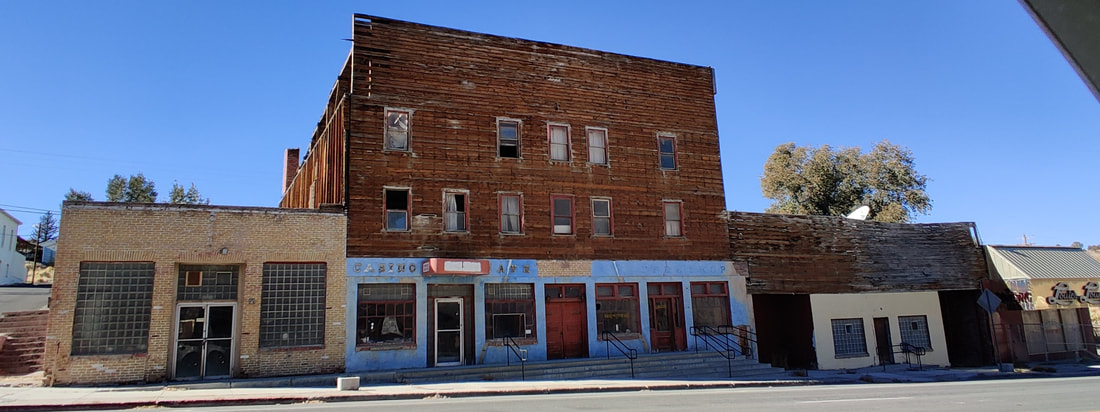
#9 Eureka Hotel - Cafe
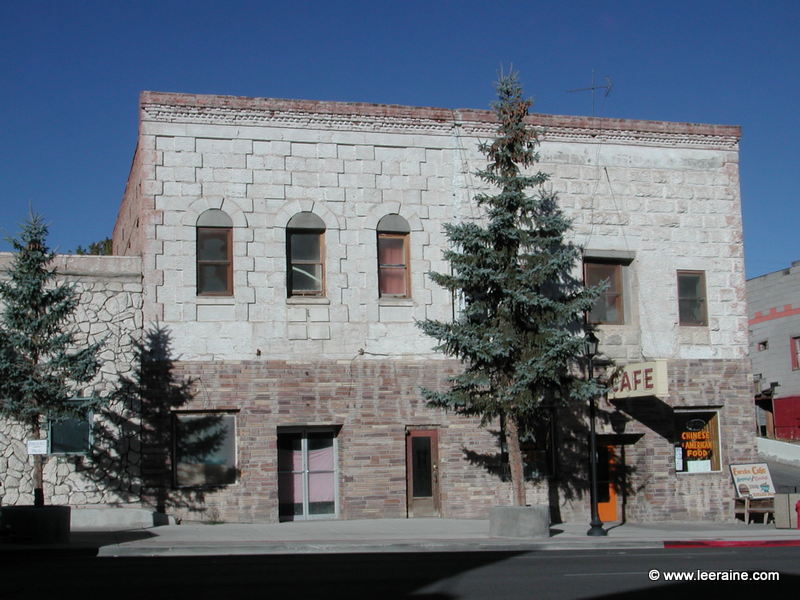
This establishment was really two buildings. In 1873, the northern half of the building was erected. It was built from local quarried volcanic tuff. The constructor, William H Clark, ran a general merchandise and hardware store downstairs and upstairs provided offices for doctors, dentists, and lawyers. A Nevada legislator and attorney, Thomas Wren had offices here. In 1907 the building was converted to the Zadow Hotel and the southern portion of the building erected. When the Lincoln Highway (now Highway 50) opened in 1915-16, the price of a hotel room was $2.50 a day under the American Plan (which includes the room and meals). In 1920 Ed Herrera acquired the property and changed the name to the Eureka Hotel. Pete Laborde, former owner of the Nevada Club, owned this hotel in the 1930s. Around 1942 the Eureka Cafe began serving American and Chinese food and remained in the hands of various members of a Chinese family until 2016.
This establishment was really two buildings. In 1873, the northern half of the building was erected. It was built from local quarried volcanic tuff. The constructor, William H Clark, ran a general merchandise and hardware store downstairs and upstairs provided offices for doctors, dentists, and lawyers. A Nevada legislator and attorney, Thomas Wren had offices here. In 1907 the building was converted to the Zadow Hotel and the southern portion of the building erected. When the Lincoln Highway (now Highway 50) opened in 1915-16, the price of a hotel room was $2.50 a day under the American Plan (which includes the room and meals). In 1920 Ed Herrera acquired the property and changed the name to the Eureka Hotel. Pete Laborde, former owner of the Nevada Club, owned this hotel in the 1930s. Around 1942 the Eureka Cafe began serving American and Chinese food and remained in the hands of various members of a Chinese family until 2016.
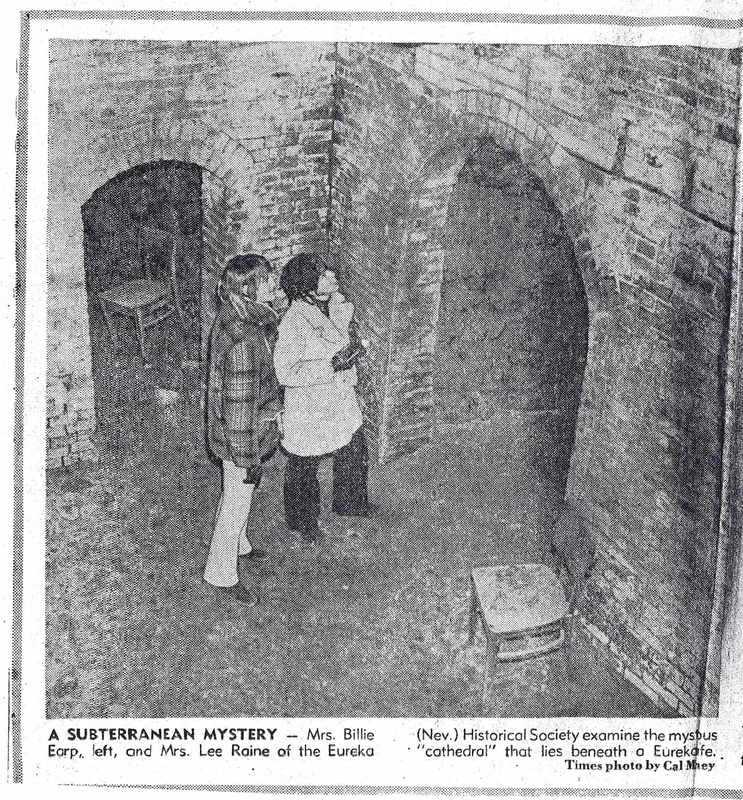
Tunnels
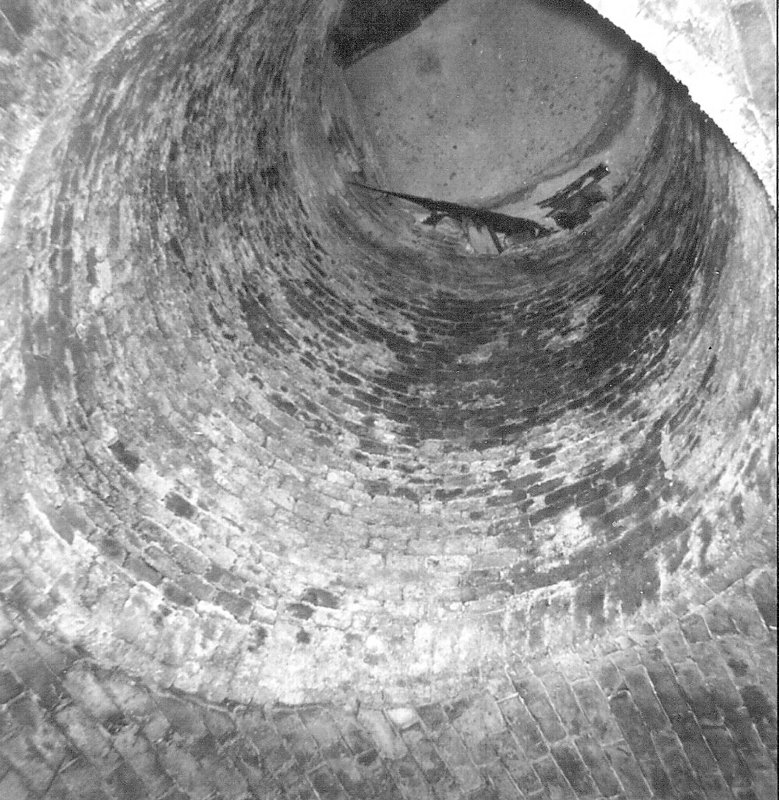
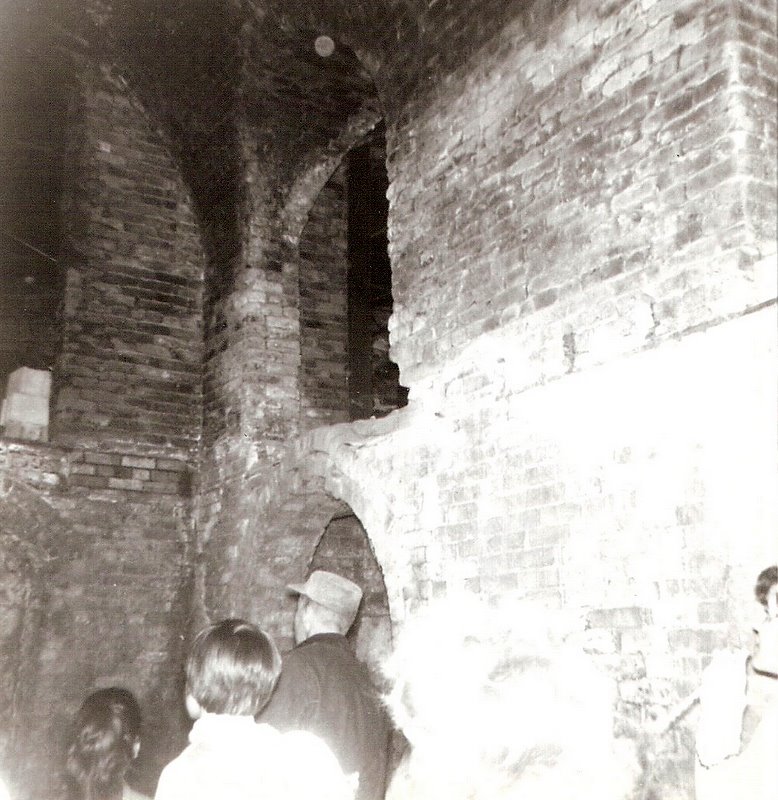
Photos above are of the underground tunnels below the Eureka Cafe. Left photo is the access from Monroe Street. These tunnels were used for storage in the early days. The right hand photo is from a Los Angeles Times article from 1975. Text from that article is in photos below. The thesis from the article that the tunnels were of Chinese origin is strongly disputed by the old timers from Eureka. Probably not the truth, but interesting interpretation. Having been down there, which is obviously a rare privilege, all one can say is the brick work is amazing.
Photos above are of the underground tunnels below the Eureka Cafe. Left photo is the access from Monroe Street. These tunnels were used for storage in the early days. The right hand photo is from a Los Angeles Times article from 1975. Text from that article is in photos below. The thesis from the article that the tunnels were of Chinese origin is strongly disputed by the old timers from Eureka. Probably not the truth, but interesting interpretation. Having been down there, which is obviously a rare privilege, all one can say is the brick work is amazing.
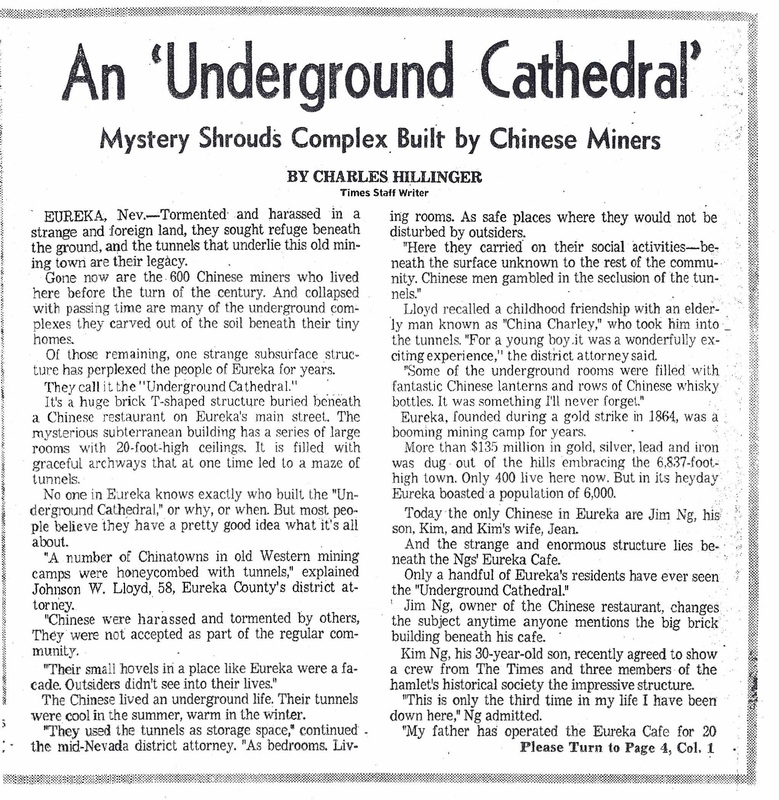

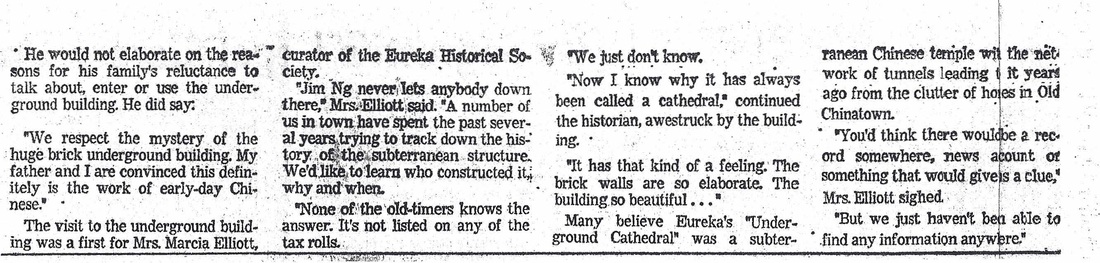
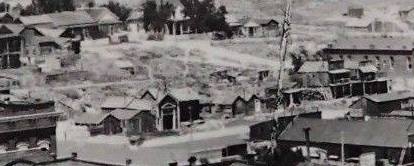
The above controversy on the tunnels under the town of Eureka gives rise to the question, where was the China Town section of Eureka? It is shown by sources such as 3 different editions of the Sanborn Fire Insurance maps spanning 30 years as being on north Monroe Street, in the now vacant area between the Sentinel Museum and the Colonnade Hotel. On the left is a detail from a larger photo that shows that area very well.
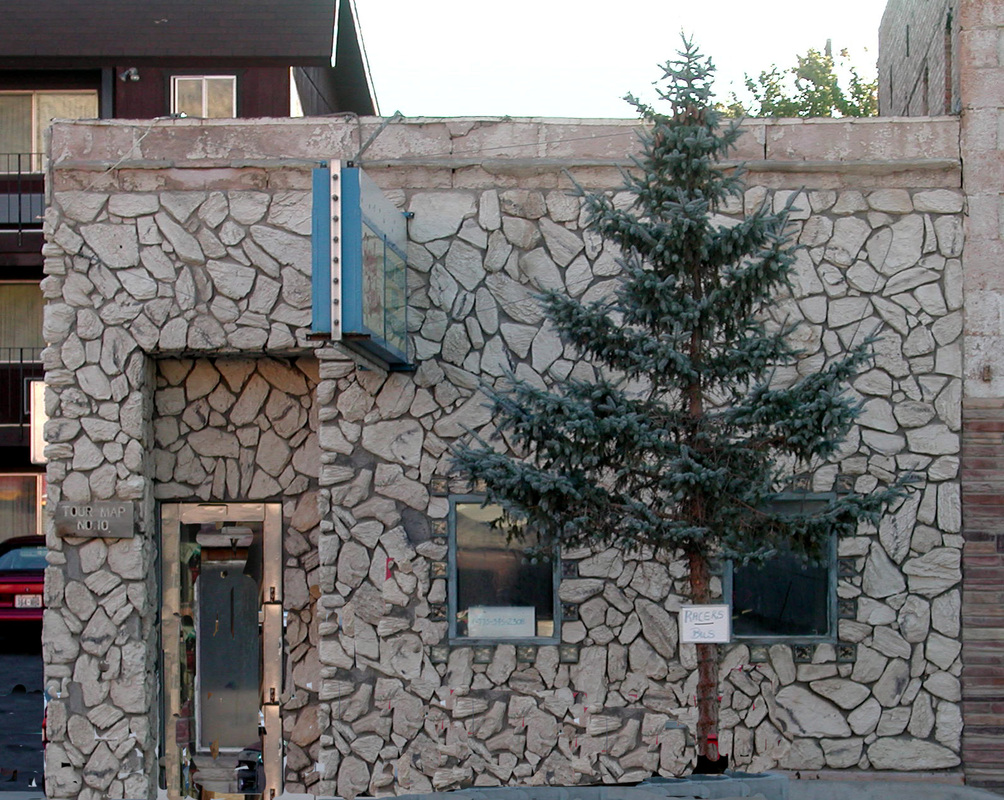
#10
This building was also built of local volcanic tuff. It was built prior to 1873 by Solomon Ashim and his brother. The building also survived the 1880 fire and was a general store managed by Flora Morris and her son David until the early 1900s.
In the 1930s and early 1940s it served as a county restaurant. It has been a bar and restaurant. For a number of years in the late 1900s it was known as Jim and Lorraine's.
This building was also built of local volcanic tuff. It was built prior to 1873 by Solomon Ashim and his brother. The building also survived the 1880 fire and was a general store managed by Flora Morris and her son David until the early 1900s.
In the 1930s and early 1940s it served as a county restaurant. It has been a bar and restaurant. For a number of years in the late 1900s it was known as Jim and Lorraine's.
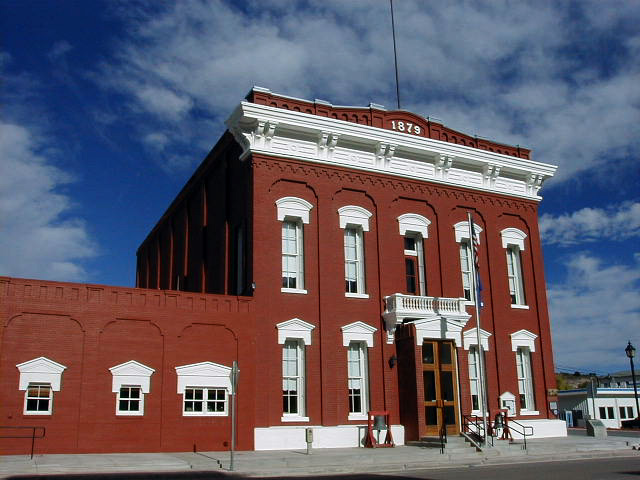
#11 Eureka County Courthouse
The Nevada legislature created Eureka County in 1873. Officials renovated a former ice rink donated by Judge John O'Darrow to serve as the first county courthouse. A fortified jail and fireproof vault were added to the 40-by-100-foot wooden building located at the intersection of Main and Bateman Streets. After fire destroyed hundreds of buildings in the town of Eureka in 1879, officials became concerned about their wooden courthouse and accepted plans from George C. Costerisan for a more formidable structure. The county hired R. Ryland to construct the courthouse. He withdrew from the project shortly after the completion of the exterior, at which point Costerisan finished the interior. J.S. Whitton supervised the construction, and McNally and Hawkins of San Francisco provided the heating and plumbing. |
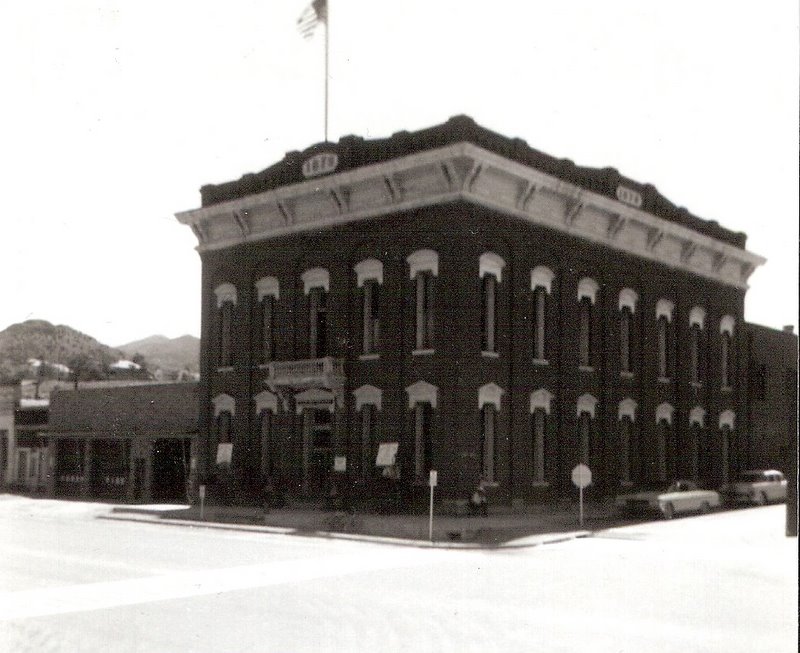
Court house in the early 1950s. Building on the left was a fire house at that time.
|
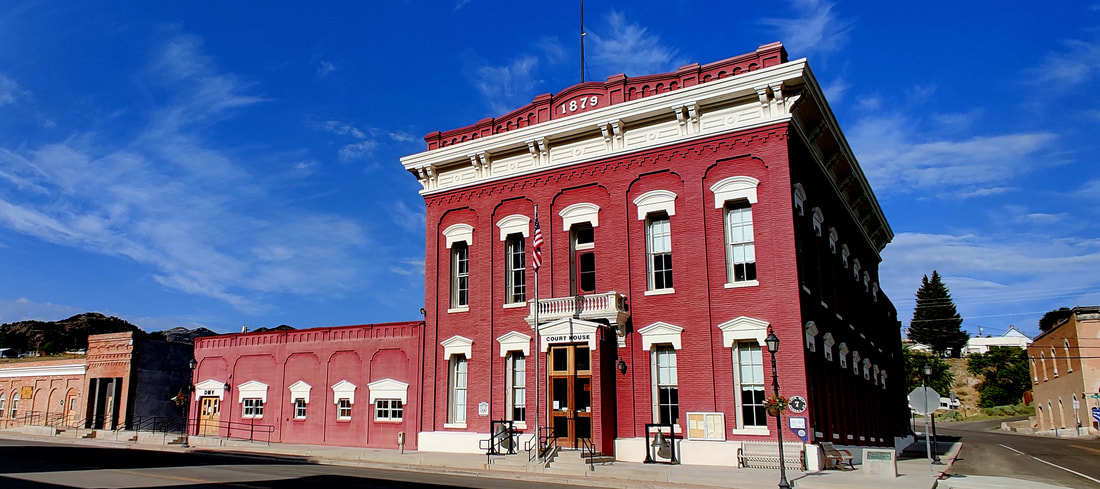
Construction of this two-story brick structure began in 1879 and was completed in 1880. The building was added to the already existing jail which remained in use through the 1980s. Construction of the courthouse cost $38,000. It was designed in a modest Italianate, turn-of-the-century style, but additional expenses for a vault and other fixtures brought the price to $50,000. The brick two-story structure measures 50-by-80-feet and stands fifty-one feet high. A second-floor balcony supported by brackets rests over the main entrance. Exterior accents include brick pilasters that rise to a metal-bracketed cornice, and a parapet wall with detailed brickwork. The large iron shutters adjacent to the windows and doors of the courthouse (and other buildings of the town) protected the windows from fires and other damages.
Interior details consist of an imported Spanish cedar judge's bench and balustrade and gilded accents throughout. Two of the original walk-in
safes are still useable. The doors are 6 inches thick iron with lovely summer scenes painted on them.The second-floor courtroom is recognized as the best preserved in Nevada. It measures forty-five square feet with a nineteen-foot high ceiling of pressed metal. A suspended gallery at the rear provides seating for one hundred. The semi-circular witness box placed in front of the judge's bench is distinctive because of its shape and its unusual location. When it was completed, it was the finest courthouse in the state of Nevada outside Virginia City. The building is one of two nineteenth-century Nevada courthouses still in use today; the other is the one located in Virginia City.
The two large bells in front of the courthouse were rung as fire alarms by two of Eureka's several volunteer fire companies. One was cast in Cincinnati, Ohio, and the other in San Francisco. Each bell was identified by its tone.
Interior details consist of an imported Spanish cedar judge's bench and balustrade and gilded accents throughout. Two of the original walk-in
safes are still useable. The doors are 6 inches thick iron with lovely summer scenes painted on them.The second-floor courtroom is recognized as the best preserved in Nevada. It measures forty-five square feet with a nineteen-foot high ceiling of pressed metal. A suspended gallery at the rear provides seating for one hundred. The semi-circular witness box placed in front of the judge's bench is distinctive because of its shape and its unusual location. When it was completed, it was the finest courthouse in the state of Nevada outside Virginia City. The building is one of two nineteenth-century Nevada courthouses still in use today; the other is the one located in Virginia City.
The two large bells in front of the courthouse were rung as fire alarms by two of Eureka's several volunteer fire companies. One was cast in Cincinnati, Ohio, and the other in San Francisco. Each bell was identified by its tone.
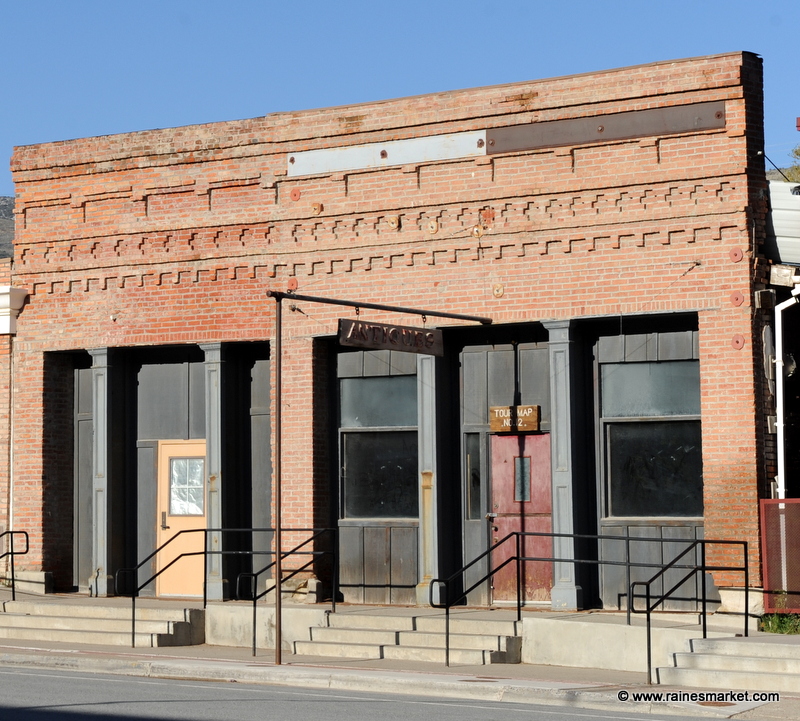
#12 The Annex
This red brick building with iron columns was built in 1880 and used as a wholesale liquor store. During the 1890s it was a stationery store and post office. The Farmers and Merchants Bank was located here in the 1930s. The Farmers and Merchants Bank was one of the few banks in the country that did not close down during the Bank Holiday of the 1930s. Later in the 1930s the bank moved down and across the street to the location on the corner of Clark and Main Streets that banks held until 2016. This building was demolished by Eureka County in 2019/20.
This red brick building with iron columns was built in 1880 and used as a wholesale liquor store. During the 1890s it was a stationery store and post office. The Farmers and Merchants Bank was located here in the 1930s. The Farmers and Merchants Bank was one of the few banks in the country that did not close down during the Bank Holiday of the 1930s. Later in the 1930s the bank moved down and across the street to the location on the corner of Clark and Main Streets that banks held until 2016. This building was demolished by Eureka County in 2019/20.
#13 Eureka Senior Center
The older portion of this building was erected in the summer of 1880. The iron doors and columns were cast by the local Eureka Foundry Company. It has housed many businesses over the years including a grocery store, variety store, and mortuary. The new extension to the building occupies the area where the two story Turner House/Bureau Hotel once stood in the 1870s and early 1880s.
The older portion of this building was erected in the summer of 1880. The iron doors and columns were cast by the local Eureka Foundry Company. It has housed many businesses over the years including a grocery store, variety store, and mortuary. The new extension to the building occupies the area where the two story Turner House/Bureau Hotel once stood in the 1870s and early 1880s.
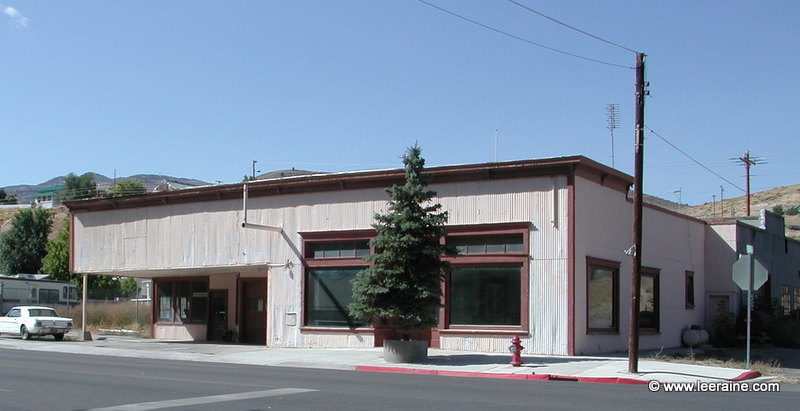
#14 Rebaleati Garage
On this site stood a hotel and boarding house that was owned and operated by the Rebaleati Family until it burned down in the early 1900s. The building in the photo was built prior to 1917. From about 1917 to 1941, the site was the Ford Dealership and Garage. Mr. Rebaleati sold and serviced Model Ts and Model As. The dirt floor was finally upgraded in the early 1930s. The southern portion of the building was built around 1945 to house generators that provided the first electricity to the town of Eureka. Electricity was produced in this building for the town from 1945-1972. The building in this picture has been demolished, but the property still remains in the Rebaleati family. Storage sheds are present occupants.
On this site stood a hotel and boarding house that was owned and operated by the Rebaleati Family until it burned down in the early 1900s. The building in the photo was built prior to 1917. From about 1917 to 1941, the site was the Ford Dealership and Garage. Mr. Rebaleati sold and serviced Model Ts and Model As. The dirt floor was finally upgraded in the early 1930s. The southern portion of the building was built around 1945 to house generators that provided the first electricity to the town of Eureka. Electricity was produced in this building for the town from 1945-1972. The building in this picture has been demolished, but the property still remains in the Rebaleati family. Storage sheds are present occupants.
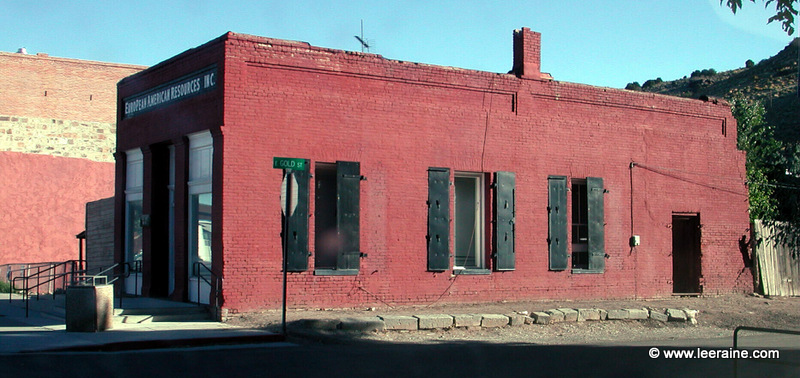
#15 San Francisco Brewery
This building was the San Francisco Brewery in the mid-1870s. Beer was bottled in the back and there was a saloon in the front portion. The original wood structure burned down in the fire of August, 1880. Later that year a brick structure was built on the site by H. Mau and Company. After 1900 Frank Brossemer purchased the building and ran a saloon in front and bottled soda pop in the back. |
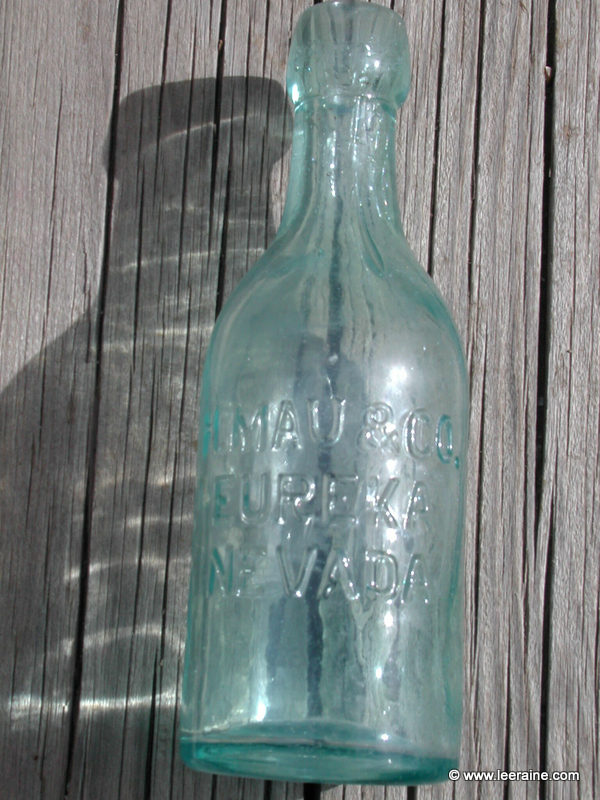
H. Mau and Company bottle
|
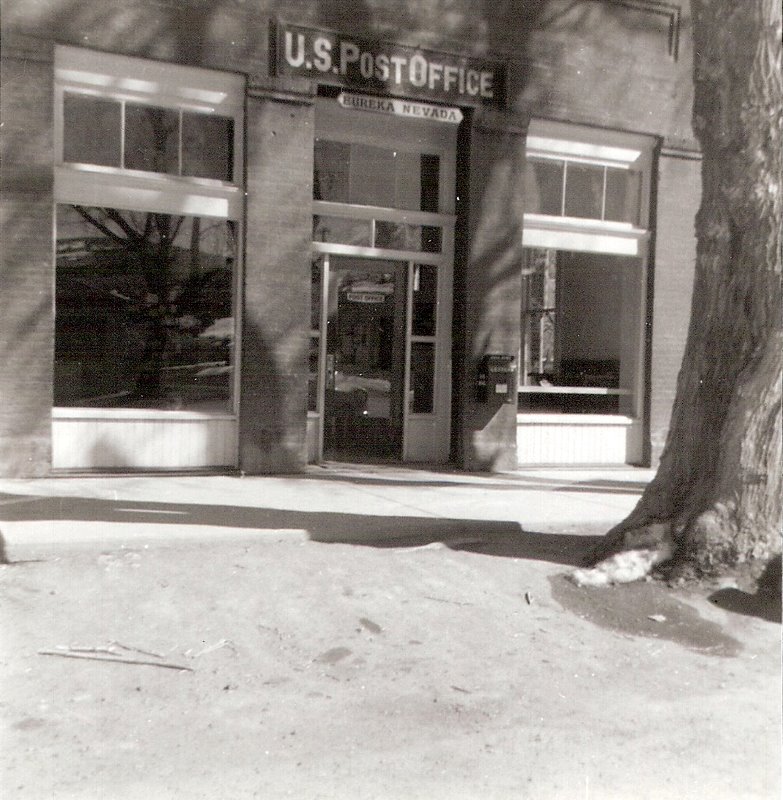
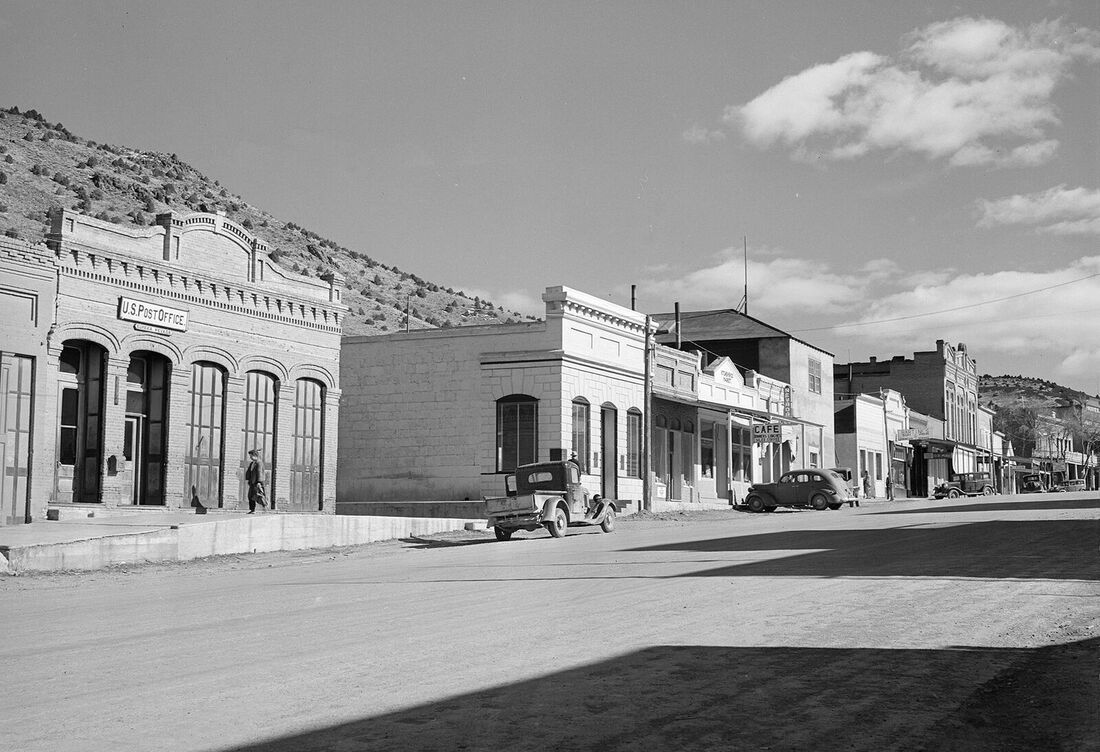
The Eureka Post Office was located here from 1941 until 1982.
|
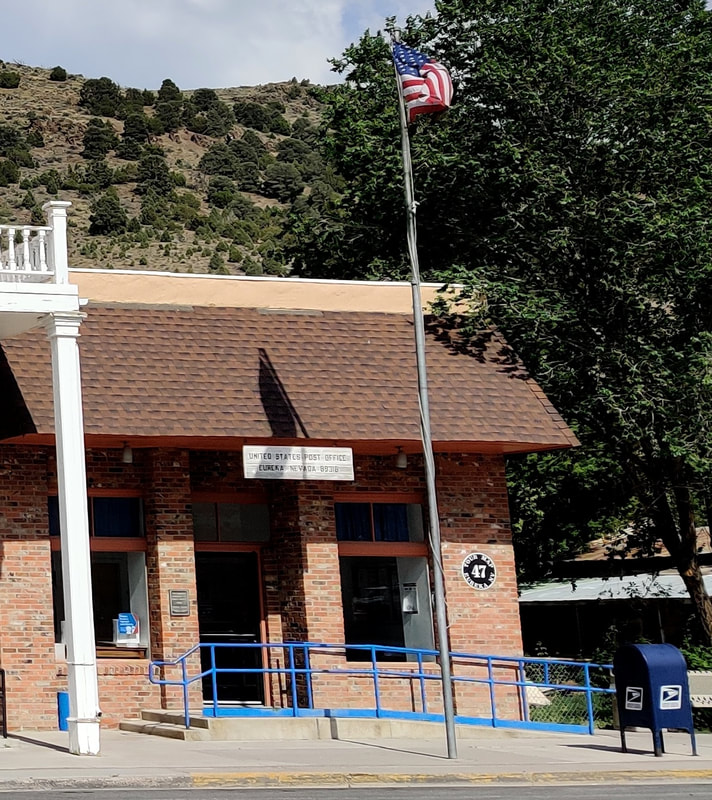
#16 Eureka Post Office
This building was built after the August 17, 1880 fire which started in the store next door. The Eureka Market, a butcher shop, was here in the 1880s. If you step inside you can see the old pressed tin ceiling with floral and bird designs. Remodeled in 1982 into a post office.
This building was built after the August 17, 1880 fire which started in the store next door. The Eureka Market, a butcher shop, was here in the 1880s. If you step inside you can see the old pressed tin ceiling with floral and bird designs. Remodeled in 1982 into a post office.
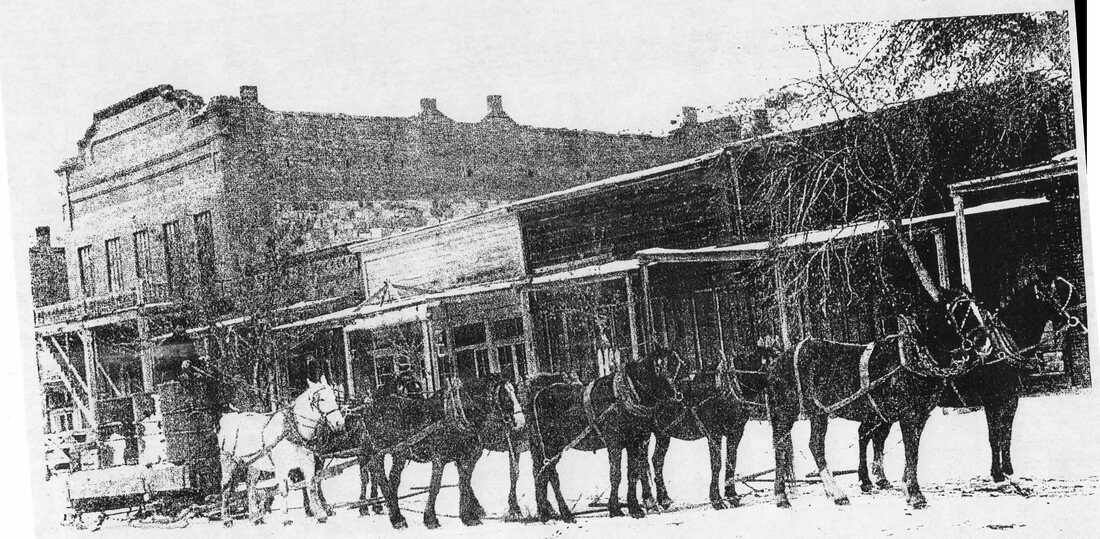
Wagon team pulling sled on Main Street.
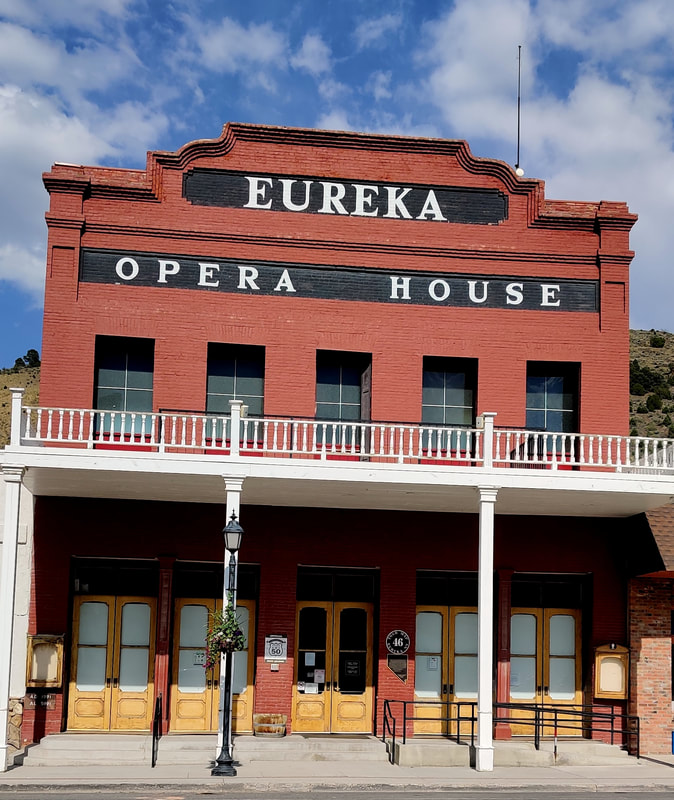
#17 Eureka Opera House
Eureka, Nevada is proud to have one of the best two restored and usable opera houses in the state. The other is Piper’s Opera House in Virginia City. The Eureka Opera House, built in 1880 when the population of the town was about 3,000, has always served as a gathering place. Eureka’s Opera House, today, is a full service convention center and Cultural Arts Center. The building is used for conventions, meetings, and community functions as well as cultural presentations. It is open to the public for tours year-around. It has meeting, kitchen, and catering capacity to accommodate over 300 people.
The Eureka Opera House was built on the ashes of the old Odd Fellows Hall, which was destroyed by the great main street fire of August 1879. The Opera House was used for the first time for the New Year’s Eve Costume Ball in 1880. The November 11, 1880 Eureka Daily Sentinel newspaper stated, "The building is, according to the plan of work now being carried on, to be thoroughly fire-proof, built with masonry (volcanic tuff) walls, brick and iron front, and slate roof. From the basement to dome the new theatre will be furnished as none of the class have ever been in Eureka. Its arrangement is pronounced to be first-class, for ventilation, for heat, for means of egress in case of fire, and in fact for a "thousand and one" reasons it is bound to be a beneficial and permanent monument to the memory of those who have erected, and who will so soon elegantly furnish the same for the edification of our people."
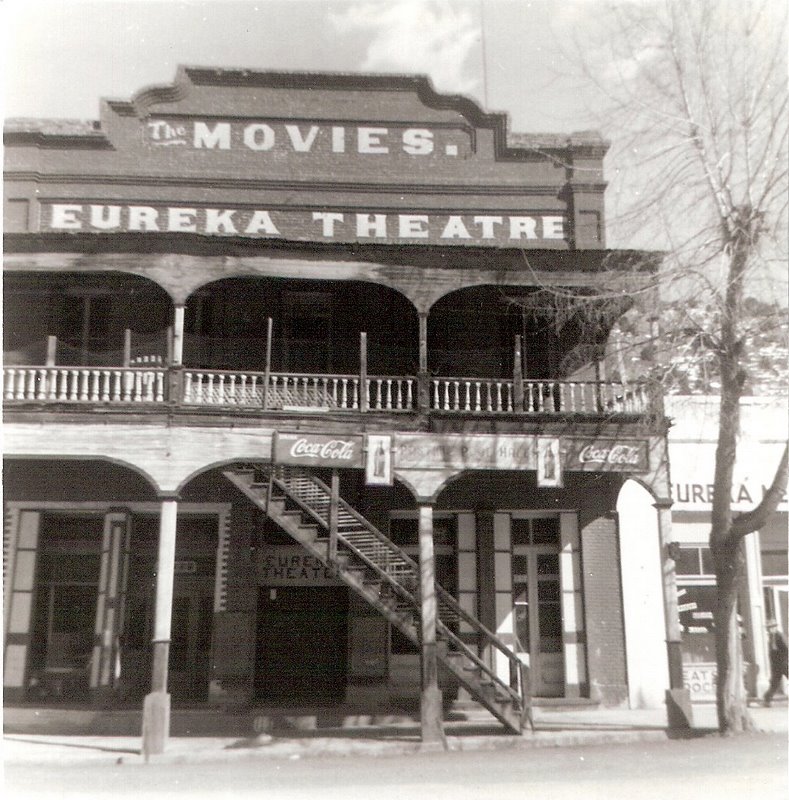
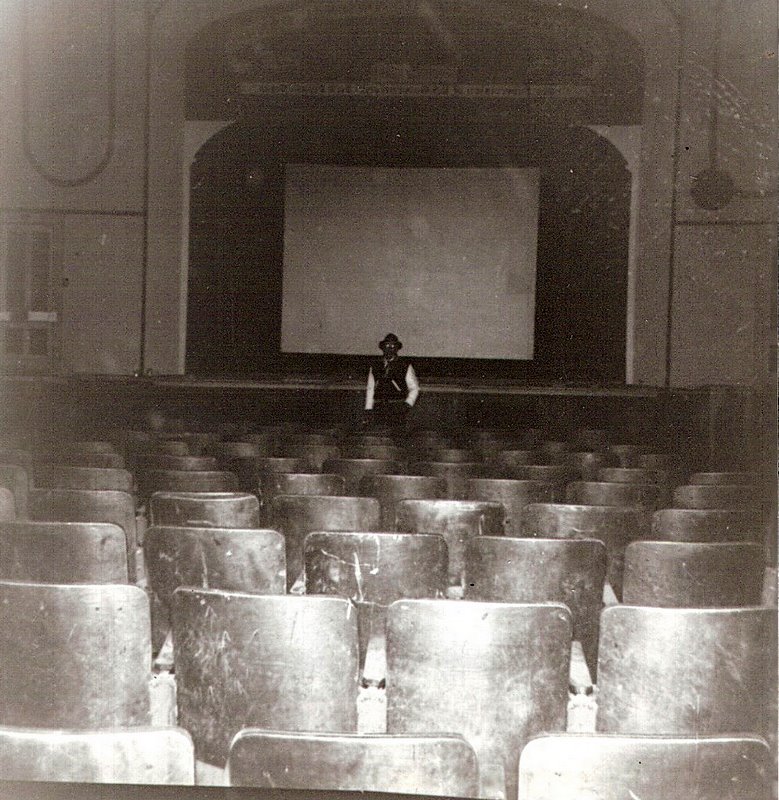
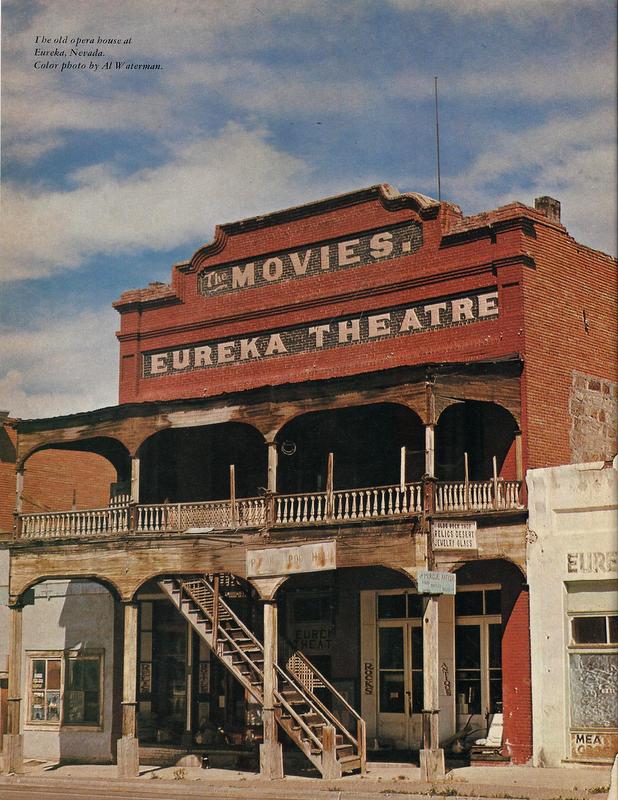
Eureka was on the main tour circuit for opera and theater performances and many famous personalities performed here during the town’s hey-day. The opera house served as a community auditorium showing anything of interest including boxing, speeches, plays, graduations, and dances including annual Nob Hill Fire Company Masquerade Ball held every year from 1880 until well into the 1900s. The first silent movie was shown there in 1915 and then in the 1920s the opera house was changed into the Eureka Theatre and “talkie” movies were presented.
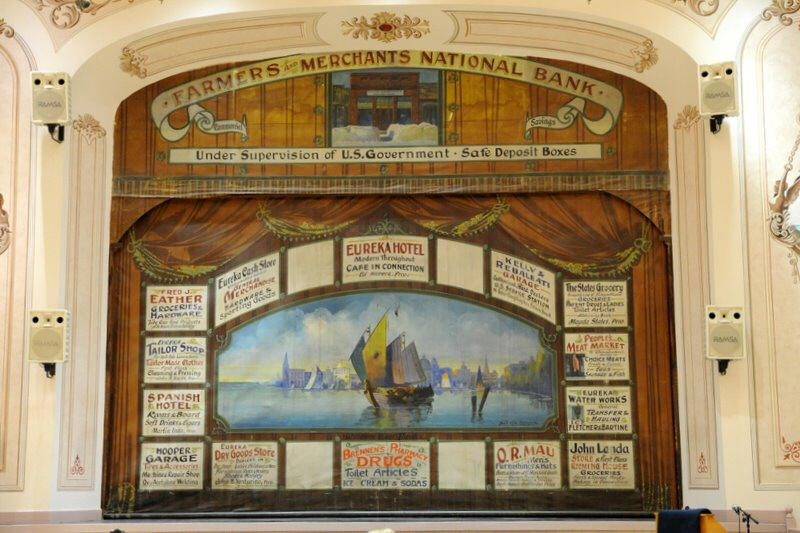
In December 1923, a fire caused by a misplaced lantern destroyed the oleo stage curtain that was originally hand-painted in Italy. The curtain was replaced in 1924 with a new one painted in Minneapolis, featuring advertisements for local businesses from 1924. The 1924 oleo curtain still hangs at the front of the stage.
The last movie was shown in 1958 and the building fell into disrepair.
In 1990, Eureka County acquired the structure and began a three-year restoration. The Opera House reopened on October 5, 1993. The Building received the 1994 National Preservation Honor Award.
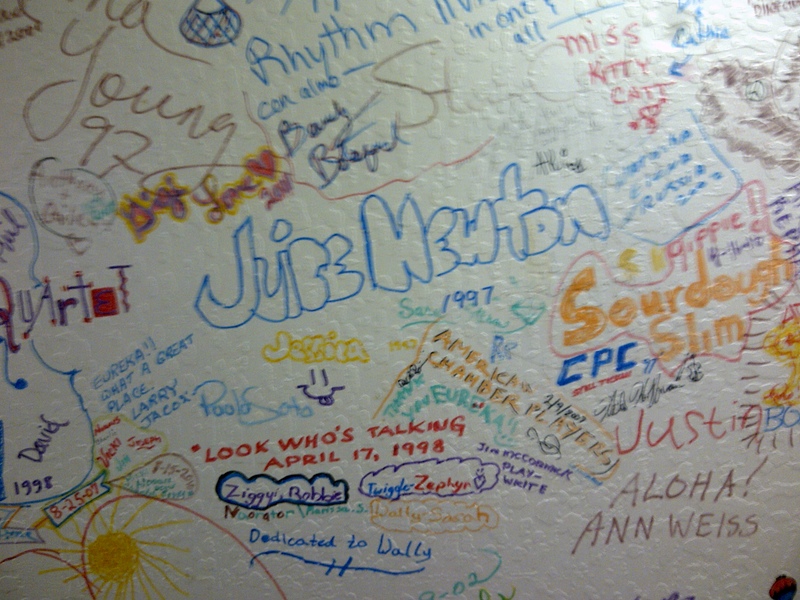
Other historic elements such as the original projectors from the early days of the silent movies, the first "talkies" projector, and a carbon-arc spotlight are on display. Historic graffiti has been preserved back stage from the early days and the tradition has been continued with signatures of the people who have performed at the Eureka Opera House since it was reopened.
The Opera House maintains a monthly schedule of cultural events as well as local events. Make them an excuse to visit and explore historic Eureka, the best-preserved historical mining town in Nevada.
Eureka, Nevada is proud to have one of the best two restored and usable opera houses in the state. The other is Piper’s Opera House in Virginia City. The Eureka Opera House, built in 1880 when the population of the town was about 3,000, has always served as a gathering place. Eureka’s Opera House, today, is a full service convention center and Cultural Arts Center. The building is used for conventions, meetings, and community functions as well as cultural presentations. It is open to the public for tours year-around. It has meeting, kitchen, and catering capacity to accommodate over 300 people.
The Eureka Opera House was built on the ashes of the old Odd Fellows Hall, which was destroyed by the great main street fire of August 1879. The Opera House was used for the first time for the New Year’s Eve Costume Ball in 1880. The November 11, 1880 Eureka Daily Sentinel newspaper stated, "The building is, according to the plan of work now being carried on, to be thoroughly fire-proof, built with masonry (volcanic tuff) walls, brick and iron front, and slate roof. From the basement to dome the new theatre will be furnished as none of the class have ever been in Eureka. Its arrangement is pronounced to be first-class, for ventilation, for heat, for means of egress in case of fire, and in fact for a "thousand and one" reasons it is bound to be a beneficial and permanent monument to the memory of those who have erected, and who will so soon elegantly furnish the same for the edification of our people."
Eureka was on the main tour circuit for opera and theater performances and many famous personalities performed here during the town’s hey-day. The opera house served as a community auditorium showing anything of interest including boxing, speeches, plays, graduations, and dances including annual Nob Hill Fire Company Masquerade Ball held every year from 1880 until well into the 1900s. The first silent movie was shown there in 1915 and then in the 1920s the opera house was changed into the Eureka Theatre and “talkie” movies were presented.
In December 1923, a fire caused by a misplaced lantern destroyed the oleo stage curtain that was originally hand-painted in Italy. The curtain was replaced in 1924 with a new one painted in Minneapolis, featuring advertisements for local businesses from 1924. The 1924 oleo curtain still hangs at the front of the stage.
The last movie was shown in 1958 and the building fell into disrepair.
In 1990, Eureka County acquired the structure and began a three-year restoration. The Opera House reopened on October 5, 1993. The Building received the 1994 National Preservation Honor Award.
Other historic elements such as the original projectors from the early days of the silent movies, the first "talkies" projector, and a carbon-arc spotlight are on display. Historic graffiti has been preserved back stage from the early days and the tradition has been continued with signatures of the people who have performed at the Eureka Opera House since it was reopened.
The Opera House maintains a monthly schedule of cultural events as well as local events. Make them an excuse to visit and explore historic Eureka, the best-preserved historical mining town in Nevada.
#18 Jackson House
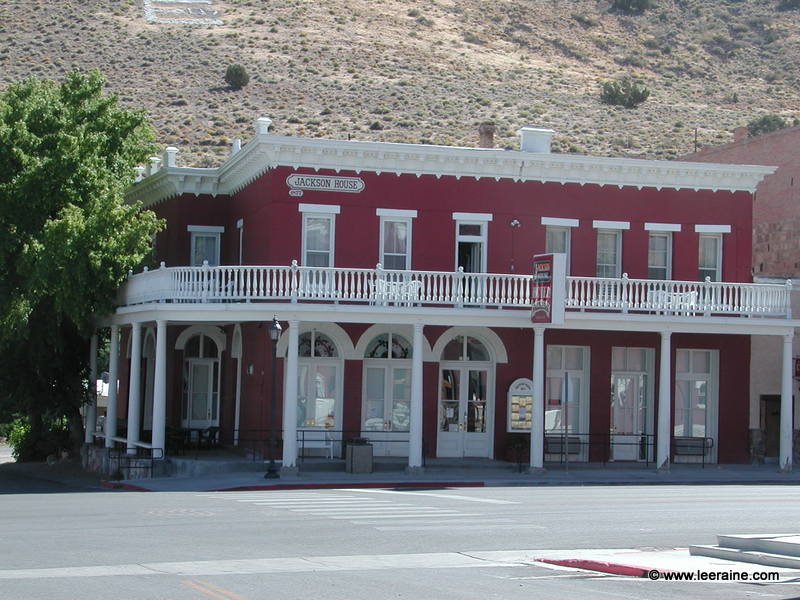
This brick building was built in 1877 as the famous Jackson House. The building was gutted in the 1880 fire, but was rebuilt and operated until the 1890s. It was advertised as the only fire-proof hotel in Nevada. In 1907 it became the Brown Hotel and operated under that name for many years. In 1981 it was restored as a historical building and once again called the Jackson House. It operates as a bar, restaurant and hotel when open.
In 2021 the Tourist Information Center is located in the downstairs of the historic Jackson House Hotel at 11 S. Main Street. https://www.visiteurekanevada.net/ is their website.
This brick building was built in 1877 as the famous Jackson House. The building was gutted in the 1880 fire, but was rebuilt and operated until the 1890s. It was advertised as the only fire-proof hotel in Nevada. In 1907 it became the Brown Hotel and operated under that name for many years. In 1981 it was restored as a historical building and once again called the Jackson House. It operates as a bar, restaurant and hotel when open.
In 2021 the Tourist Information Center is located in the downstairs of the historic Jackson House Hotel at 11 S. Main Street. https://www.visiteurekanevada.net/ is their website.
#19 Ryland Building (private residence)
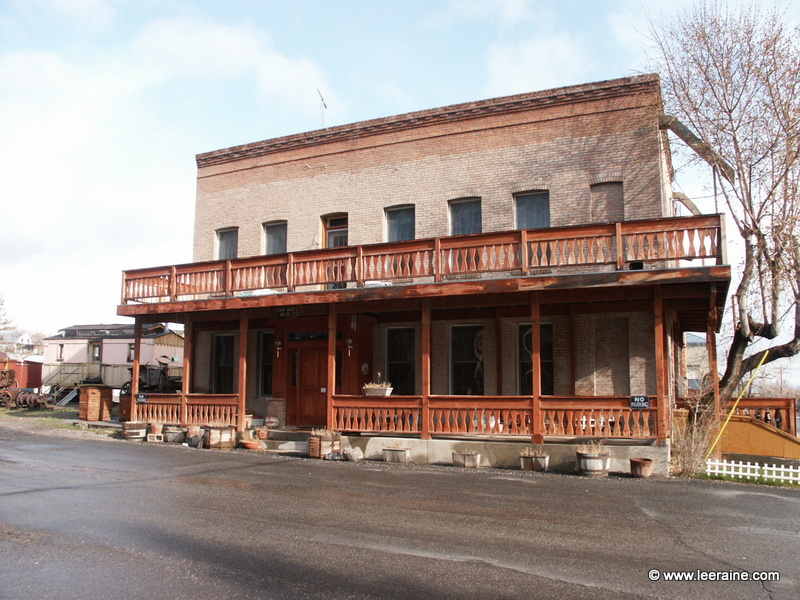
This is the second building to occupy this spot. The first was destroyed by the August, 1880 fire. The building has been used as offices, apartments and a restaurant. It has been restored and is now a private home. |
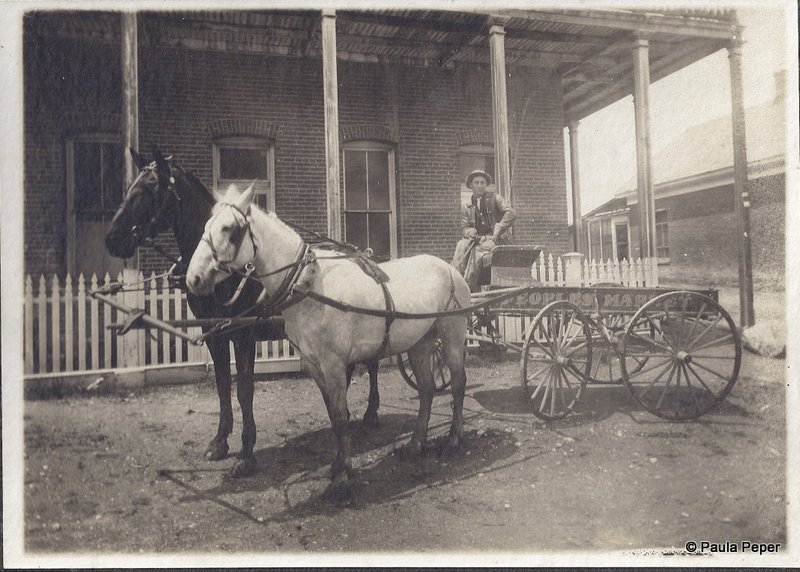
Rudolph Zadow driving the butcher wagon for People’s Market, taken June 8, 1907, on Bateman Street in front of what may be the Ryland Building in Eureka.
|
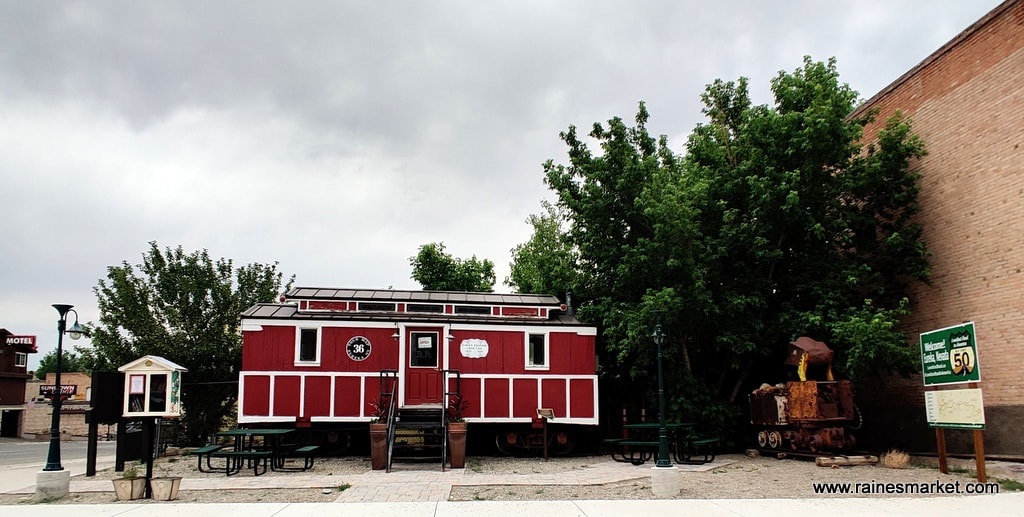
#20 Crew Car 29
This crew car is the only piece of rolling stock left in Eureka County from the Eureka & Palisade Railroad. The once thriving railroad began in 1875 when Eureka businessmen formed a railroad company and sold stock to wealthy San Francisco bankers who made their fortune from the Comstock mines in Virginia City. The narrow gauge railroad was built to haul refined ore from the Eureka smelters and several other mining camps, some eighty miles to Palisade, where it connected with the main line of the transcontinental Central Pacific Railroad. This crew car was used as sleeping quarters for the men working on the rail line. The first train of the Eureka & Palisade Railroad arrived in October 1875. The railroad was revived in 1912 and ran until 1938. When construction of the Eureka & Palisade Railroad began in 1874, Palisade became the headquarters for the railroad where it met the Central Pacific Railroad. By 1878, 31 million pounds of ore had been shipped through Palisade. Once the Eureka-Nevada railroad folded in 1938, only a handful of people were left in Palisade and after its post office finally closed in 1961, it became a ghost town.
This area is currently a small park with tourist information and a Little Free Library.
This crew car is the only piece of rolling stock left in Eureka County from the Eureka & Palisade Railroad. The once thriving railroad began in 1875 when Eureka businessmen formed a railroad company and sold stock to wealthy San Francisco bankers who made their fortune from the Comstock mines in Virginia City. The narrow gauge railroad was built to haul refined ore from the Eureka smelters and several other mining camps, some eighty miles to Palisade, where it connected with the main line of the transcontinental Central Pacific Railroad. This crew car was used as sleeping quarters for the men working on the rail line. The first train of the Eureka & Palisade Railroad arrived in October 1875. The railroad was revived in 1912 and ran until 1938. When construction of the Eureka & Palisade Railroad began in 1874, Palisade became the headquarters for the railroad where it met the Central Pacific Railroad. By 1878, 31 million pounds of ore had been shipped through Palisade. Once the Eureka-Nevada railroad folded in 1938, only a handful of people were left in Palisade and after its post office finally closed in 1961, it became a ghost town.
This area is currently a small park with tourist information and a Little Free Library.
|
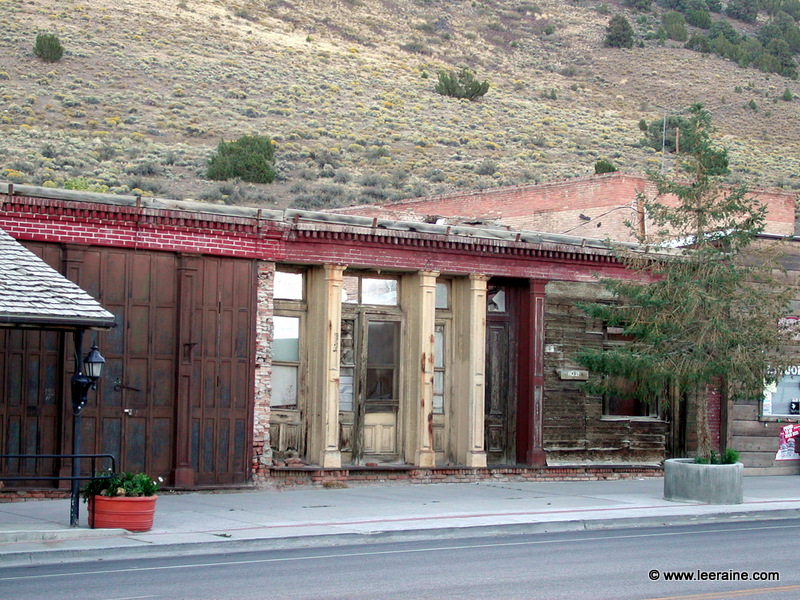
#21 Foley-Rickard-Johnson-Remington Building This was the site of Eureka's first adobe house built by Abe Bateman. In 1879 M. D. Foley and Richard Rickard built this brick structure which was originally a two-story building. The cost when completed was approximately $28,000. The Remington, Johnson and Company hardware store was located in the northern portion of the present building in the 1880s and 1890s. A book store and stationery store, saloon, assay office, and wells Fargo Express Office used other portions of the first floor during this period. The upstairs was the Masonic and Odd Fellow's Hall. During the 1920s groceries were sold in the old Remington Store. The original iron columns remain today. The second story of the building was completely demolished in 1983 after earthquake damage.
|
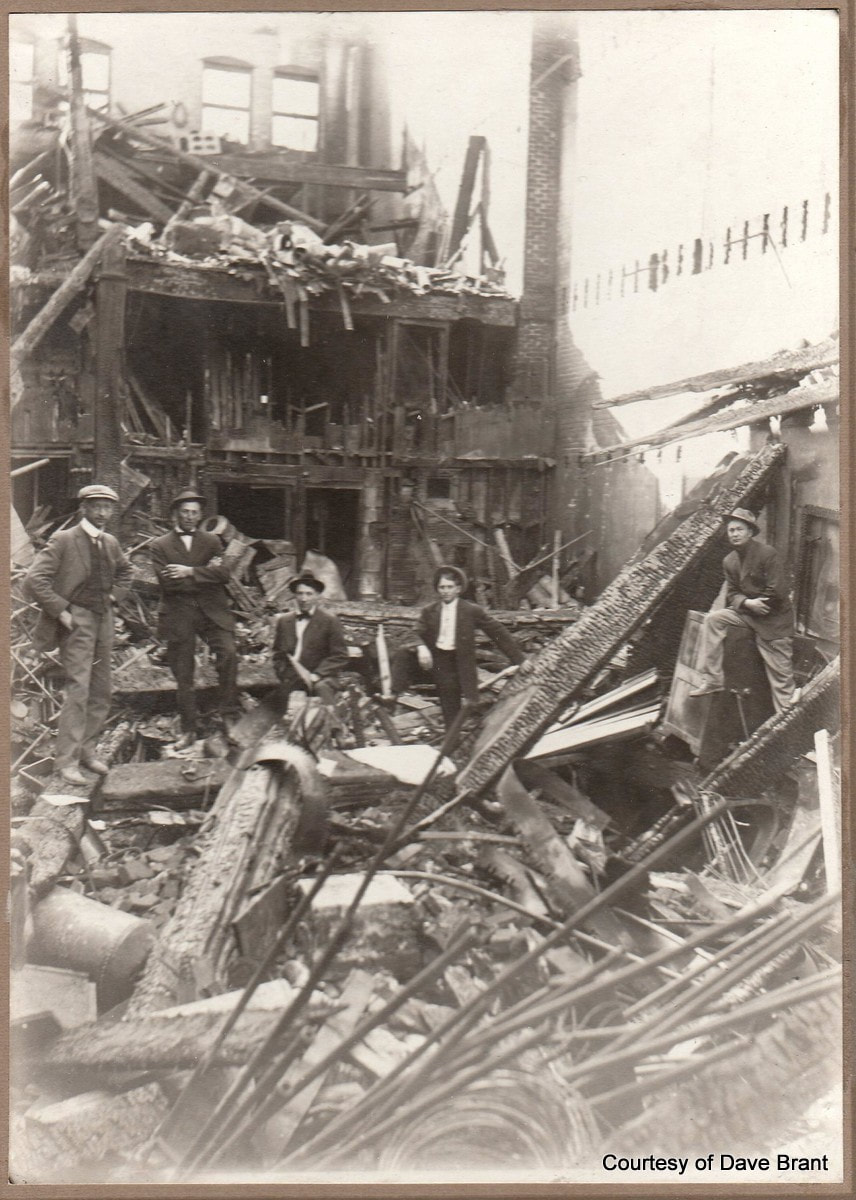
Back of Remington building circa 1912
|
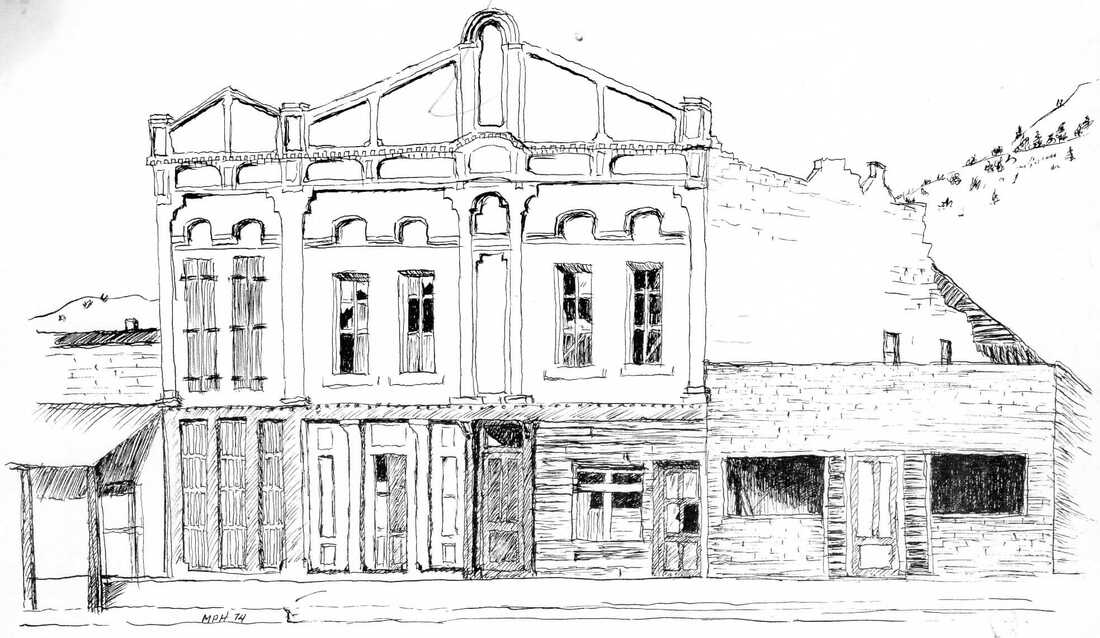
Remington building drawing by Marion Hoekenga.
Upper portion was destroyed in 1983 after earthquake damage.
|
Main Street circa 1880s.
|
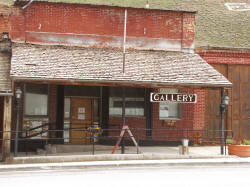
#22 Eureka Gallery
Paxton and Co. Bank was Eureka's first bank. Contained inside the bank was a large fireproof vault. Inside the vault were brass safety deposit boxes. The vault has an arched ceiling of brick and a walk-in iron door. The bank had a chance to prove its claim that the vault was fireproof two times. The entire side of town containing the bank burned to the ground, leaving only the vault. The bank was rebuilt around the vault. Eighteen months later the identical area burned again. The only thing left standing was the vault, uninjured. Once more, the bank was built around the vault. The bank issued its own currency with its name on the bills. Around 1890, a Western Union Telegraph Office was added to the bank. The bank closed, but the vault remains. By the year 1941, a store occupied this building and in later years it was operated as the Gold Bar. For a period of time after that it was a gift shop called the Tommyknocker then became a gallery and gift shop, open occasionally. |
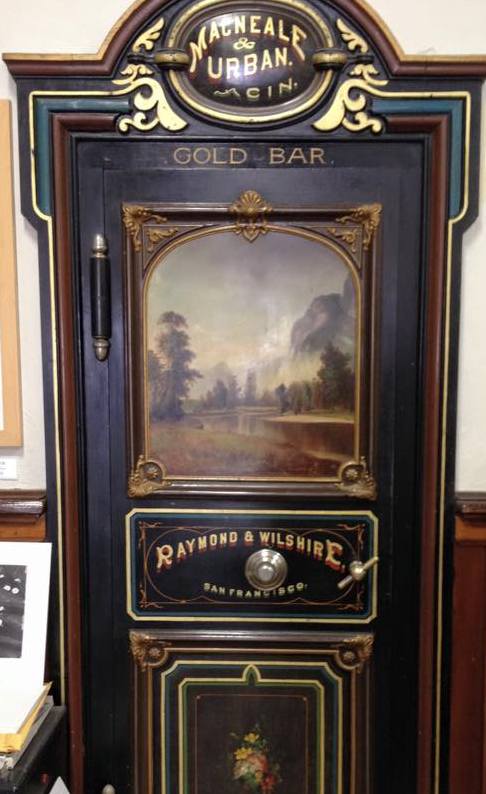
Gold Bar Bank Vault
|
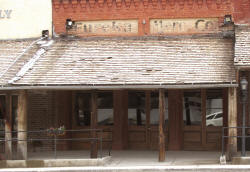
#23 Stone Building with iron shutters.
The original building on this site was built in the late 1870s and operated as a hardware business until the fires of 1879. The present building was completed in September of 1879. At that time, it became a clothing store. In the early 1900s the Mau Brothers purchased the building and sold clothing, shoes, books, and stationery out of the it.
The building is called the Eureka Mercantile.
The original building on this site was built in the late 1870s and operated as a hardware business until the fires of 1879. The present building was completed in September of 1879. At that time, it became a clothing store. In the early 1900s the Mau Brothers purchased the building and sold clothing, shoes, books, and stationery out of the it.
The building is called the Eureka Mercantile.
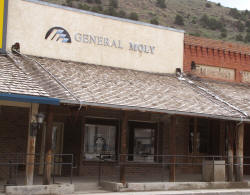
#24 The Raine Building
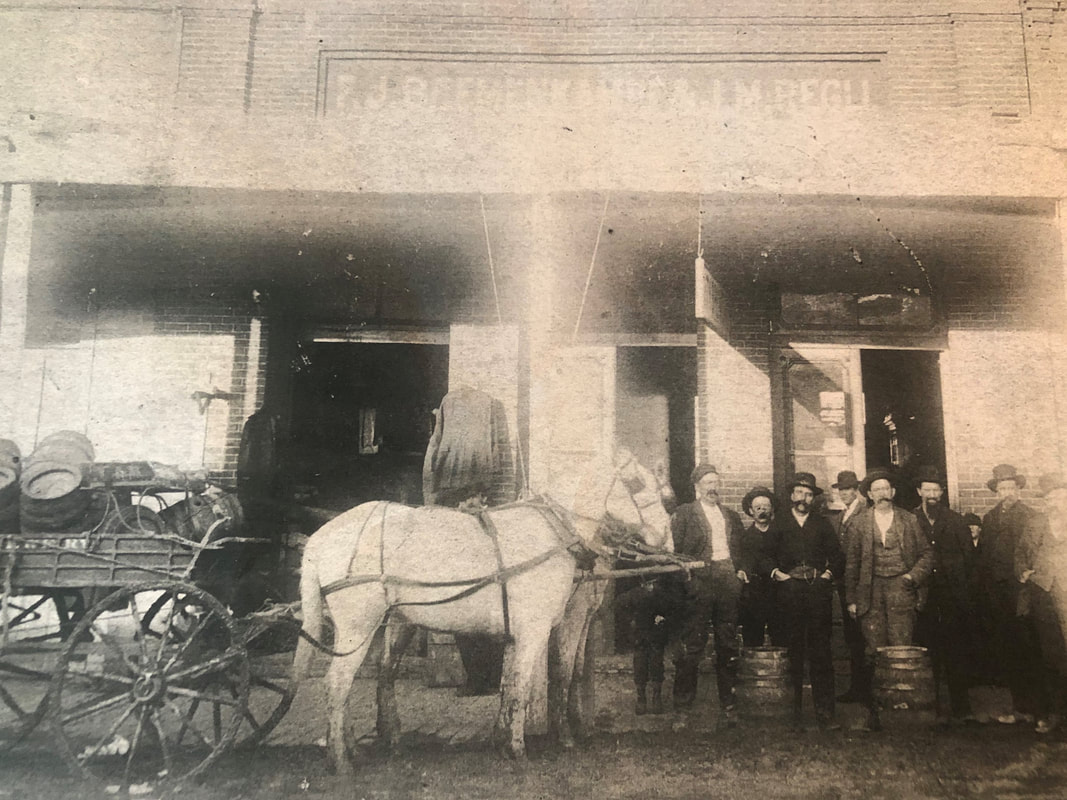
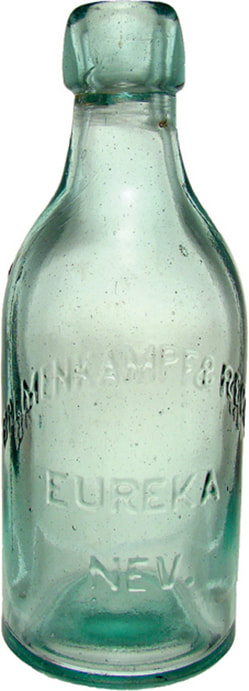
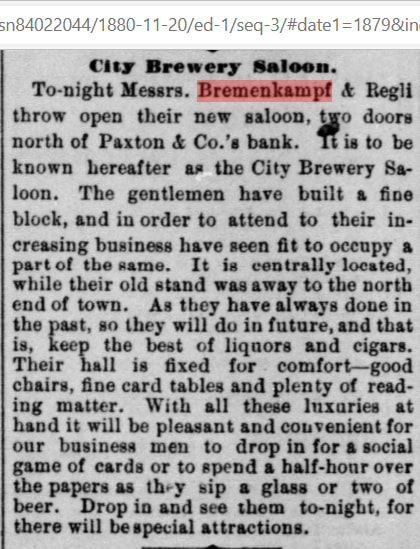
This building was the City Brewery and Soda Works, which supplied the first beer in Eureka. It has been a barber shop, the Bank Club Bar, and from about 1945 into the 1960s, it was Bays Fountain. The building has been owned by the Raine Family since the 1970s. It was the Tumbleweed movie theater during the 1970s and a ceramic and gift shop called the "Hanging Tree" into the 21st century. It is currently occupied by mining offices.
Circa 1880, City Brewery Saloon: Bremenkampf and Regli Props open Day and night second door next to Paxton Bank Eureka Nevada.
This building was the City Brewery and Soda Works, which supplied the first beer in Eureka. It has been a barber shop, the Bank Club Bar, and from about 1945 into the 1960s, it was Bays Fountain. The building has been owned by the Raine Family since the 1970s. It was the Tumbleweed movie theater during the 1970s and a ceramic and gift shop called the "Hanging Tree" into the 21st century. It is currently occupied by mining offices.
Circa 1880, City Brewery Saloon: Bremenkampf and Regli Props open Day and night second door next to Paxton Bank Eureka Nevada.
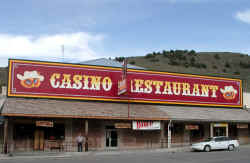
#25 Owl Club Bar and Steakhouse
Originally this establishment was a two-story structure. The C. P. Brewery was downstairs and the Palace Saloon upstairs. A one story structure was built after the 1880 fire. This building has been used as a bar and cafe for many years. It has now been consolidated with the Nevada Club buildings described below. The Carrion family purchased the Owl Club Bar & Steakhouse from Harland Hiles in 1981.
Originally this establishment was a two-story structure. The C. P. Brewery was downstairs and the Palace Saloon upstairs. A one story structure was built after the 1880 fire. This building has been used as a bar and cafe for many years. It has now been consolidated with the Nevada Club buildings described below. The Carrion family purchased the Owl Club Bar & Steakhouse from Harland Hiles in 1981.
#26 Nevada Club
The southern portion of this establishment was originally called the Tiger Saloon. It gained notoriety on separate occasions. Gunfights in the saloon resulted in the death of two men. The original frame structure was destroyed in fire in March, 1880. After the March, 1880 fire, the saloon was rebuilt as a two story frame structure in only 13 days. No sooner had the new saloon been rebuilt, when it was consumed again by the August, 1880 fire. The northern portion of the building was constructed in 1880 or1881 by Joseph Tognini & Company. The saloon and dance hall continued to operate into the 1890s. The building was again destroyed around the turn of the century. In 1930, the present two story concrete and brick structure was rebuilt. During the 1940s and 50s, Pete Laborde ran the Nevada Club. Jim and Lorraine Dotson bought the property from Laborde. In 2001, the Carrion family bought the property and incorporated it with #25, the Owl Club.
The southern portion of this establishment was originally called the Tiger Saloon. It gained notoriety on separate occasions. Gunfights in the saloon resulted in the death of two men. The original frame structure was destroyed in fire in March, 1880. After the March, 1880 fire, the saloon was rebuilt as a two story frame structure in only 13 days. No sooner had the new saloon been rebuilt, when it was consumed again by the August, 1880 fire. The northern portion of the building was constructed in 1880 or1881 by Joseph Tognini & Company. The saloon and dance hall continued to operate into the 1890s. The building was again destroyed around the turn of the century. In 1930, the present two story concrete and brick structure was rebuilt. During the 1940s and 50s, Pete Laborde ran the Nevada Club. Jim and Lorraine Dotson bought the property from Laborde. In 2001, the Carrion family bought the property and incorporated it with #25, the Owl Club.
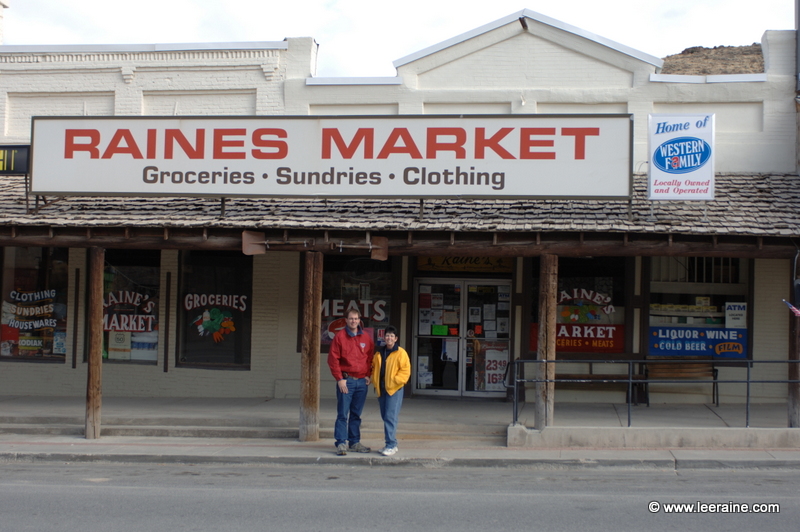
#27 Raine's Market Building
There are actually two historical buildings used as Raine's Market. The southern portion of the building was known as the Bishop and Chamblin building after its owners who completed the brick structure in June 1880. The earlier frame structure occupied by F. J. Schneider's drugstore and Spiro Gregovich's restaurant burned on March 16, 1880, but the new brick building survived the August 1880 fire. F. J. Schneider's Drugstore moved back in the new building and remained there into the 1910s. Another portion of the building has been used as Brown, Tassel and Company shoe and boot store in 1880, a saloon in 1886, and an assay office in 1890. In about 1929 the building became Kitchen Brothers' Market owned by Joe and Hiram Kitchen. After Hiram Kitchen passed away April 23, 1972, the business was put up for sale and sold by the Kitchen estate becoming Raine's Market in July 1973. The northern section was built in 1879 by W. J. Smith and Company as a saloon. This building also survived the fire of 1879. After the fire it was opened as the San Francisco Clothing Store by H. Kayser in the spring of 1880 after the Tognoni building burned earlier in March. And it survived the August 1880 fire. Wholesale liquor was sold in this portion of Raine's Market in 1886 by W. J. Tonkin. It was also a warehouse, a saloon, a men's clothing store, and a notions store. From the 1940s to 1978 it was the Eureka Drug and Fountain containing a restaurant and soda fountain and later a curio shop. The original pressed tin ceiling can still be seen in this portion of the building. It was combined with Raine's Market in 1979. After 43 years in this location, the Raine's Market business moved to a new location at 901 North Main Street in August 2016. The new Raine’s Supermarket / ACE Hardware opened for business there 15 August 2016. |
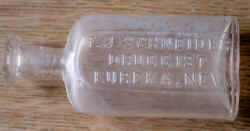
Schneider's Drug bottle
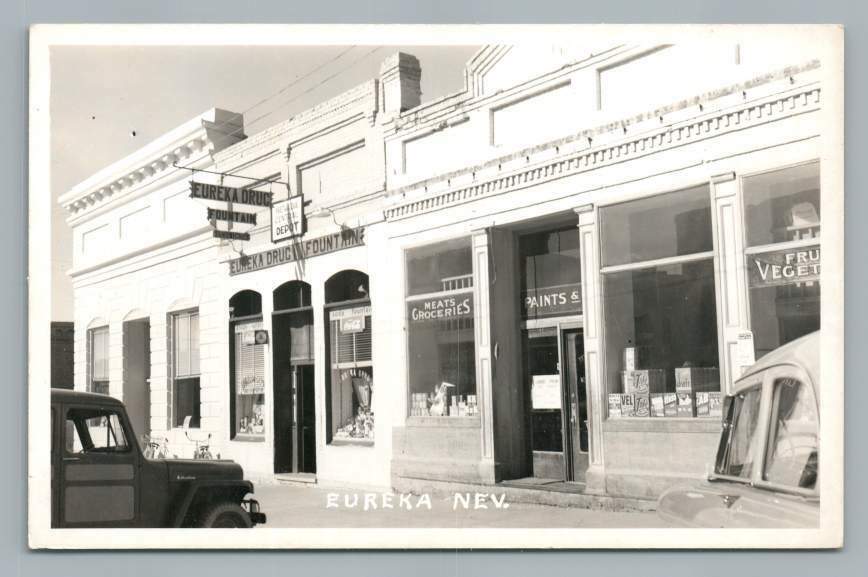
Eureka Drug and Fountain
|
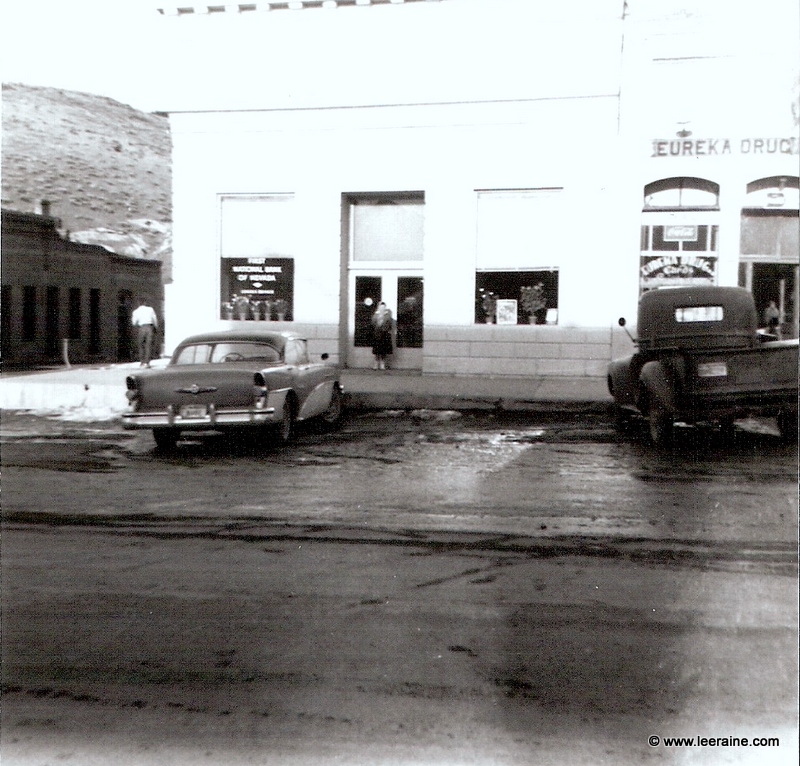
First National Bank and Eureka Drug in the 1950s.
|
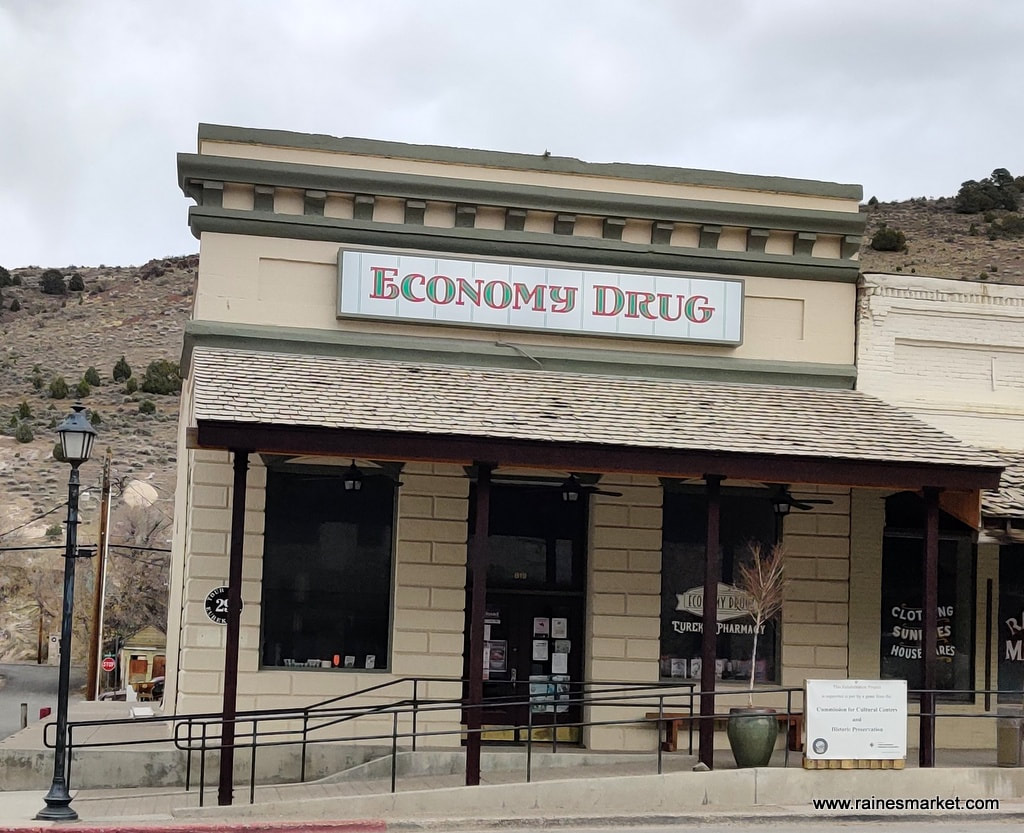
2021
|
#28 Charles Lautenschlager Building
This was the original site of the first livery stable in Eureka, established by Ham and Hunter in the early 1870s. A stone building was built here later, but prior to 1873. Housed in it was what was advertised in 1878 as "The Corner! The Largest and Finest Saloon in the State." Charles Lautenschlager bought the building in 1879 and promptly tore it down. He had just completed a new building when it was burned down in the fire of April, 1879. He erected the present store building in October of the same year. A saloon operated in the front and the Old Corner Chop House was in the rear. Around 1912, the building housed the Lani and Repetto Saloon and Eureka Brewery.
This was the original site of the first livery stable in Eureka, established by Ham and Hunter in the early 1870s. A stone building was built here later, but prior to 1873. Housed in it was what was advertised in 1878 as "The Corner! The Largest and Finest Saloon in the State." Charles Lautenschlager bought the building in 1879 and promptly tore it down. He had just completed a new building when it was burned down in the fire of April, 1879. He erected the present store building in October of the same year. A saloon operated in the front and the Old Corner Chop House was in the rear. Around 1912, the building housed the Lani and Repetto Saloon and Eureka Brewery.
In the late 1930s, the Farmers and Merchants Bank, founded by Edna Howard Covert Plummer in July, 1920, was moved to this location. (Edna C. Plummer held the distinction of being the first woman in the nation to found a national bank. She was also the first woman district Attorney in the nation serving in that office in Eureka County in 1918.) The Farmers and Merchants Bank was the only bank in Nevada to stay open during the Bank Holiday of 1933. Banks were ordered not to re-open after the closing of a certain business day. The Farmers and Merchants Bank simply stayed open 24 hours a day until the holiday ended. Later this bank became the First National Bank of Nevada, in 1981, the First Interstate Bank of Nevada, in 1996, Wells Fargo Bank, and then Nevada State Bank. The NS Bank business moved to a new location at 901 North Main Street in September 2016.
The building is renovated as a drug store.
The building is renovated as a drug store.
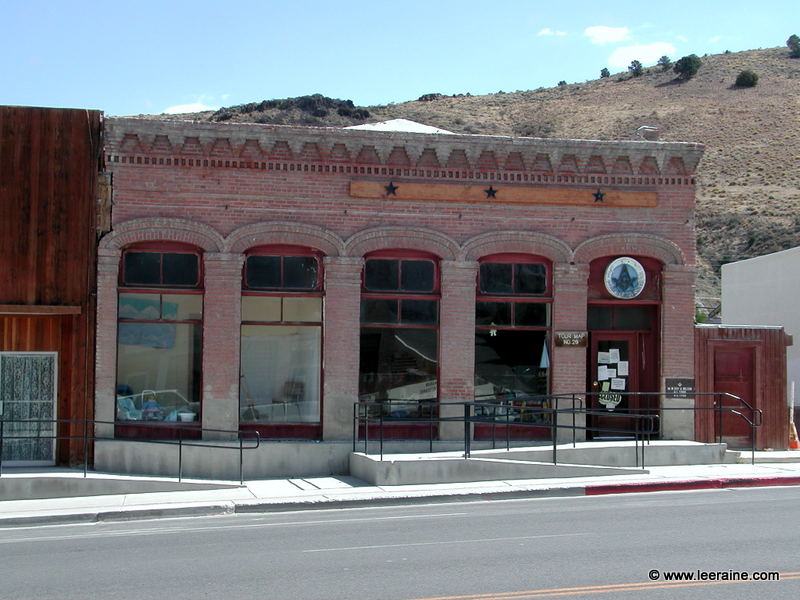
#29 Masonic Building
The American Exchange Building stood on this corner before the fire of August, 1880 when it was destroyed. Inside the building were offices and stores. After the fire, the owner of the property, James Whitton, built the present brick building. Over the next few years, it contained a dry good store, jewelry store, barber shop, bath house, tailor shop and tinsmith shop.
In 1907, a portion of the building was used as the Eureka Post Office and the rest of the building was vacant. It was noted in the October 25th 1871 Eureka Sentinel that Postmaster James Whitton, owner of the American Hotel, was building a fireproof cellar built under the hotel building.
In 1872 the Odd Fellows bought the old American Hotel building. The Masonic Lodge received its charter in 1872 and had its first meetings in the office of Judge J. P. Adams. The Odd Fellows met and shared the building as a meeting place with the Masons. Later the Odd Fellows membership fell so low that they joined their lodge with the one in Ely and sold the building to the Eureka Masonic Lodge No. 16 for $1.00. Today the building is under renovation. It is believed to be the only underground Masonic temple in use in the United States.
Eureka Lodge #16 Free and Accepted Masons meets the Second Saturday of every month at 2pm.
Local Master Masons have been known to give tours upon request.
The American Exchange Building stood on this corner before the fire of August, 1880 when it was destroyed. Inside the building were offices and stores. After the fire, the owner of the property, James Whitton, built the present brick building. Over the next few years, it contained a dry good store, jewelry store, barber shop, bath house, tailor shop and tinsmith shop.
In 1907, a portion of the building was used as the Eureka Post Office and the rest of the building was vacant. It was noted in the October 25th 1871 Eureka Sentinel that Postmaster James Whitton, owner of the American Hotel, was building a fireproof cellar built under the hotel building.
In 1872 the Odd Fellows bought the old American Hotel building. The Masonic Lodge received its charter in 1872 and had its first meetings in the office of Judge J. P. Adams. The Odd Fellows met and shared the building as a meeting place with the Masons. Later the Odd Fellows membership fell so low that they joined their lodge with the one in Ely and sold the building to the Eureka Masonic Lodge No. 16 for $1.00. Today the building is under renovation. It is believed to be the only underground Masonic temple in use in the United States.
Eureka Lodge #16 Free and Accepted Masons meets the Second Saturday of every month at 2pm.
Local Master Masons have been known to give tours upon request.
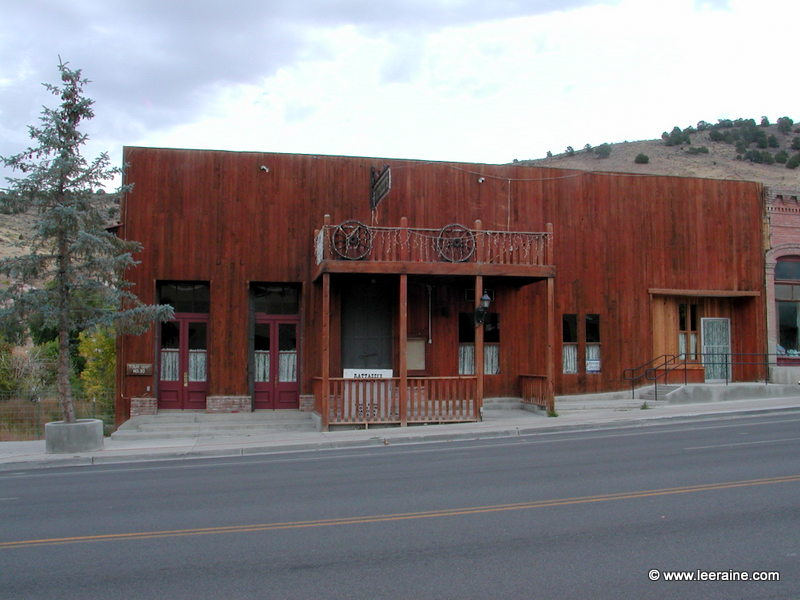
#30 Rattazzis
This establishment is a combination of two original buildings. The southern part was Brown and Godfrey's Oyster Saloon, Chop House and confectionery. It was open 24 hours a day and was the only candy maker in town. During the remodeling of this building in 1994, innumerable oyster shells were found. The northern half of the building was the Knights of Pythias Lodge, a fraternal and benevolent society founded in 1864. The adjoining buildings now provide a bar and restaurant when open.
This establishment is a combination of two original buildings. The southern part was Brown and Godfrey's Oyster Saloon, Chop House and confectionery. It was open 24 hours a day and was the only candy maker in town. During the remodeling of this building in 1994, innumerable oyster shells were found. The northern half of the building was the Knights of Pythias Lodge, a fraternal and benevolent society founded in 1864. The adjoining buildings now provide a bar and restaurant when open.
|
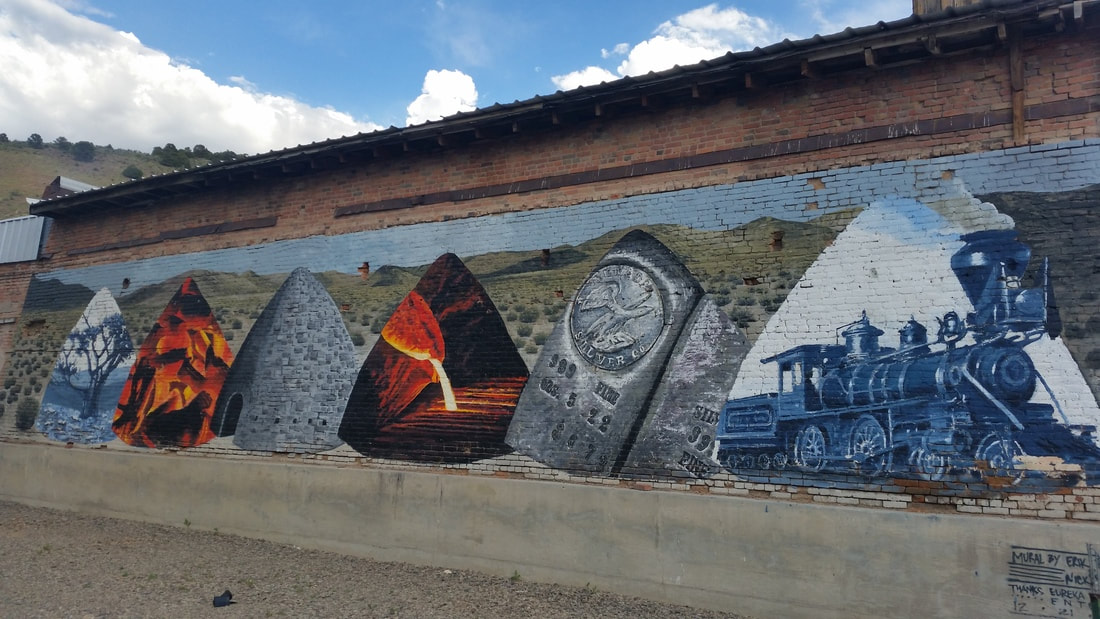
Mural of the charcoal ovens and the silver-smelting process created by artist Erik Burke, a Reno, Nevada native, appears on the north wall of the Rattazzi building.
On the right is the Eureka Veterans' Park. which lies between items 30 and 31. |
|
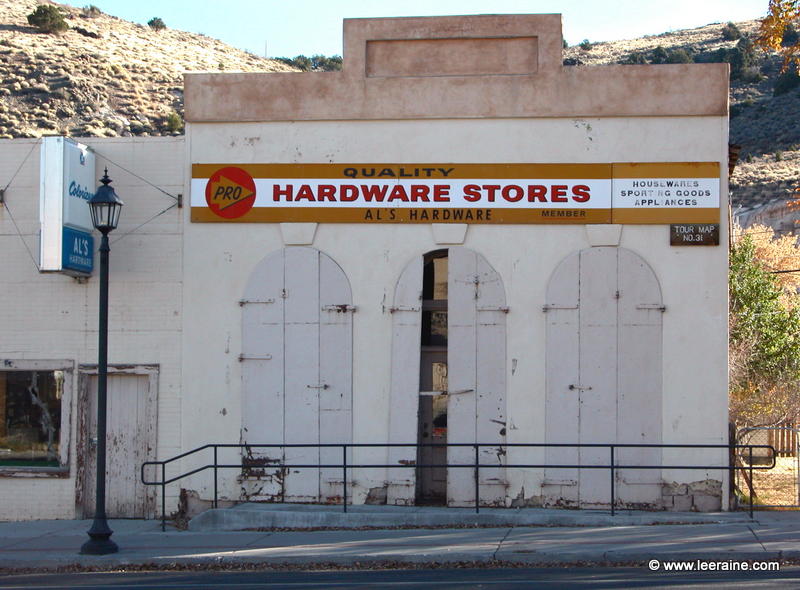
#31 Al's Hardware
This building has been owned by the same family since the 1870s. It was originally a two-story building but, after the two fires, it was reduced to one story. It began as the Stone Saloon with a boarding house upstairs. In 1903, it became the Eureka Cash Store. In 1946, Al Biale took over from his father and started Al's Hardware. Al Biale operated the hardware business until his retirement. Al's son Arthur continued the business and also eventually retired. Al's daughter and son-in-law continued in the same tradition. The business is now closed, but the building remains in the Biale family.
This building has been owned by the same family since the 1870s. It was originally a two-story building but, after the two fires, it was reduced to one story. It began as the Stone Saloon with a boarding house upstairs. In 1903, it became the Eureka Cash Store. In 1946, Al Biale took over from his father and started Al's Hardware. Al Biale operated the hardware business until his retirement. Al's son Arthur continued the business and also eventually retired. Al's daughter and son-in-law continued in the same tradition. The business is now closed, but the building remains in the Biale family.
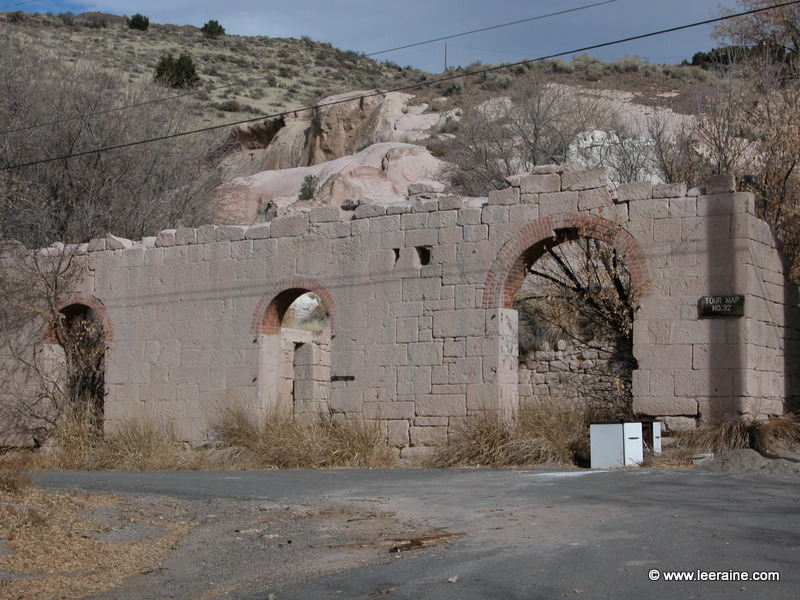
#32 Stone Building
This native stone building was several things, most notably a warehouse. Notice the excellent stone work. The blocks were cut to fit together using a mortar made from local clay. The front portion shown in this photo has since fallen down and only the back wall remains. A private residence is on the lot. It has been removed from the walking tour.
This native stone building was several things, most notably a warehouse. Notice the excellent stone work. The blocks were cut to fit together using a mortar made from local clay. The front portion shown in this photo has since fallen down and only the back wall remains. A private residence is on the lot. It has been removed from the walking tour.
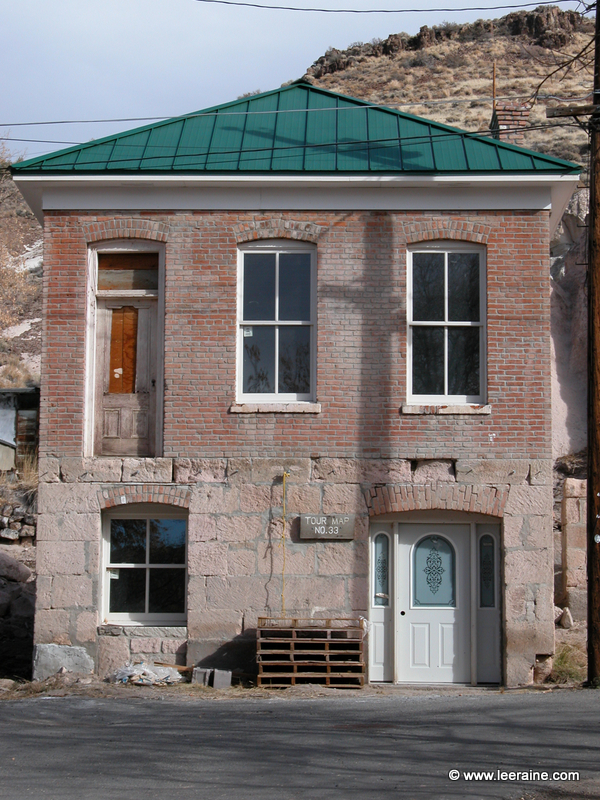
#33 Skillman House
This two-story brick building was known as the Skillman House. It was the home of Archibald Skillman, founder and publisher of the Eureka Sentinel Newspaper in 1870. Skillman sold the newspaper in 1944, but this property remained in the Skillman family for many years.
This two-story brick building was known as the Skillman House. It was the home of Archibald Skillman, founder and publisher of the Eureka Sentinel Newspaper in 1870. Skillman sold the newspaper in 1944, but this property remained in the Skillman family for many years.
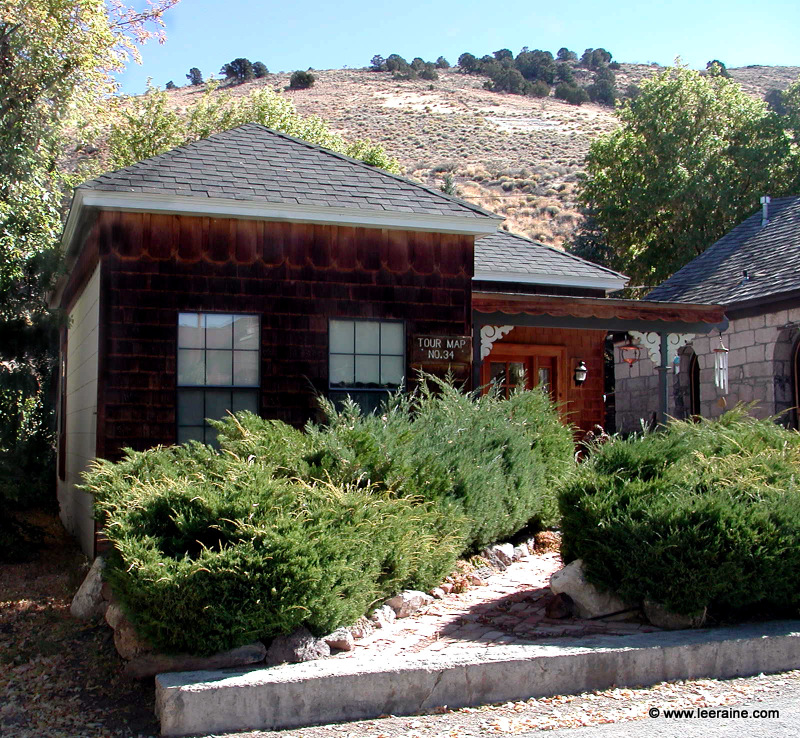
#34 The Parsonage House
This house known as the Parsonage House was originally built in 1886. There have been two major renovations to this house over the past 100 years of its existence. The latest renovation was completed in 1986 and it has served as a bed and breakfast and a private residence.
This house known as the Parsonage House was originally built in 1886. There have been two major renovations to this house over the past 100 years of its existence. The latest renovation was completed in 1986 and it has served as a bed and breakfast and a private residence.
#35 Old Methodist Church
Now a private residence. The first two Methodist Churches were destroyed by two of Eureka's famous fires. The present structure was dedicated in 1881. A newspaper article on the building states that it had a library, vestibule, and small sleeping area for visiting clergy. The insides were said to be richly arrayed with red fern carpeting, stain glass windows, and seating for 250 people. During the 1920s revivals were held in the church. In 1982, it was only a shell when it was purchased and remodeled by private individuals. It has served as a bed and breakfast. |
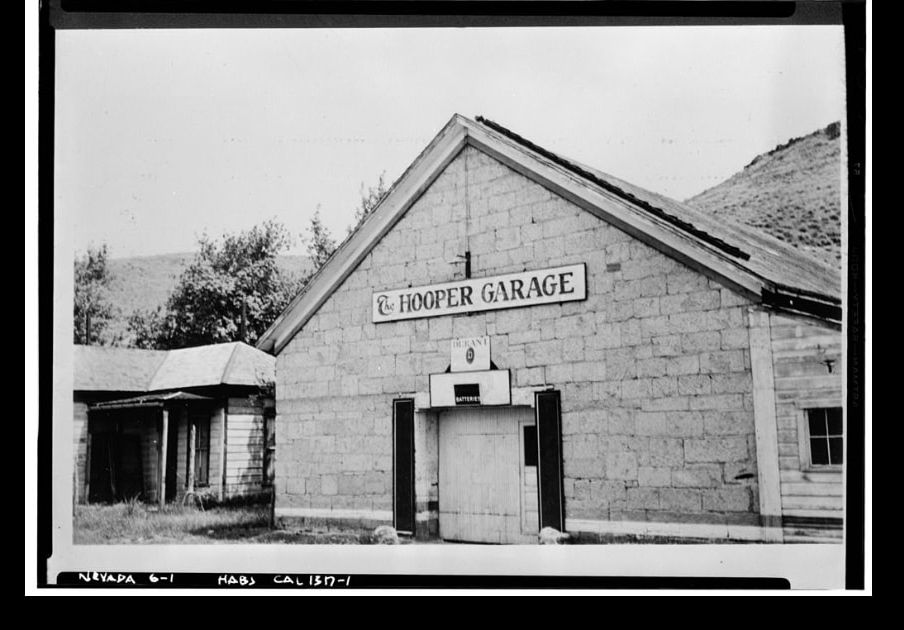
Historic American Buildings Survey, Creator, and W Bailey, Nevada Professional & Service Project, photographer. First Methodist Church, Spring Street, Eureka, Eureka County, NV. Nevada Eureka County Eureka, 1933.
|
#36 Saint James Episcopal Church
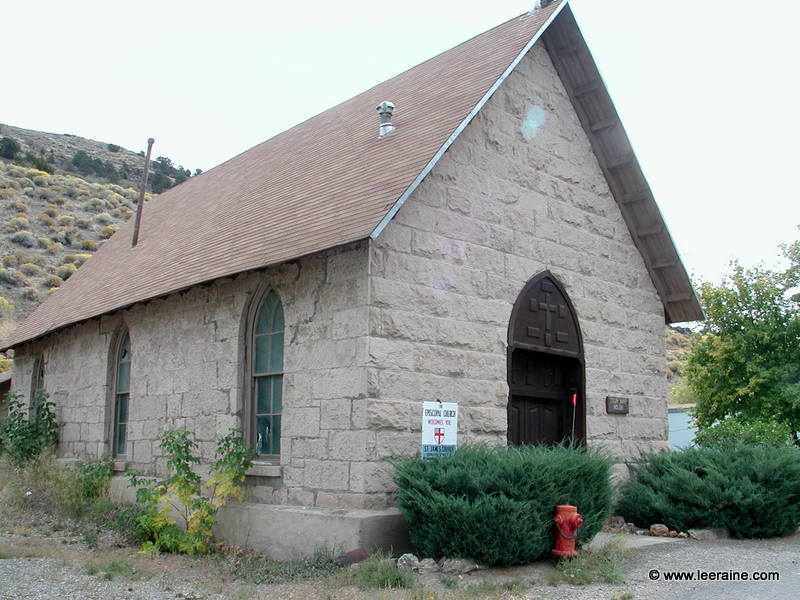
This is Eureka's first permanent Church, built in 1872, one year after the cornerstone was laid. It was built to accommodate the miners who had come from England. Regular services were held from 1893 until the church was closed in 1907. The building is made of hand-cut local volcanic stone and survived the disastrous fires of the 1880s. Today church services are again held here on a regular basis. |
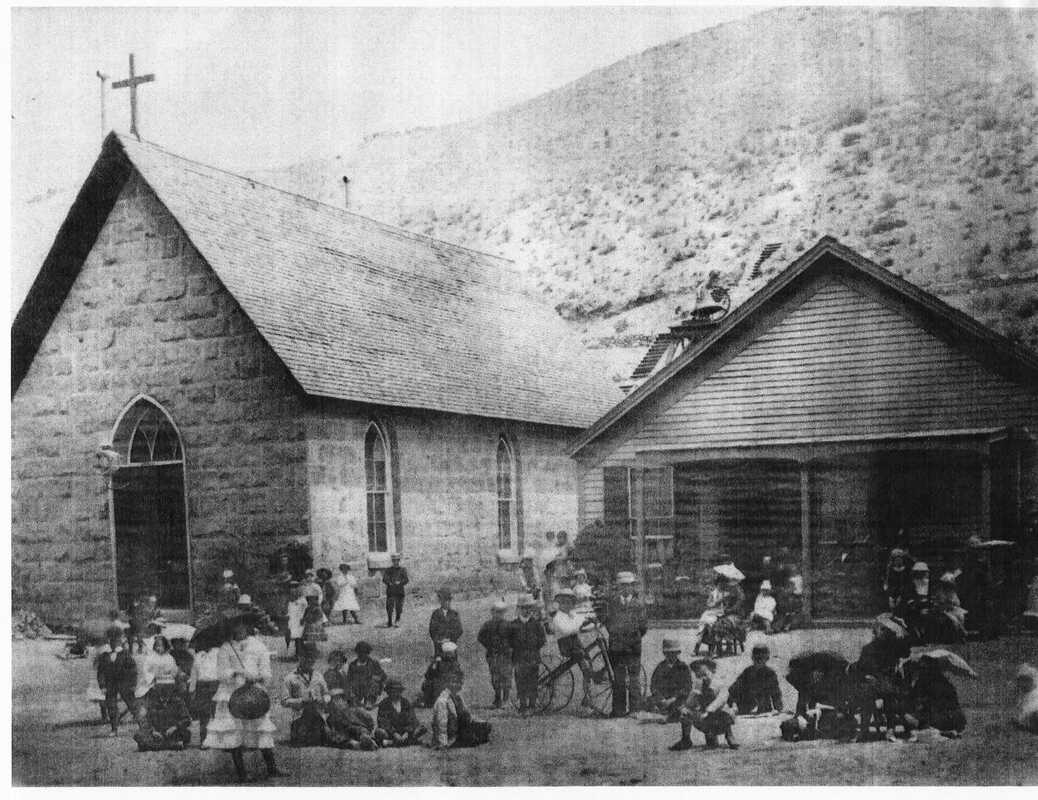
Saint James Episcopal Church
|
|
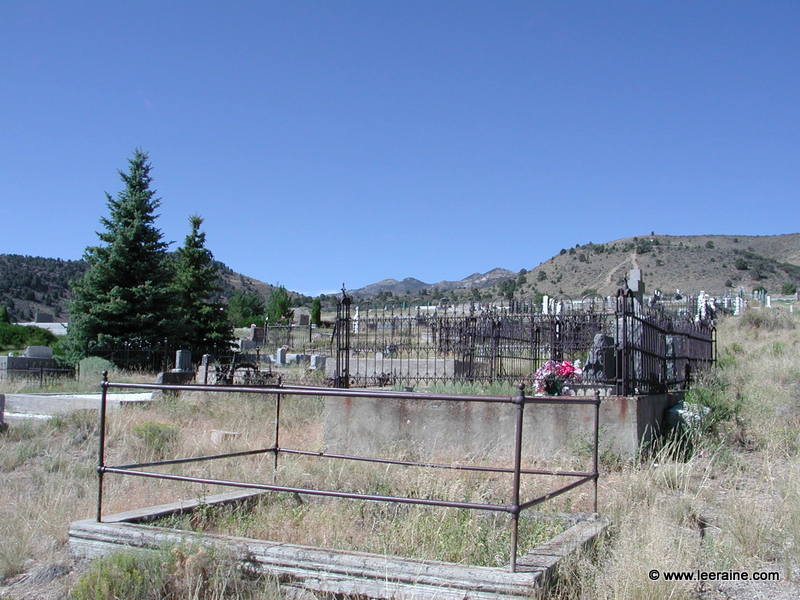
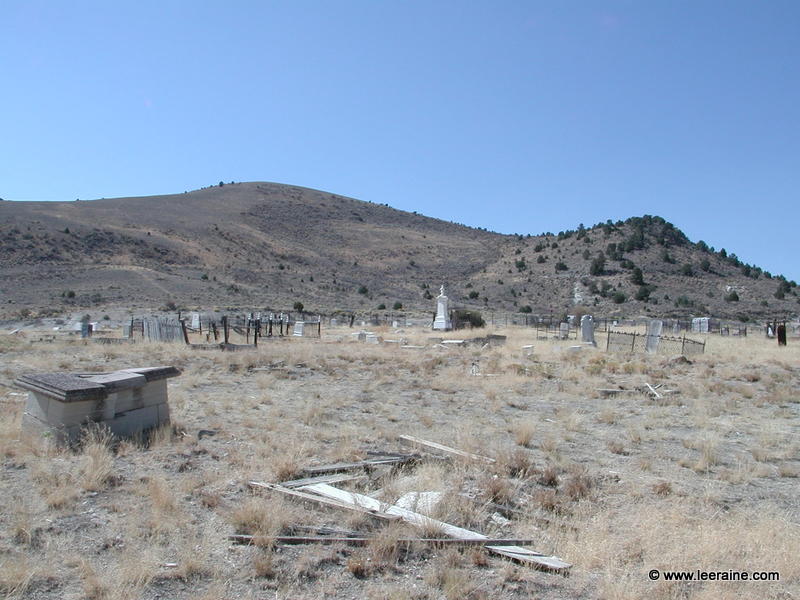
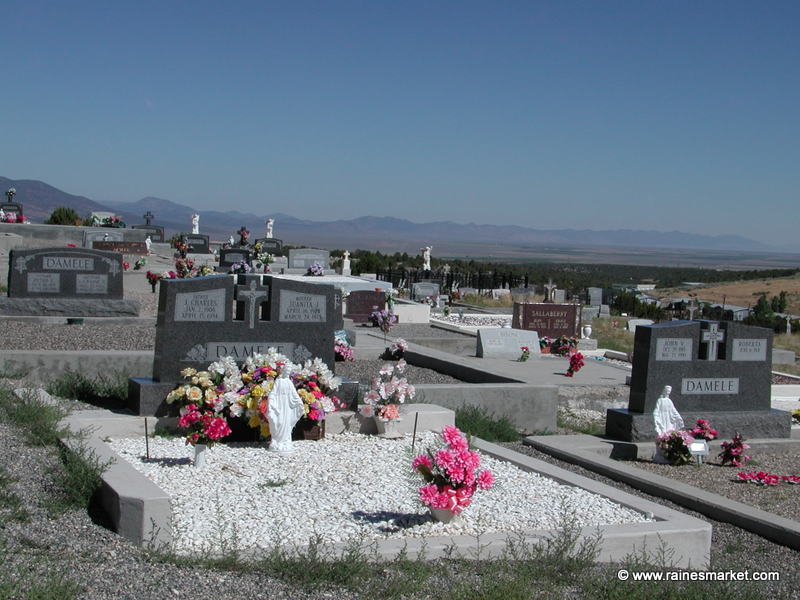
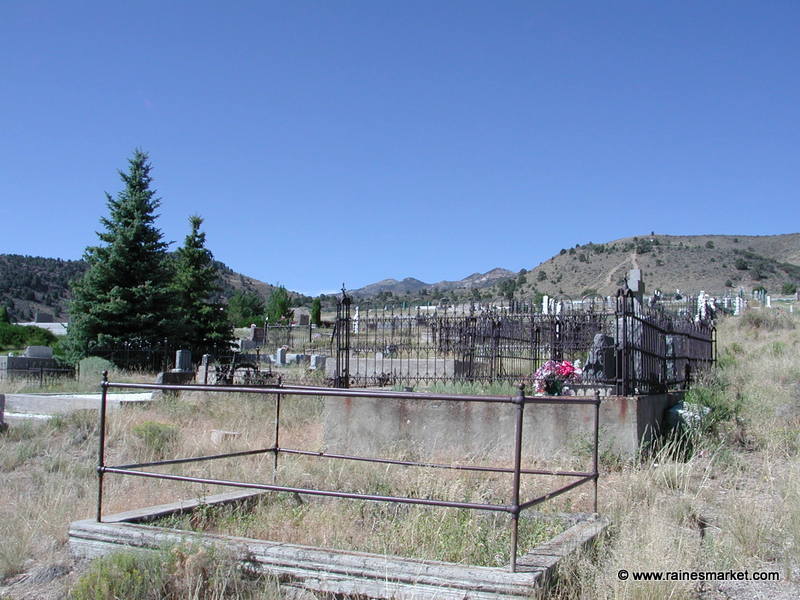
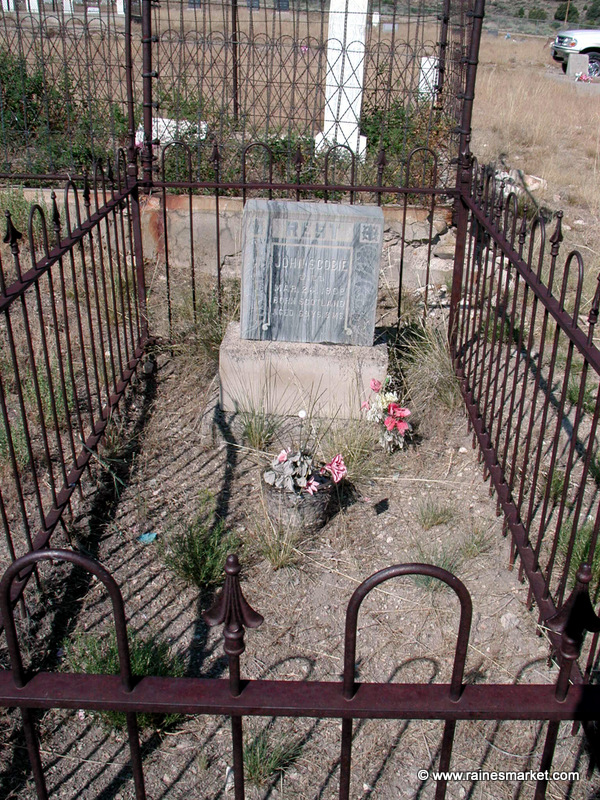
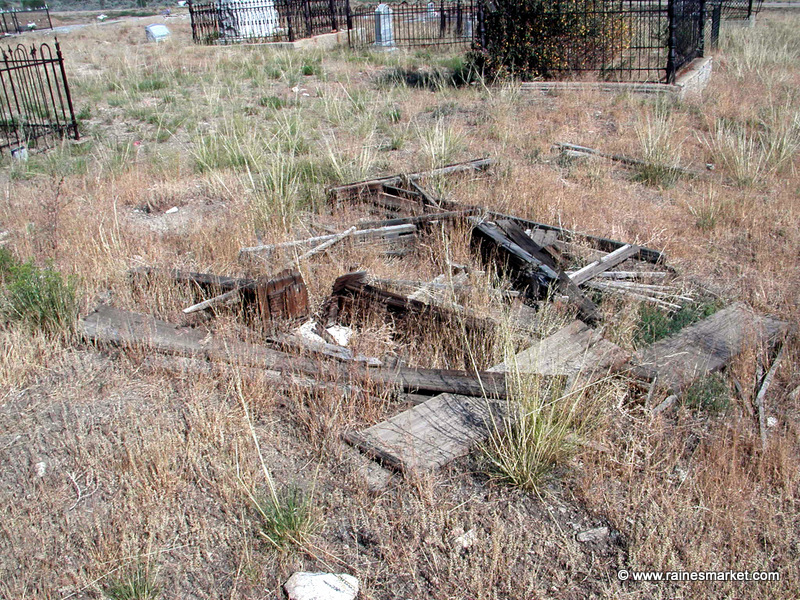
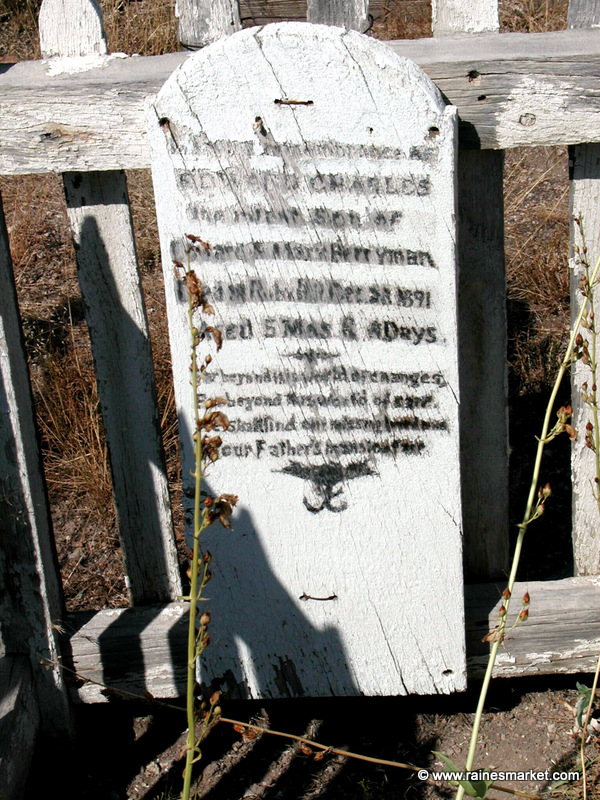
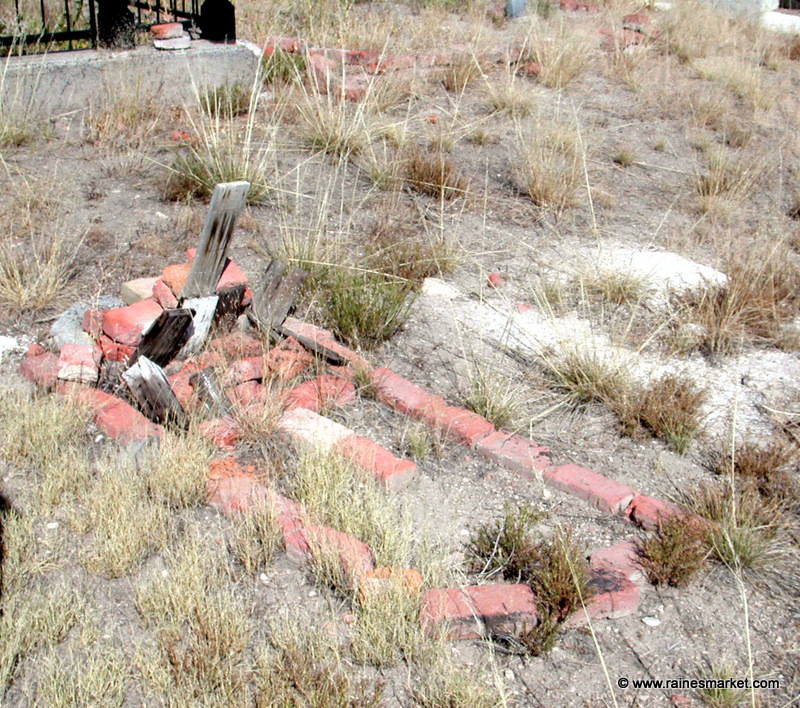
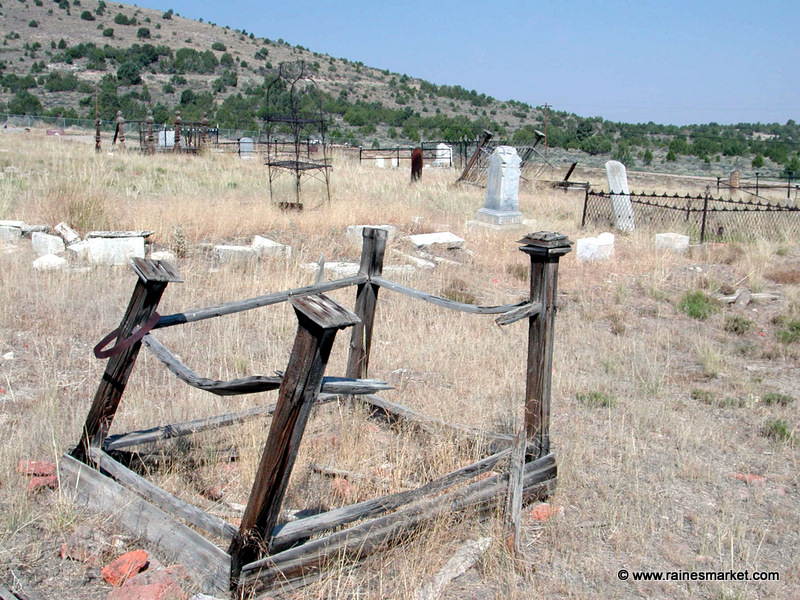
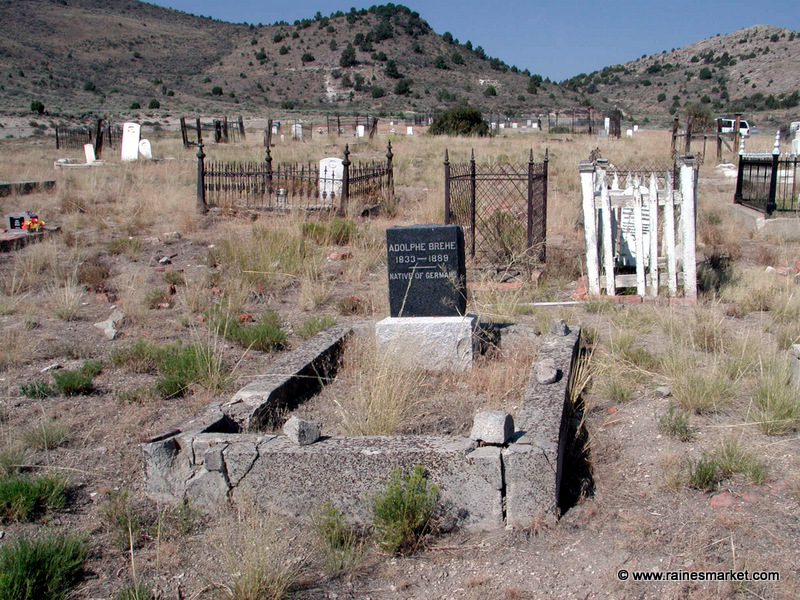
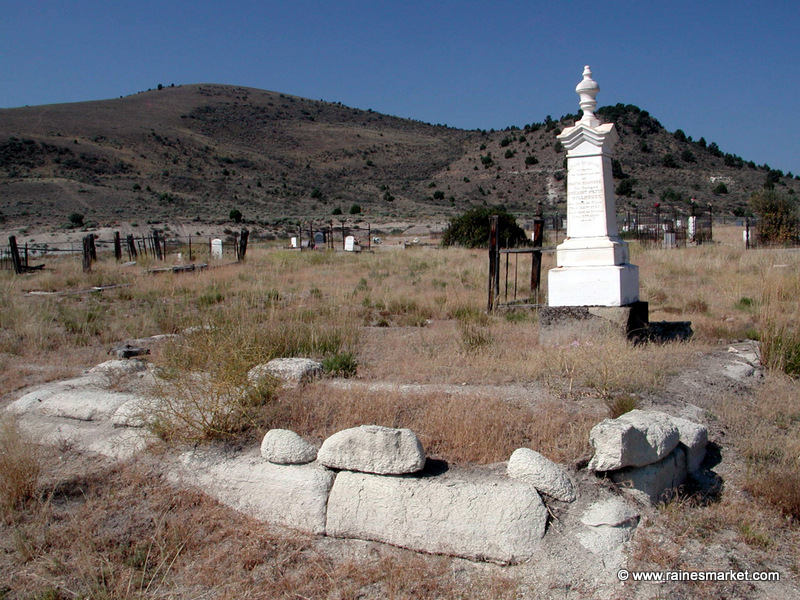
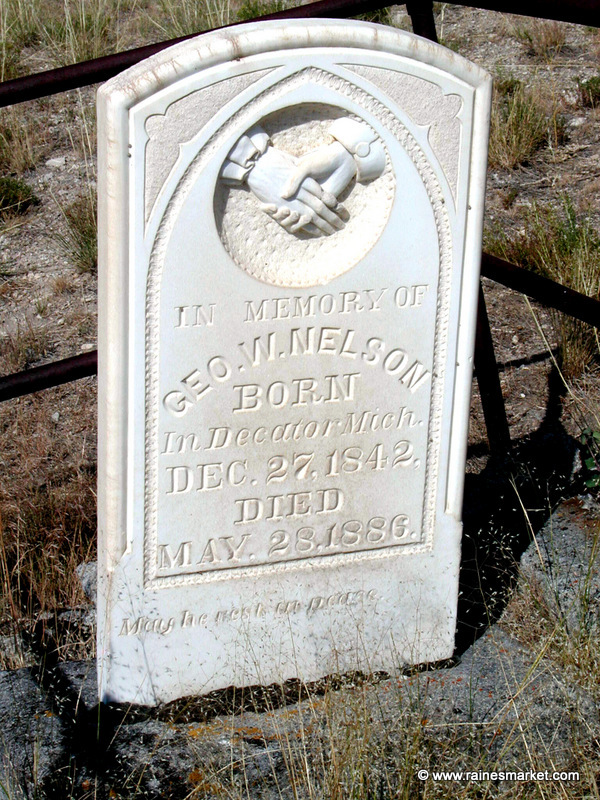
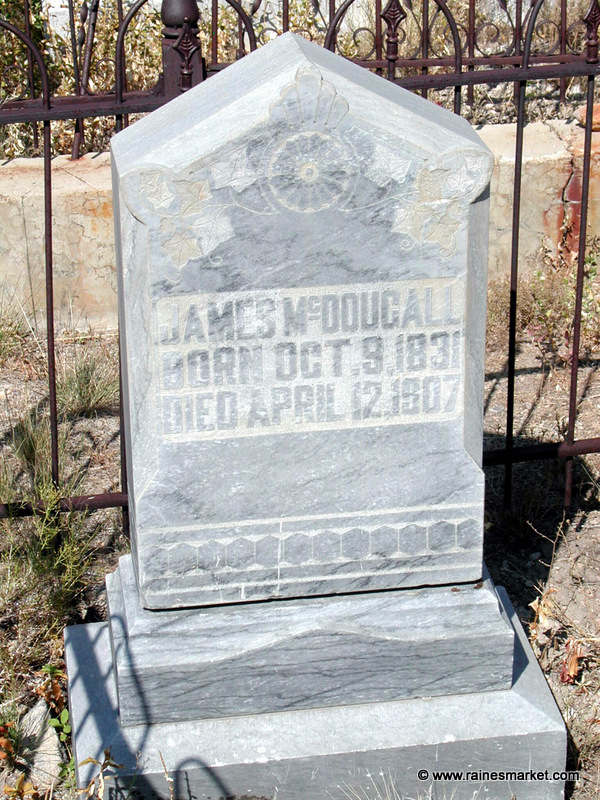
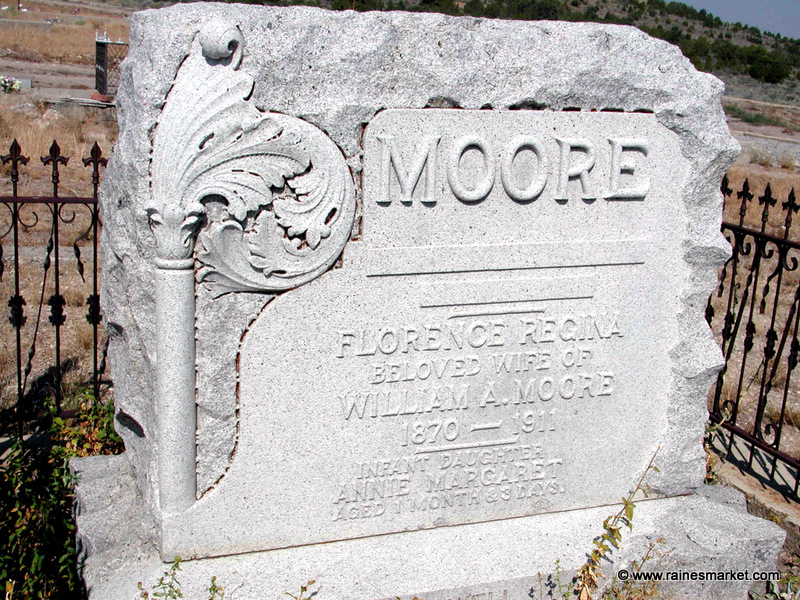
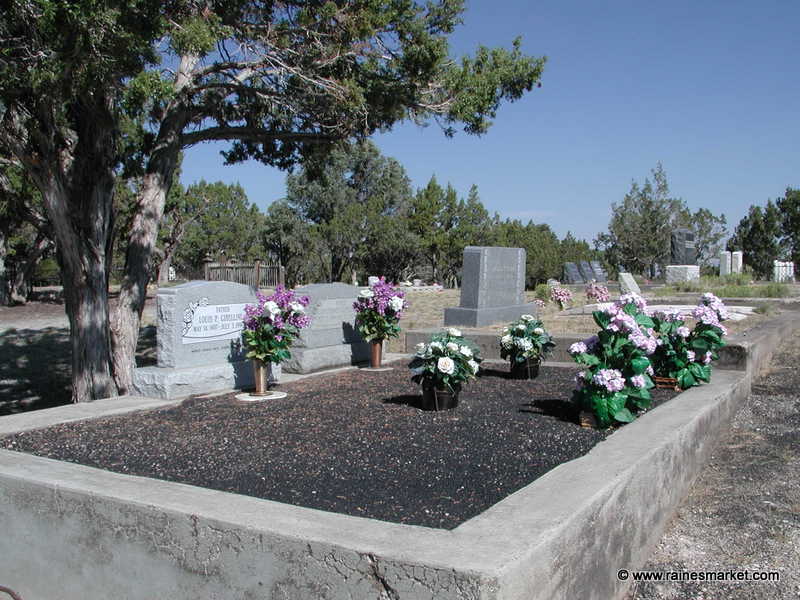
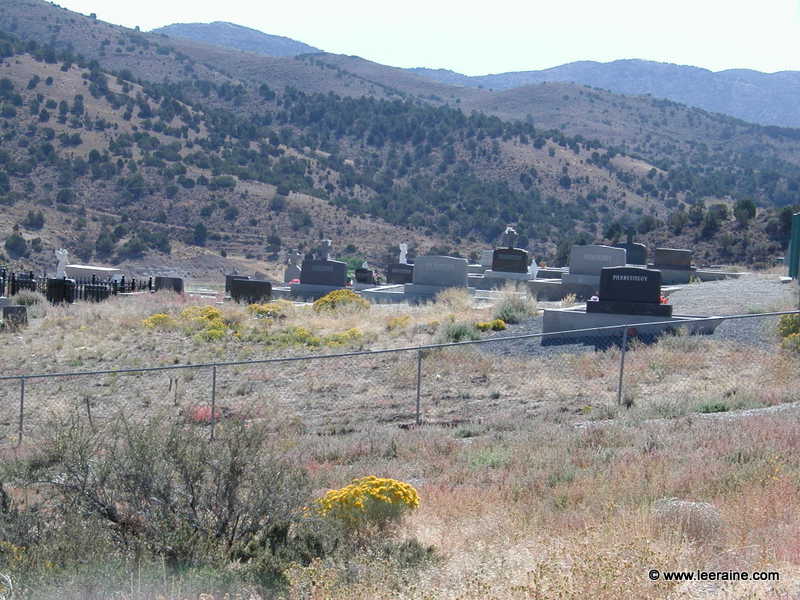
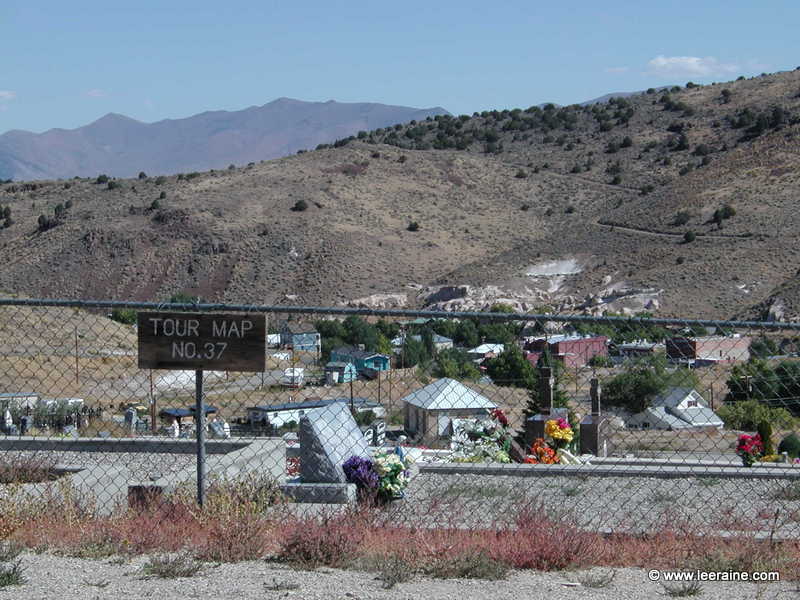
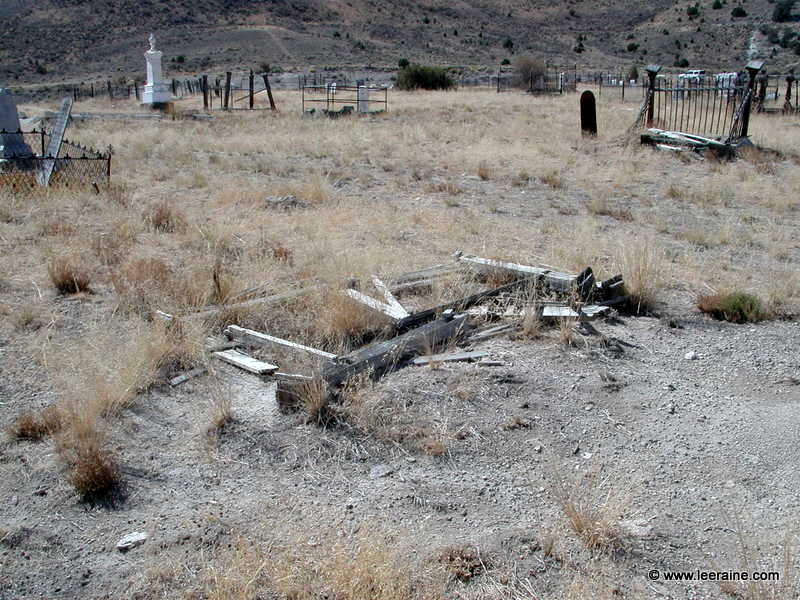
#37,38,39,40 Eureka Cemeteries
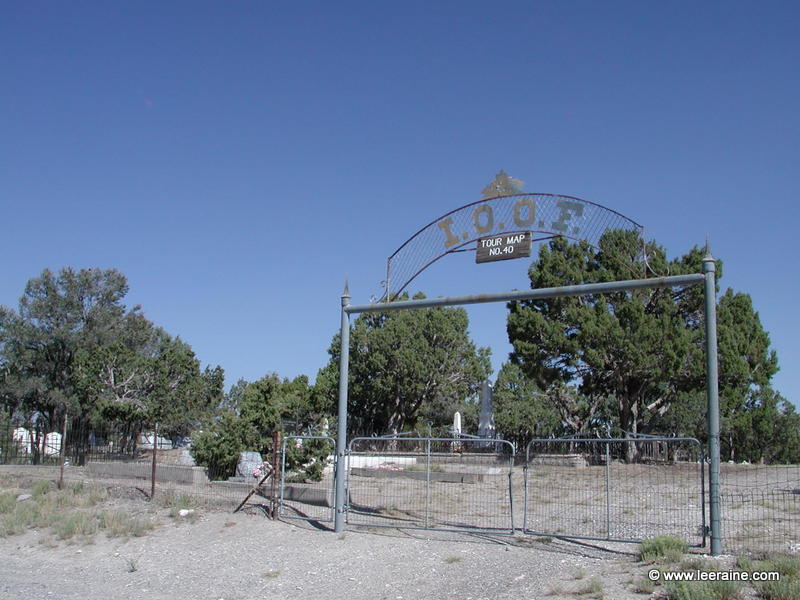
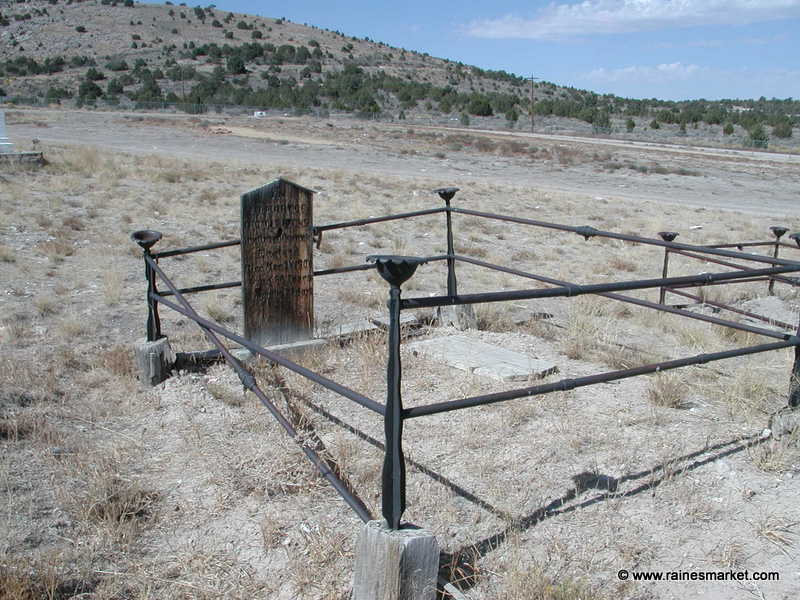
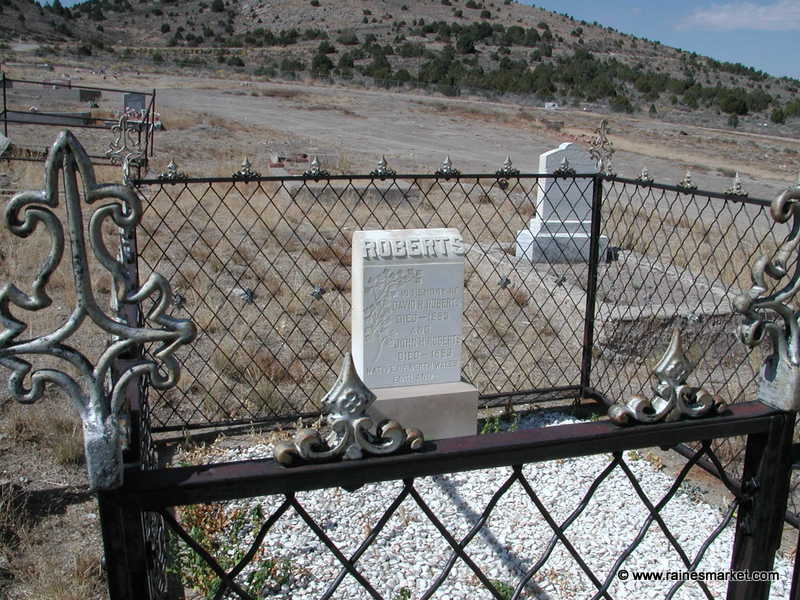
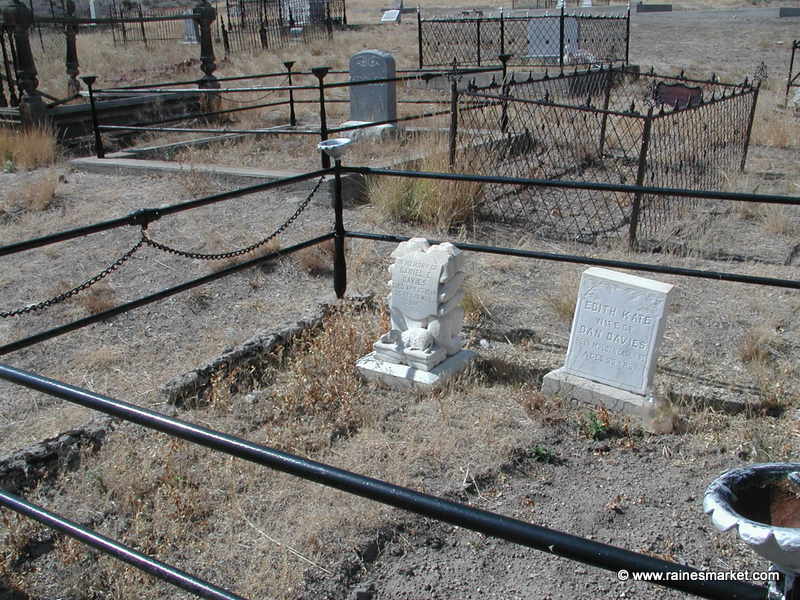
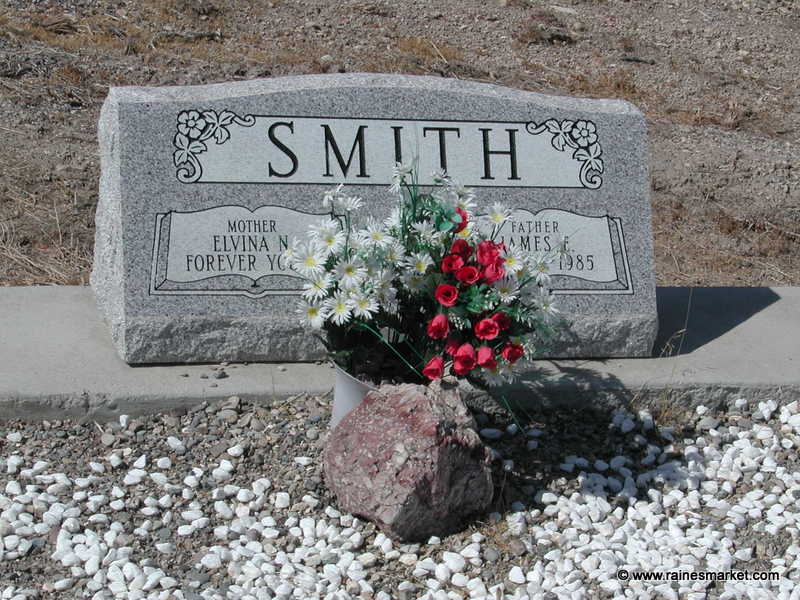
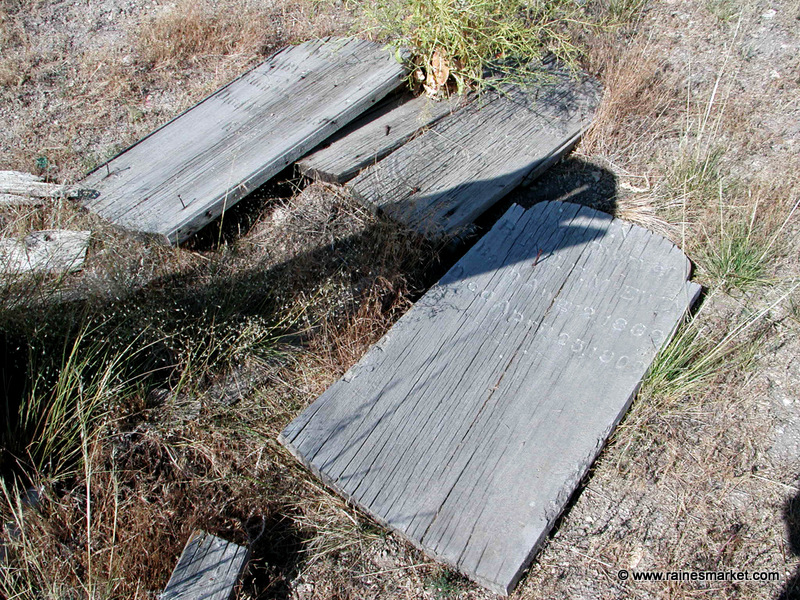
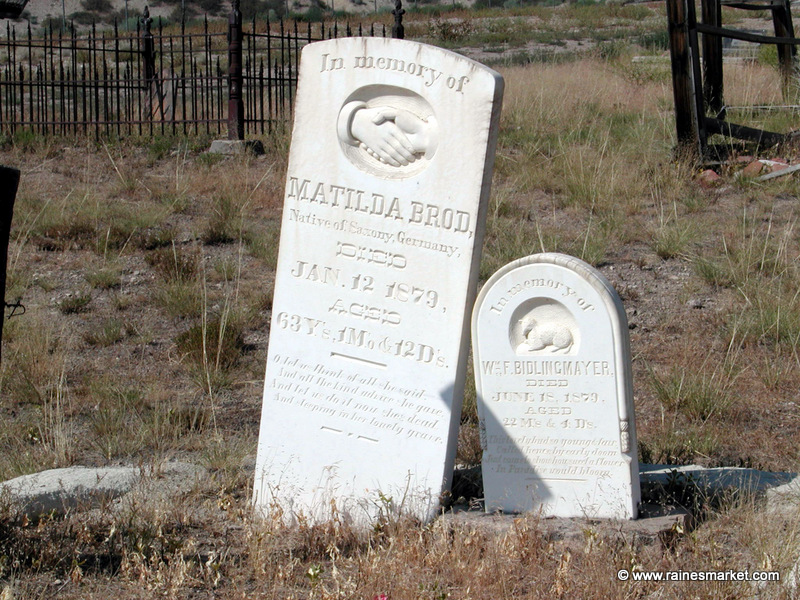
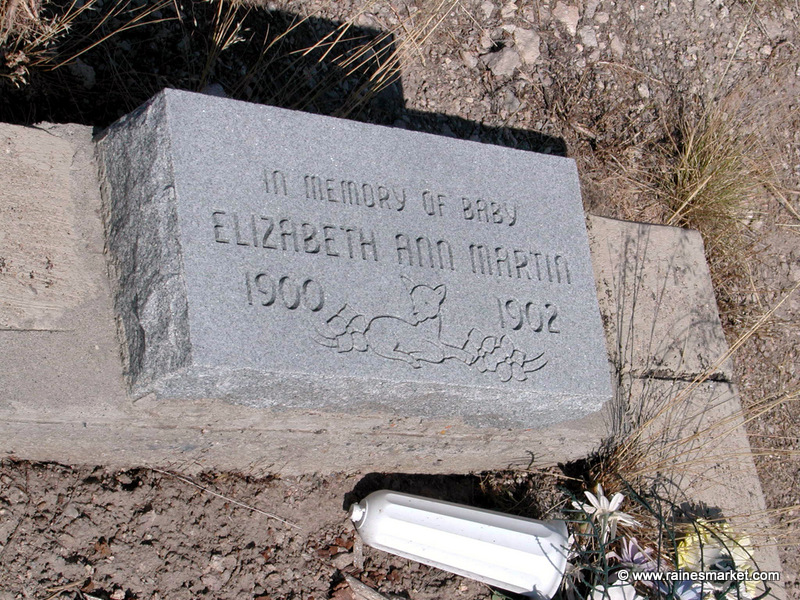
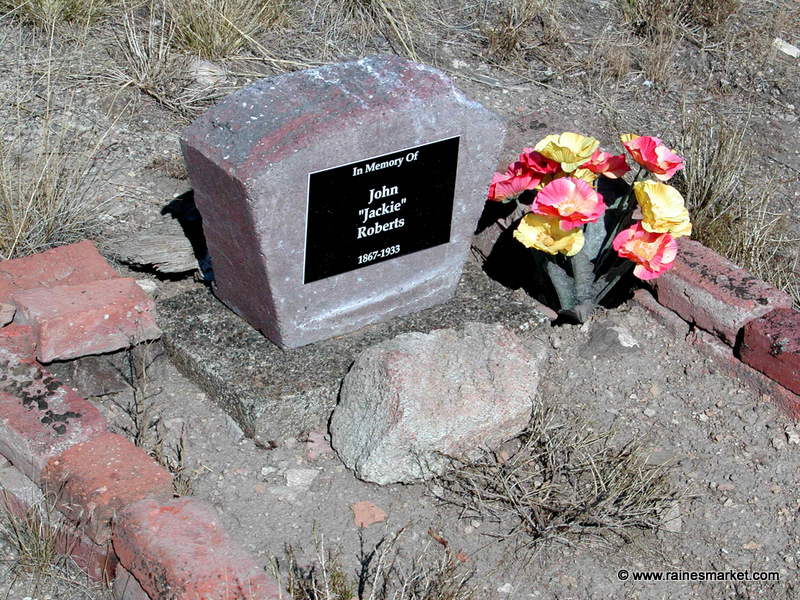
Five cemeteries are located on the west side of Eureka in Grave Yard Flat, or as it was known in the 1880s, Death Valley. The cemeteries can be reached by driving west past the courthouse up Ruby Hill Avenue. the first one on the south side of the avenue is the Catholic, next, the Masonic. Across the road to the north are the County and City Cemeteries and further north, nestled in the piñon/juniper trees, is the I. O. O F. Cemetery. In the 1870s and 80s, the County Cemetery was privately owned by C. W. Schwamb, an undertaker who had an office above the Sentinel Office. It is adjacent to the City Cemetery. Eureka also had Chinese and Jewish Cemeteries, but there is very little remaining of those grave sites. Most of the cemeteries are still being used today. Please show respect for those that have passed on and do not disturb any of the headstones or grave sites. |
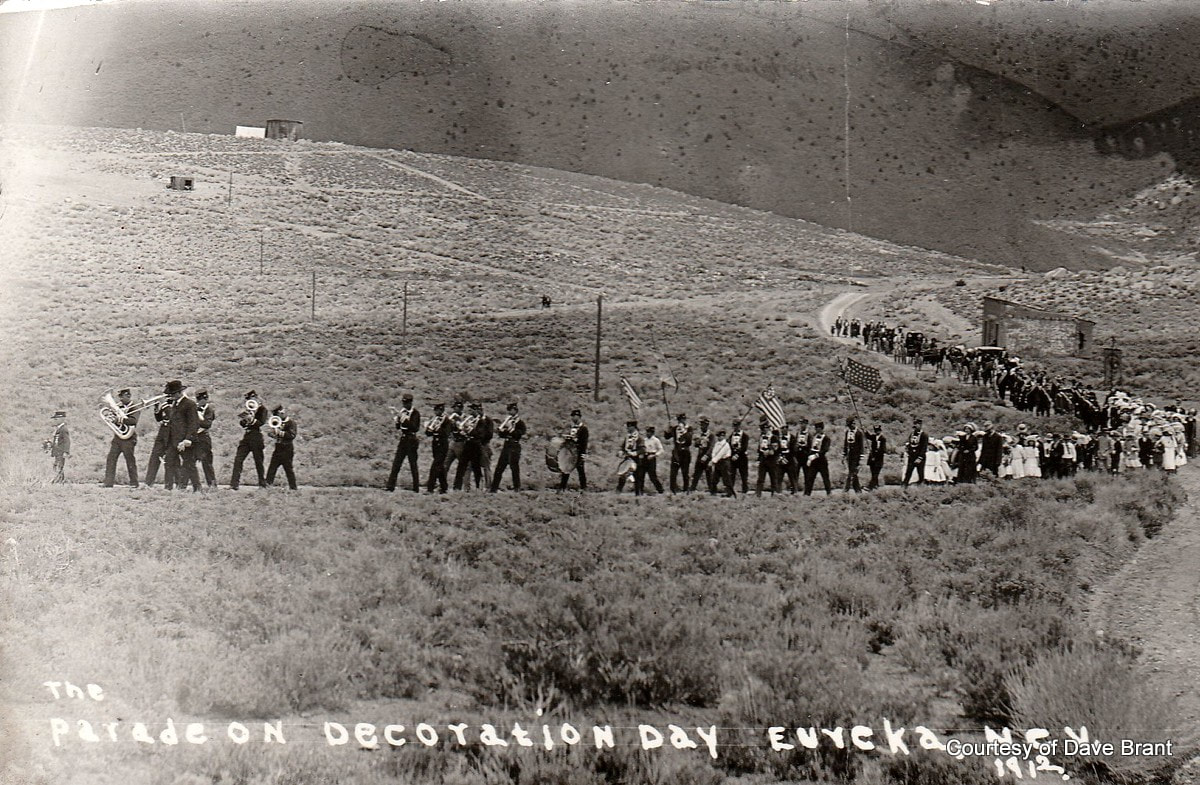
Decoration Day Parade to cemeteries 1912.
|
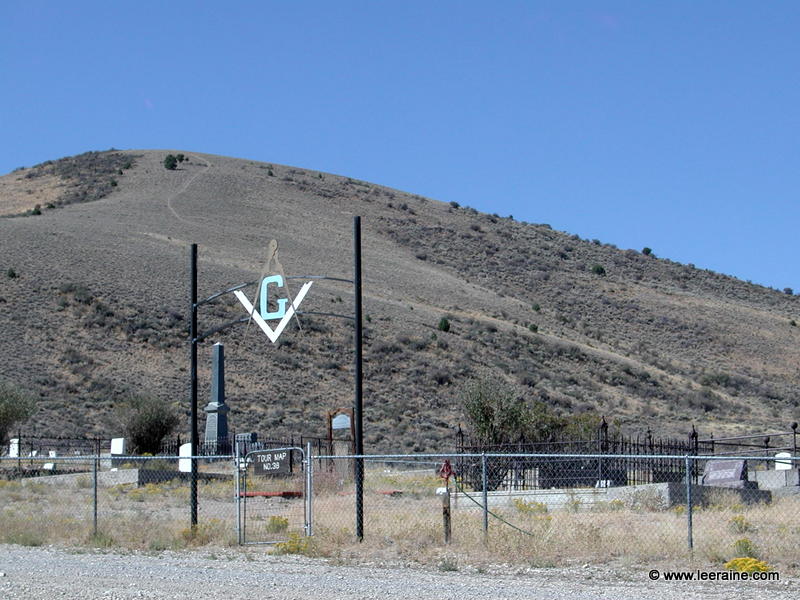
38. MASONIC CEMETERY
Across from the Catholic Cemetery is the Masonic Cemetery. This Cemetery is currently managed and maintained by Eureka Lodge #16 Free and Accepted Masons
Across from the Catholic Cemetery is the Masonic Cemetery. This Cemetery is currently managed and maintained by Eureka Lodge #16 Free and Accepted Masons
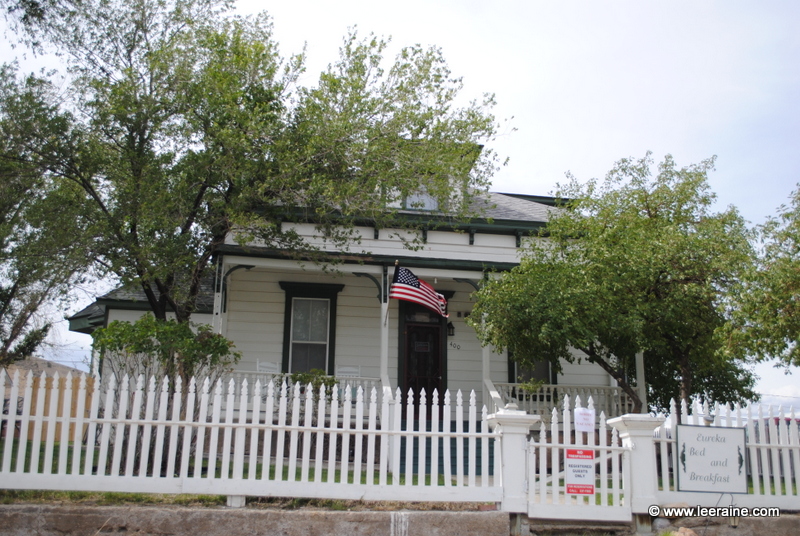
#41 Zadow and Morrison House (private residence)
This Victorian style house was built around 1886 by James Wilson for one of the mine managers. It is typical of the Victorian style with bay windows, gingerbread trim, and white pillared porch. Later it was owned by William Zadow, the owner of People's Meat Market, a butcher shop on main street and later the Zadow Hotel where the Eureka Cafe is today. Around 1910, this home was purchased by Dan Morrison. The Morrison Family owned it until the 1970s. In 1976, under new ownership, it was renovated as a private home. Many homes of this type were burned in the fires that swept through town, although three of the same design remain along the crest of the hill.
This Victorian style house was built around 1886 by James Wilson for one of the mine managers. It is typical of the Victorian style with bay windows, gingerbread trim, and white pillared porch. Later it was owned by William Zadow, the owner of People's Meat Market, a butcher shop on main street and later the Zadow Hotel where the Eureka Cafe is today. Around 1910, this home was purchased by Dan Morrison. The Morrison Family owned it until the 1970s. In 1976, under new ownership, it was renovated as a private home. Many homes of this type were burned in the fires that swept through town, although three of the same design remain along the crest of the hill.
The Zadow family was of special note because suffrage supporter Sophia Zadow was active in Nevada’s successful effort to pass the equal franchise during 1913-1914. Sophia Fulton was born at home in Eureka, Eureka County, NV on September 24, 1886. Her mother was widowed and had two other children. Sophia married Rudolph "Rudy" Zadow (born 1886) on October 7, 1908 in Eureka, NV. They had two children, Frederic F. Zadow and Vera Nevada Zadow. The Zadow family moved to Reno, NV, where Rudolph died in 1937. Sophia died in Reno in October of 1975.
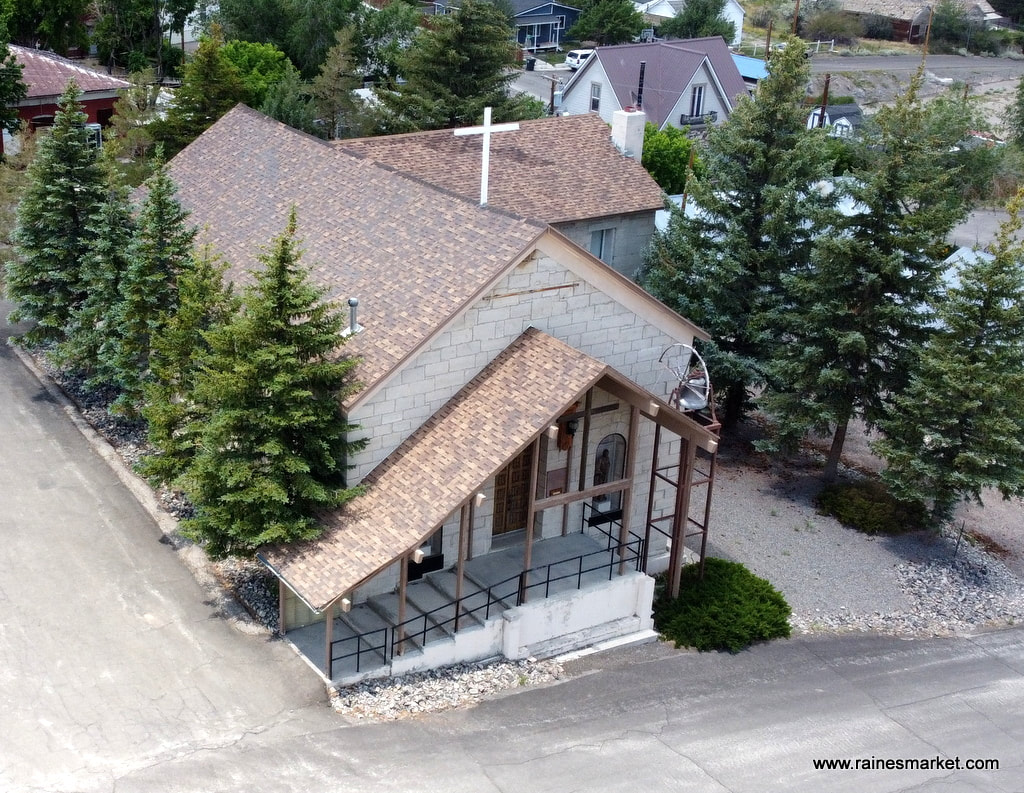
#42 Saint Brendan's Catholic Church
This still-active Catholic Church was erected in 1874 to replace the original wood structure built in 1871 by Father D. Monteverde. The present stone structure was built for a cost of $5000 from volcanic rock that came from the Chandler Quarry above the west side of town.
Eureka's first two-story brick school was located on the south side of the church. The school was built in 1879, but was torn down in the late 1930s. It had to be vacated in the early 1920s due to structural damage.
This still-active Catholic Church was erected in 1874 to replace the original wood structure built in 1871 by Father D. Monteverde. The present stone structure was built for a cost of $5000 from volcanic rock that came from the Chandler Quarry above the west side of town.
Eureka's first two-story brick school was located on the south side of the church. The school was built in 1879, but was torn down in the late 1930s. It had to be vacated in the early 1920s due to structural damage.
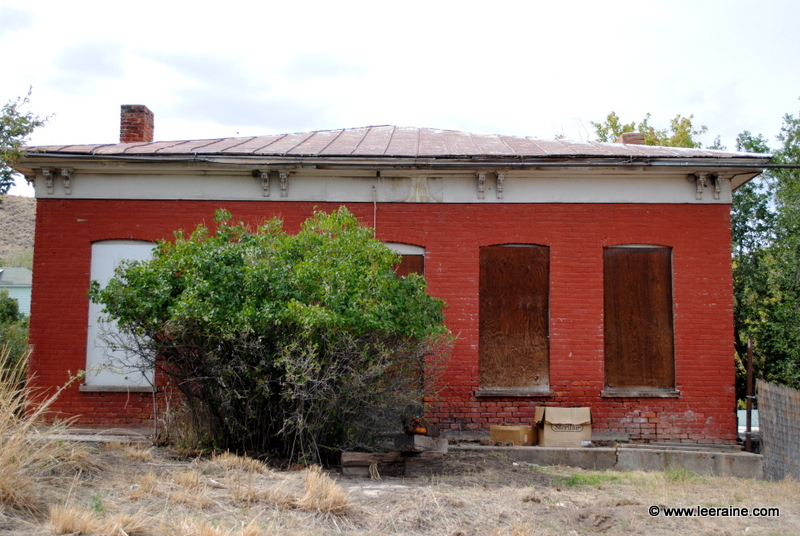
#43 Mary Wattle's Home (private residence)
Mrs. Mary Elizabeth Isles-Wattles was born on April 21, 1845 in Stratton, England. At the age of five, she sailed to America with her parents. As a young woman, she married Luther Wattles in Illinois. In 1903 the family came to Nevada. They purchased a ranch of 1800 acres with range rights in Nye County, between Eureka and Tonopah. They successfully operated these holdings for 30 years, then sold the property, and moved to Eureka. In 1920, they took possession of 320 acres in Italian Creek, 4 miles northeast of Eureka. It is believed that this brick home was built prior to 1883 by Claude Ford, owner of the Eureka Livestock Company. In 1927, Mrs. Wattles purchased the seven-room brick dwelling. Ten years later, she bought an eight room home in Los Angeles, California where she spent several of her winters. At the time of her death in March, 1952, Mrs. Wattles was 106 years old and the oldest living Nevada Resident. After five generations of family ownership, this property changed hands in 1995.
Mrs. Mary Elizabeth Isles-Wattles was born on April 21, 1845 in Stratton, England. At the age of five, she sailed to America with her parents. As a young woman, she married Luther Wattles in Illinois. In 1903 the family came to Nevada. They purchased a ranch of 1800 acres with range rights in Nye County, between Eureka and Tonopah. They successfully operated these holdings for 30 years, then sold the property, and moved to Eureka. In 1920, they took possession of 320 acres in Italian Creek, 4 miles northeast of Eureka. It is believed that this brick home was built prior to 1883 by Claude Ford, owner of the Eureka Livestock Company. In 1927, Mrs. Wattles purchased the seven-room brick dwelling. Ten years later, she bought an eight room home in Los Angeles, California where she spent several of her winters. At the time of her death in March, 1952, Mrs. Wattles was 106 years old and the oldest living Nevada Resident. After five generations of family ownership, this property changed hands in 1995.
|
Note from Theodore Ardans August, 2012
Hi Scott, I hope someday to meet you. I have only heard of your town thru my father and I sadly was never taken there as a child. My father is Pete Ardans, son of Leon Ardans and Marie Ardans (nee Harriet) who are both long deceased. My father Pete is still alive living in Arizona, where I grew up. My work has taken me to Bellingham Washington, where I am now. My father and I speak on the phone regularly, and he still tells me things that I had not heard before. Even when he speaks of things he has told me before, I listen for new details. Your town has a tremendous history, and I assume you know. Today he brought up Mrs. Wattle. We had been talking about Lincoln, and the assassination, and my father said that he knew a woman that had known John Wilkes Booth as a child. She was my father's neighbor in Eureka, she died at 106 when Pete was fourteen. He often could hear Mrs. Wattle calling for her daughter Belle, who would be working in the garden. Mrs. Wattle had been a few yrs younger than John Wilkes Booth, but she shared that with my father that she had been in the same neighborhood in the east, after she had come from England. My father's teenage job in Eureka was to deliver groceries and work in a store . My father worked for the store [now Raine's Market] in the 1950s. His brother is Rene, and sister Rose. I hope that you would consider this bit about Mrs. Wattle for your piece on the web, and I will print your page and mail it to my father so he can see the great work you are doing. Best Regards Theodore Ardans |
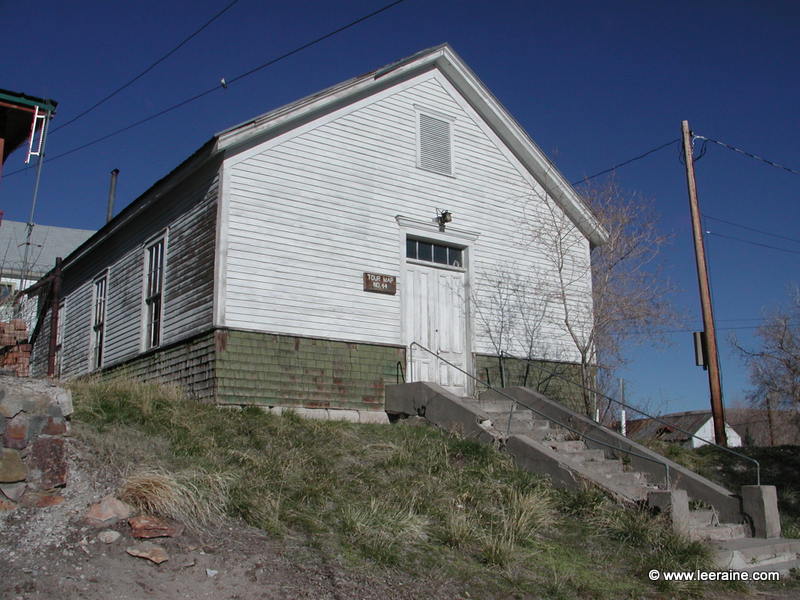
#44 Presbyterian Church
This church was organized and built in 1873. At the turn of the century, the Presbyterian congregation had dwindled and the Methodist Church occupied the building. Later it again served the Presbyterian Church. At the present time it is owned by the Diamond Valley Baptist Church and is called the Eureka Bible Church. The bell from the church is now on the south side of the Sentinel Museum building. |
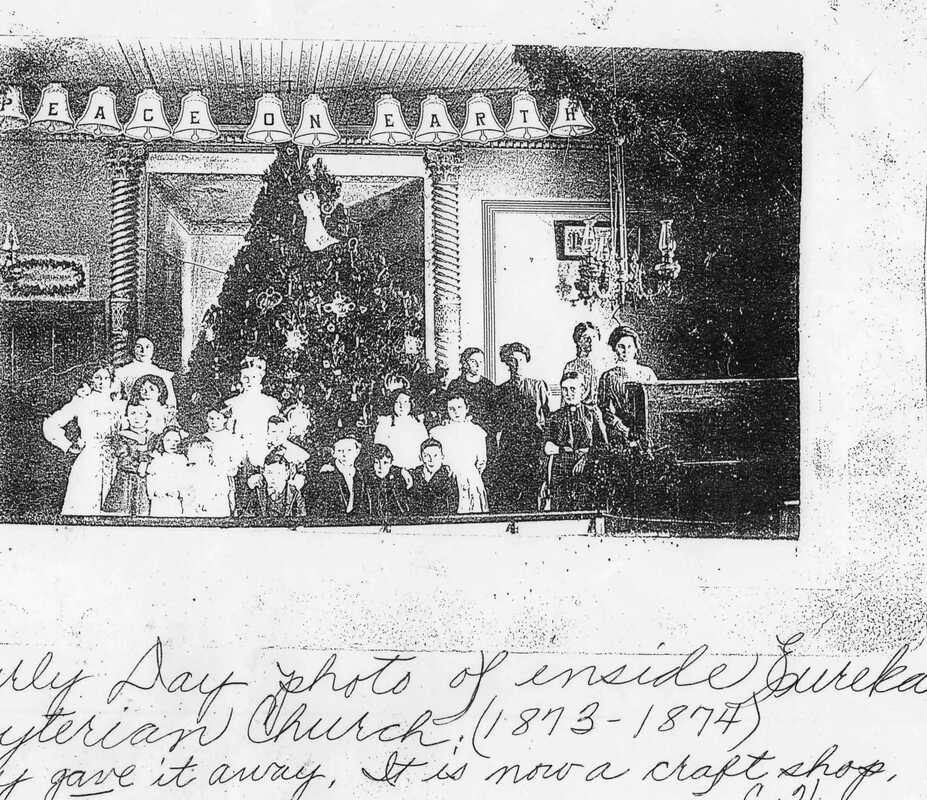
|
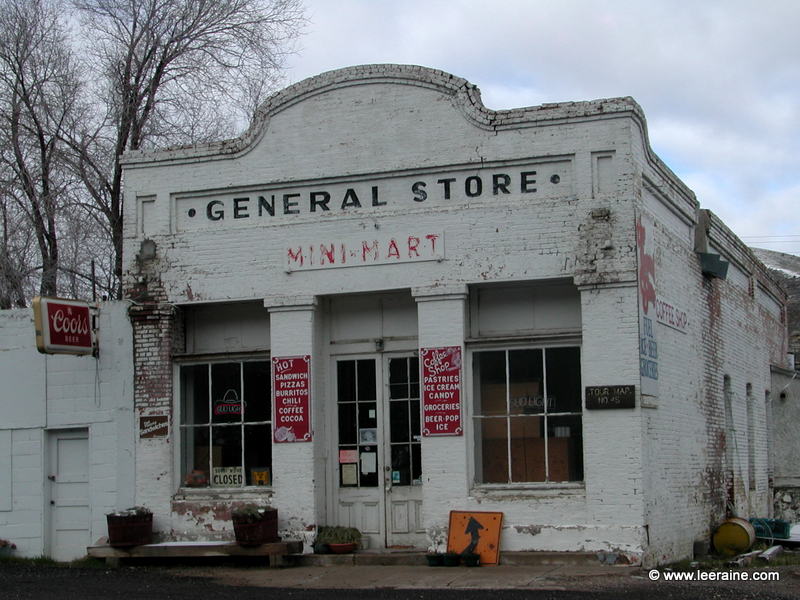
#45 General Store
This brick building was built in 1882 as the Ottawa Hotel to replace an earlier frame structure. For many years, into the twenty-first century, it served as a grocery and general store.
This brick building was built in 1882 as the Ottawa Hotel to replace an earlier frame structure. For many years, into the twenty-first century, it served as a grocery and general store.
The Eureka Mining District
From 1869-1879 Eureka was a major producer of lead in the United States. Sixteen smelters refined the ores of the mining district. At one time 2 to 3 thousand tons of rich gold, silver, lead and iron or a day were smelted from the Eureka mines. Total production exceeded $135 million. The smoke was so heavy at times, that the black clouds floated over town, leaving soot and dirt everywhere and poisoning the air. The name "Pittsburgh of the West" grew out of this somber aspect of early Eureka. Ditches were dug and pipes laid up the hill to deliver the smoke high in the air where it could be blown away by the wind. The Eureka area was once wooded. The trees within 50 miles of town were stripped over the years to make charcoal to power the smelters. Many early immigrants, notably Italians, made a living by gathering wood and burning charcoal for Eureka's smelters. By 1885 most of the easily accessible ore had been mined and the Eureka Consolidated and the Richmond Consolidated smelters ceased operation by 1891.
From 1869-1879 Eureka was a major producer of lead in the United States. Sixteen smelters refined the ores of the mining district. At one time 2 to 3 thousand tons of rich gold, silver, lead and iron or a day were smelted from the Eureka mines. Total production exceeded $135 million. The smoke was so heavy at times, that the black clouds floated over town, leaving soot and dirt everywhere and poisoning the air. The name "Pittsburgh of the West" grew out of this somber aspect of early Eureka. Ditches were dug and pipes laid up the hill to deliver the smoke high in the air where it could be blown away by the wind. The Eureka area was once wooded. The trees within 50 miles of town were stripped over the years to make charcoal to power the smelters. Many early immigrants, notably Italians, made a living by gathering wood and burning charcoal for Eureka's smelters. By 1885 most of the easily accessible ore had been mined and the Eureka Consolidated and the Richmond Consolidated smelters ceased operation by 1891.

#46 Slag Heap
This black pile on the south end of the town is the site of the Richmond Consolidated Smelter. Small portions of the smelter, slag heaps, and the ditch for the smoke stack can still be seen on the east side of Highway 50. The first furnace on this site was built in 1871 to process ore from the Richmond Mine. Later that year, the furnace and mine were purchased by the Richmond Consolidated Mining Company and two other furnaces were built along with three hydrocycle or water jacket hydrocycle furnaces to replace the old smelter operation. In 1890, the Richmond Smelter stopped operations and around the turn of the century was dismantled. |
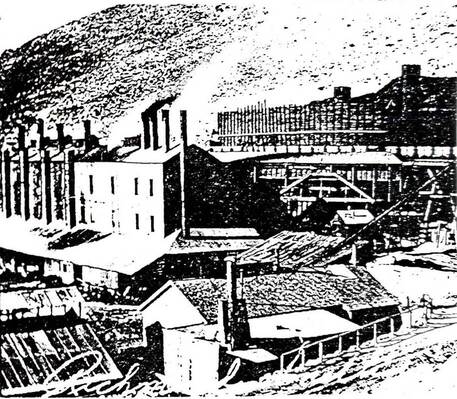
Richmond Consolidated Smelter at the south end of Eureka town.
|
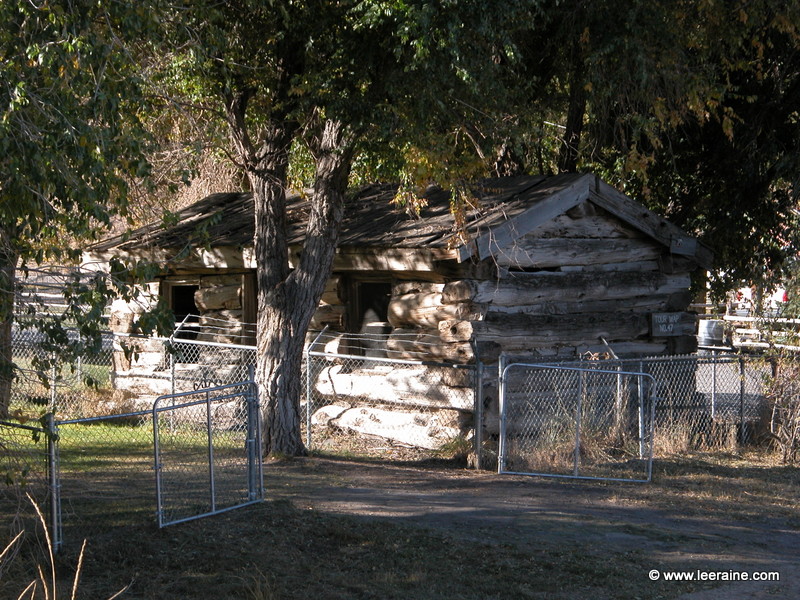
#47 Tannehill Log Cabin
This log cabin is believed to have been the first house built in Eureka around 1865. In later years it served as Eureka's first store. It is built of massive pine logs from the pinion pine trees that then grew at higher elevations around Eureka. The ceiling is composed of smaller pinion and juniper logs. It has been modified slightly since its original construction. |
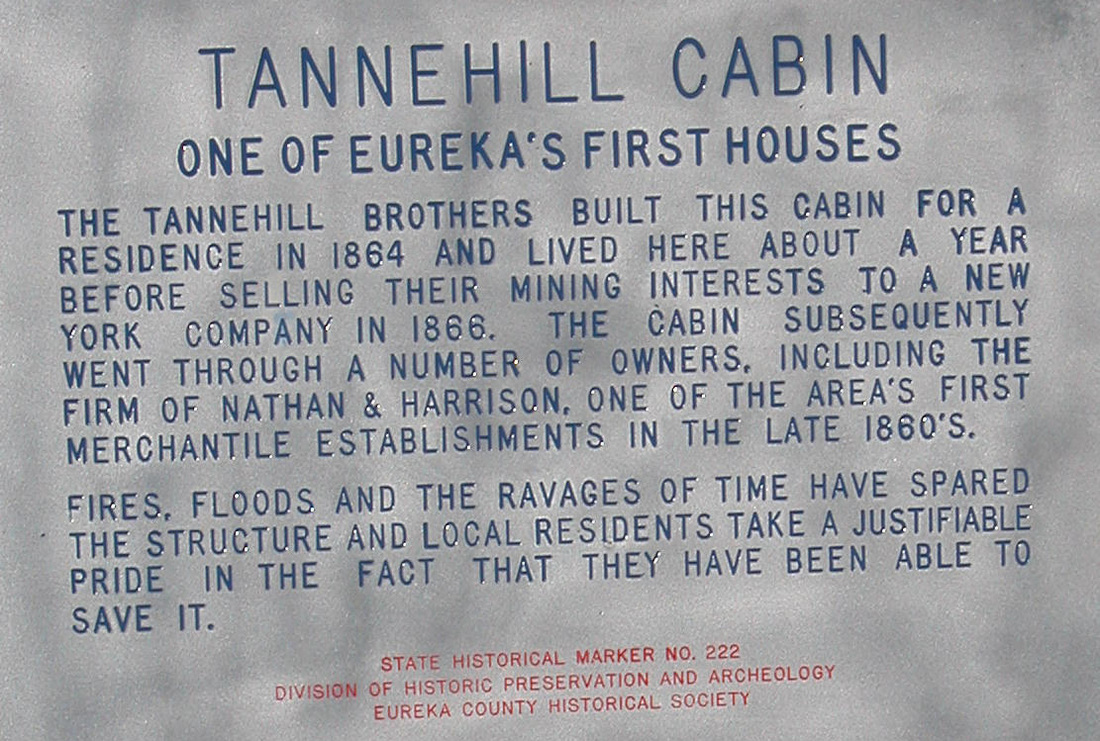
|
Photos on this page courtesy of Lee Raine © 2001-2023.
Historic black and white photos on this page and historical commentary courtesy of Connie Hicks.
Other submitted photos are credited individually.
Historic black and white photos on this page and historical commentary courtesy of Connie Hicks.
Other submitted photos are credited individually.
